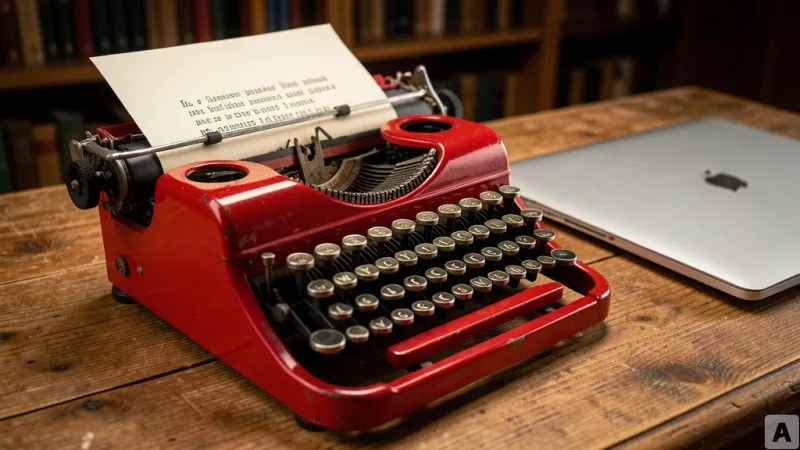
A sharp metallic bell rings, and a sheet of coarse paper slides forward with a mechanical jerk. Catherine Mong, a 19-year-old university student, stares at the machine before her with a mixture of confusion and hesitation. There is no glowing screen, no blinking cursor, and most importantly, no backspace key. For a generation raised on the seamless fluidity of cloud-based documents and instant autocorrect, the device on her desk feels less like a tool and more like an artifact from a distant century.
The Analog Experiment in the Age of LLMs
In the spring of 2023, Grit Matthias Phelps, a German language instructor at Cornell University, decided that the only way to protect the integrity of her students' learning was to move backward in time. Phelps began sourcing dozens of manual typewriters from thrift stores and online marketplaces, integrating them directly into her classroom environment. The mandate is absolute: students must complete their German assignments using these machines, stripped of any access to generative AI, online translation software, or digital spellcheckers.
This is a total analog immersion. Depending on the machine sourced, students work with either specialized German keyboards or standard QWERTY layouts. To ensure the boundary between the digital and physical worlds remains intact, Phelps enlisted a unique security detail. Her own seven- and nine-year-old children serve as the classroom tech support team, though their primary role is not to help with the hardware, but to monitor the students and ensure that smartphones remain out of sight.
The learning curve is physical. Students must learn the tactile precision required to feed paper into the roller and apply the exact amount of pressure to the keys to prevent ink smudges. The ringing bell at the end of a line serves as a mandatory signal to manually return the carriage, a rhythmic interruption that dictates the pace of their work.
The Cognitive Value of Friction
At first glance, replacing a laptop with a typewriter seems like an exercise in unnecessary hardship. However, the shift is a deliberate attempt to reintroduce friction into the cognitive process. In a digital environment, writing is akin to driving on a high-speed highway. With the aid of LLMs and search engines, students can leap from a prompt to a finished product in seconds, erasing errors instantly and bypassing the struggle of synthesis. In this frictionless flow, the critical stage of deep deliberation is often skipped entirely.
The typewriter transforms this process into a series of high-stakes decisions. Because an error cannot be deleted with a keystroke, a mistake must be marked with a physical X. This limitation forces a psychological shift: students must fully construct the sentence in their minds before committing it to paper. The physical resistance of the keys and the slow pace of the machine act as a cognitive brake, granting the brain the necessary time to process complex linguistic structures.
This friction produces unexpected psychological results. Catherine Mong, who initially struggled with the machines due to a wrist injury that limited her to one hand, found that the messy, error-strewn pages became a map of her progress. The act of failing and correcting became a visible part of the learning process rather than a hidden digital edit. Even for those with technical backgrounds, the impact was profound. Ratchapon Lerdamrongwong, a computer science major, noted that the absence of AI allowed him to reclaim agency over his own problem-solving, moving from outsourcing his thoughts to owning them.
This movement at Cornell is not an isolated eccentricity but part of a broader systemic retreat across American higher education. From the return of pen-and-paper examinations to the resurgence of oral testing, institutions are discovering that the most effective way to combat the erosion of critical thinking caused by AI is to remove the interface entirely.
When the most advanced technology threatens to replace the act of thinking, the most primitive tools become the most sophisticated defense.