The current atmosphere in Silicon Valley is defined by a specific kind of anxiety: the fear that the smartphone, as we know it, is an endangered species. For over a decade, the digital experience has been governed by the tap-and-swipe paradigm, a world where users navigate a fragmented landscape of individual apps to get things done. But with the rise of large language models and autonomous agents, a provocative question has emerged. If an AI agent can handle your ride-sharing, your scheduling, and your shopping through a single natural language interface, why do you need a screen full of icons? This tension reached a boiling point recently when veteran tech journalist Steven Levy challenged Apple's leadership on whether the company is prepared for the moment the app ecosystem collapses.
The Philosophy of the Invisible Inflection Point
In a series of discussions with John Ternus, Apple's Senior Vice President of Hardware Engineering, and Greg Joswiak, Apple's head of global marketing, the internal logic of Apple's AI strategy began to surface. Ternus describes the current state of AI not as a mere feature update, but as an immense kind of inflection point. To the outside observer, this might sound like a signal that a revolutionary new device is imminent. However, within the walls of Cupertino, this inflection point is viewed through the lens of a long-term product lineage. Apple does not see AI as a departure from its history, but as the next logical step in a sequence that began with the Apple II and moved through the Mac, the iPod, and the iPhone.
Central to this approach is a rigid adherence to a specific product philosophy: Apple does not ship technology. This distinction is critical. When the iPod launched, Apple did not market the efficiency of the MP3 format or the technical specifications of the 1.8-inch hard drive. They marketed the experience of owning and listening to a thousand songs in your pocket. Similarly, the iPhone was not presented as a triumph of mobile telecommunications engineering, but as a fundamental redefinition of what a mobile device should be. In both cases, the underlying technology was relegated to the background, serving as the invisible engine for a tangible user experience.
Applying this logic to AI means that Apple has little interest in the metrics that currently dominate the AI discourse. While the rest of the industry obsesses over parameter counts, token generation speeds, and benchmark scores, Apple views these as implementation details. Forcing a user to think about the scale of a large language model is, in Apple's view, a failure of design. The goal is to ensure the customer never consciously registers the presence of the underlying AI, experiencing only the result: a device that anticipates their needs and executes tasks with seamless precision. AI is not intended to be a destination or a standalone service, but a pervasive intelligence that permeates every touchpoint of the existing ecosystem.
Pervasive Infrastructure vs the Killer App
This strategy stands in direct opposition to the vision proposed by Steven Levy. Levy suggests that AI agents will effectively destroy the iPhone's core value proposition by eliminating the need to open apps. In his scenario, a user no longer opens Uber or Lyft to get home; they simply tell an always-on agent they are ready to leave, or the agent, sensing the context, has already arranged the ride. This transition from "there is an app for that" to "just tell the agent" implies a total collapse of the current interface, potentially rendering the App Store and the individual app structure obsolete.
However, this perspective confuses the evolution of the interface with the obsolescence of the hardware. Apple's counter-argument is rooted in the history of pervasive technology. Consider the trajectory of wireless networking. Apple never released a standalone "Wi-Fi device" to define the market for wireless connectivity. Instead, they treated Wi-Fi, Bluetooth, and cellular data as pervasive technologies—infrastructure that should be embedded in every single product they sell. By making connectivity a default attribute of the hardware rather than a separate product category, they strengthened the entire ecosystem.
AI is being treated with the same architectural intent. Rather than creating a "killer AI device" to replace the iPhone, Apple is integrating AI as a fundamental layer of the operating system and the silicon. This is similar to the early promises of cloud computing; while some predicted the cloud would replace the local computer, it instead became the invisible way services were delivered. AI is not a new category of product, but a new category of capability. It is the invisible engine that enhances the value of the existing hardware rather than a replacement for it.
Furthermore, the physical reality of human-computer interaction creates a ceiling for the "invisible agent" theory. For an AI agent to function in the real world, it requires three physical pillars: a microphone to receive intent, a speaker to provide feedback, and a screen to verify complex information. While a smart glass or an earbud can handle some of these, the smartphone remains the most efficient hub for these interfaces. The high-resolution camera needed for visual context and the screen needed for detailed state confirmation ensure that the smartphone remains the central node of the user's digital life. Even in 2030, the primary tool for summoning a ride-share will likely be a handheld device, even if the process of doing so has shifted from tapping an icon to a voice command.
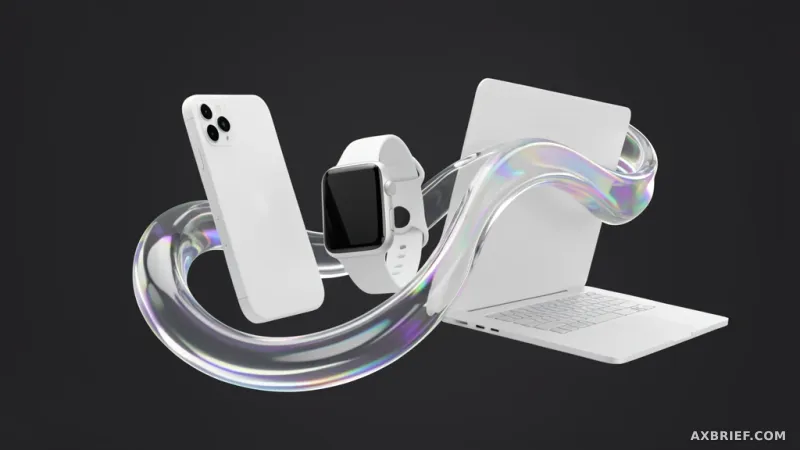
Smaller wearables like the Apple Watch or AirPods are not designed to be independent compute units, but extensions of this hub. The trade-off between power efficiency and computational performance means that the heavy lifting of AI processing will continue to rely on a central device. The interface may become more transparent, and the act of "opening an app" may fade away, but the physical necessity of the hardware remains. The challenge for developers and engineers is therefore not to invent a new form factor, but to figure out how to weave the AI agent into the existing interface layer to optimize the user experience.
Apple is betting that the future of AI is not a new gadget, but a universal standard. By treating intelligence as a basic specification—much like battery life or screen resolution—they are ensuring that the iPhone does not become a relic of the app era, but the primary gateway to the agent era.