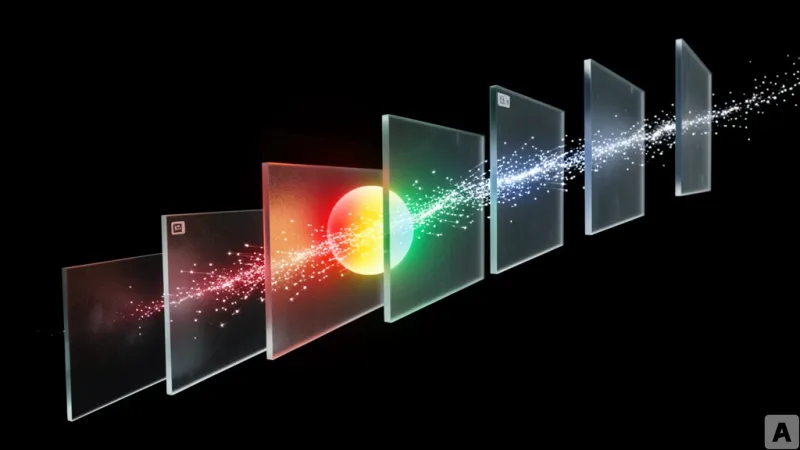
The crowd at Booth 204 during ICLR 2026 in Rio de Janeiro is not gathered for a typical academic presentation. Instead, they are watching a live demonstration of local large language models running on Apple Silicon via the MLX framework. On the screen, a single static photograph is transformed into a fully realized 3D scene in less than a second. The speed is jarring, but the implication is deeper: the industry's obsession with massive, cloud-dependent Transformer models is meeting a sophisticated, hardware-optimized counter-offensive from Cupertino.
The Return of the RNN and the SSM Breakthrough
Apple has officially introduced ParaRNN, a parallel training framework designed to breathe new life into Recurrent Neural Networks (RNNs). For years, the AI community largely abandoned RNNs in favor of the Transformer architecture because RNNs are inherently sequential, making them nearly impossible to scale to billions of parameters without prohibitive training times. Apple's research team has shattered this bottleneck, implementing a training speedup of 665x compared to traditional sequential methods. This breakthrough allowed Apple to train a classic RNN with 7 billion parameters for the first time, achieving performance levels that directly compete with modern Transformer-based models. To accelerate global research into these efficient architectures, Apple has released the ParaRNN codebase as open source.
Parallel to the RNN revival, Apple is tackling the limitations of State Space Models (SSMs), such as Mamba. SSMs are prized for their linear computational complexity and fixed memory footprints, making them far more efficient than Transformers when processing long sequences of data. However, SSMs suffer from a critical flaw: a limited memory capacity that causes performance to degrade as the complexity of the task increases. Even the implementation of Chain-of-Thought (CoT) prompting failed to solve this inherent capacity ceiling. Apple's solution was to pivot from internal memory to external utility. By designing SSMs that can interactively access external tools and combining this with problem-specific training data, the models demonstrated a newfound ability to generalize across arbitrary problem lengths and complexities. This approach yielded powerful results in arithmetic, logical reasoning, and coding tasks.
The Hardware-Software Synergy Twist
On the surface, these developments look like isolated academic wins in efficiency. But the real shift occurs when you analyze the convergence of ParaRNN, SSMs, and the newly unveiled MANZANO model. MANZANO is a unified multimodal LLM that handles both image understanding and image generation within a single framework. Historically, open-source multimodal models have faced a brutal trade-off: a model that understands images well usually generates them poorly, and vice versa. MANZANO eliminates this friction using a hybrid vision tokenizer.
The architecture employs a single shared vision encoder that feeds into two lightweight adapters. The first adapter generates continuous embeddings for image understanding, while the second produces discrete tokens for image generation. Both operate within a shared semantic space. A unified autoregressive LLM then predicts high-level meanings in the form of text and image tokens, which an auxiliary diffusion decoder finally converts into actual pixels. This design allows MANZANO to achieve state-of-the-art (SOTA) performance among unified models, particularly in text-heavy evaluations where it rivals specialized, single-purpose models.
This is not merely a quest for benchmark dominance; it is a strategic pivot toward the edge. The industry is currently trapped in a cycle of increasing Transformer size, which leads to higher latency and massive cloud costs. By reviving RNNs and optimizing SSMs, Apple is attacking the quadratic compute overhead of the Transformer. When these linear-complexity models are paired with the unified efficiency of MANZANO, the result is a software stack that requires significantly fewer resources to perform complex multimodal tasks. The goal is to move the intelligence from a distant data center directly onto the NPU of a MacBook or iPhone.
Apple is betting that the future of AI leadership will not be decided by who can build the largest model, but by who can most effectively shrink the intelligence to fit the silicon.