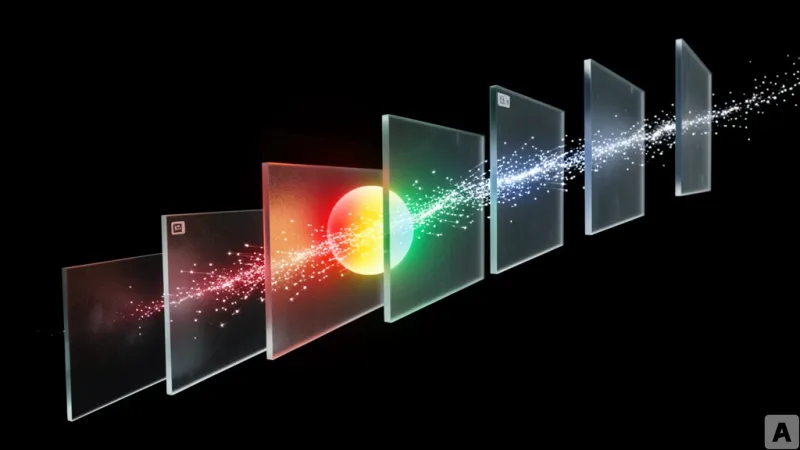
Video search is currently broken because it relies on a fundamental lie: the idea that a text description can accurately capture a visual moment. For decades, finding a specific scene in a one-hour clip required a human or an AI to write a tag or a transcript, effectively turning a rich, sensory experience into a flat string of characters. Amazon Nova Multimodal Embeddings change this paradigm by allowing users to locate a precise second of footage based on conceptual meaning, sound, and sight, without needing a single word of metadata.
The End of the Metadata Bottleneck
Amazon is integrating Nova Multimodal Embeddings into Amazon Bedrock, providing enterprises with a way to map text, images, video, and audio into a single, unified vector space. In this mathematical environment, similar concepts cluster together regardless of their original format. When a user searches for a tense car chase accompanied by the wail of sirens, the AI does not look for those specific words in a description file. Instead, it analyzes the visual patterns of high-speed motion and the acoustic signatures of emergency vehicles simultaneously.
This capability transforms how industries handle massive archives of unstructured data. For sports broadcasters, the ability to instantly isolate the exact moment a player scores a goal across thousands of hours of footage eliminates the need for manual logging. News organizations can now retrieve footage based on the atmosphere of a scene or a specific location without relying on the accuracy of a journalist's notes from three years ago. In a market where the speed of information processing directly correlates to revenue, the ability to bypass manual tagging is a massive competitive advantage.
Eliminating Information Loss in Video Analysis
To understand why this shift matters, one must look at the failures of the traditional video-to-text pipeline. Historically, AI search functioned by converting video into text through automated speech recognition or image captioning. However, this process creates a significant information bottleneck. A breathtaking athletic maneuver or a subtle emotional shift in an actor's expression is nearly impossible to describe in text with enough precision to be searchable. When a scene is reduced to a caption like a man running, the nuance of the movement, the lighting, and the tension is lost.
Nova bypasses this translation layer entirely. By converting the video itself into a numerical embedding, the system preserves the raw essence of the content. It treats the visual frames, the background score, and the spoken dialogue as a single, cohesive data point. This eliminates the risk of transcription errors or the omission of critical visual context. The AI understands the intent of the search query by comparing the vector of the user's request to the vector of the video segment, leading to a level of accuracy that text-based search cannot match.
Hybrid Search and Intelligent Scene Segmentation
Precision in video search requires more than just a broad understanding of meaning; it requires a surgical approach to how data is retrieved and sliced. Amazon employs a hybrid search strategy that combines lexical search with semantic search. Lexical search handles the rigid requirements, such as searching for a specific proper noun or a unique product ID. Semantic search handles the conceptual requirements, such as searching for a feeling of loneliness or a chaotic environment. By merging these two streams, Nova ensures that the results are both technically accurate and conceptually relevant.
Beyond the search logic, the way Nova processes the video files themselves is a critical engineering choice. Most AI video tools use a crude method of chopping footage into fixed intervals, such as every ten seconds. This often cuts a scene in half, destroying the context the AI needs to understand the moment. Amazon instead utilizes FFmpeg to implement intelligent scene detection. The system identifies the actual points where a visual cut occurs, ensuring that each segment represents a complete, meaningful action.
These intelligently segmented clips are then converted into embeddings, maximizing the efficiency of the search process. By aligning the data boundaries with the actual narrative boundaries of the video, Amazon ensures that the AI is analyzing coherent scenes rather than random fragments of time. This technical foundation allows the system to pinpoint a specific second of footage with high confidence.
As the volume of global video content continues to explode, the industry can no longer rely on the manual labor of tagging or the limitations of text-based indexing. Amazon Nova represents a shift toward a world where AI perceives video the way humans do: as a fluid blend of sight and sound. By treating video as a direct mathematical entity rather than a transcription project, Amazon is redefining the boundaries of content discovery.