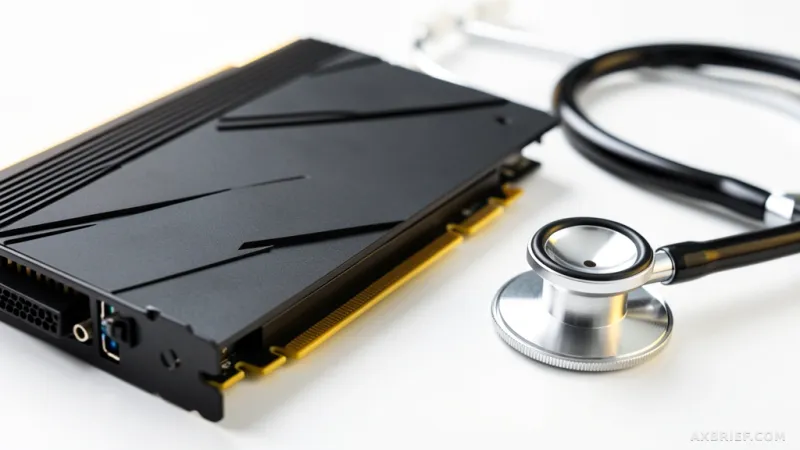
Every morning, the developer community wakes up to new attempts to breach the walled garden of a single GPU manufacturer. For those working in medical AI, where a single percentage point of accuracy can be the difference between a helpful insight and a dangerous error, hardware lock-in is more than a nuisance; it is a barrier to entry. The industry has long operated under the assumption that high-performance AI training requires a specific proprietary ecosystem. However, a new project appearing on GitHub this week is challenging that narrative by successfully training a medical question-answering model entirely within the AMD ROCm environment, completely bypassing the need for NVIDIA's CUDA.
The Architecture of a CUDA-Free MedQA
This implementation focuses on MedQA, a specialized model designed to solve complex medical multiple-choice questions and provide the clinical reasoning behind its answers. To achieve this, the project leverages the AMD Instinct MI300X, a high-performance accelerator equipped with 192GB of HBM3 memory. The base model used for this experiment is Qwen3-1.7B, a small language model with 1.7 billion parameters released by Alibaba.
The technical execution was rigorous, ensuring that the entire pipeline—from initial data loading to the final export of the adapter—was handled within the ROCm (Radeon Open Compute) platform. The developers explicitly avoided any CUDA-dependent code, proving that the software stack is now mature enough to handle specialized medical fine-tuning. The training process utilized a dataset of 2,000 samples, and thanks to the raw power of the MI300X, the entire training cycle was completed in approximately 5 minutes.
To set up the environment for this specific hardware configuration, the following environment variables are required:
export HSA_OVERRIDE_GFX_VERSION=9.4.2
export ROCM_PATH=/opt/rocm
export TORCH_HIP_ARCH_LIST=gfx942
Breaking the Quantization Tax
For years, the standard workflow for training medical AI involved a compromise. Because most available GPUs lacked sufficient VRAM, developers were forced to use 4-bit or 8-bit quantization to fit models into memory. While quantization reduces the memory footprint, it often introduces noise or artifacts and can lead to a loss of precision—a risky trade-off when dealing with clinical data.
The shift to the MI300X changes the fundamental math of the training process. With 192GB of VRAM, the need for aggressive quantization vanishes. This project demonstrates that the model can be trained using fp16 (16-bit floating point) precision, preserving the original integrity of the weights and the nuances of the medical data. This is made possible by the seamless integration of the ROCm stack with the broader HuggingFace ecosystem, specifically the Transformers library for model loading, PEFT (Parameter-Efficient Fine-Tuning) for optimization, and TRL for reinforcement learning.
To maintain efficiency without sacrificing precision, the team employed LoRA (Low-Rank Adaptation). By targeting only a small fraction of the model's weights, they trained approximately 2.2 million parameters out of the total 1.5 billion, drastically reducing memory overhead while maintaining high performance.
For developers looking to implement the inference stage, the LoRA adapter can be integrated as follows:
python
추론 시 LoRA 어댑터 결합 예시
from peft import PeftModel
from transformers import AutoModelForCausalLM
base_model = AutoModelForCausalLM.from_pretrained("Qwen/Qwen3-1.7B")
model = PeftModel.from_pretrained(base_model, "path/to/adapter")
This transition from hardware-constrained training to VRAM-abundant training allows researchers to focus on the quality of clinical reasoning rather than the limitations of their memory buffers. The project has made its results accessible via the official repository, allowing others to deploy the clinical reasoning model without complex configuration. Furthermore, a CPU-based demo is available via HuggingFace Spaces for those who wish to test the model's reasoning capabilities immediately.
The ultimate goal of medical AI is not merely to select the correct letter in a multiple-choice test, but to articulate the clinical logic that leads to a diagnosis. By proving that high-performance medical AI can be built using an open-source hardware and software combination, this project signals a shift toward a more democratic and flexible AI infrastructure.
The era of hardware-locked AI is beginning to crack, opening the door for a more diverse and accessible medical intelligence ecosystem.