
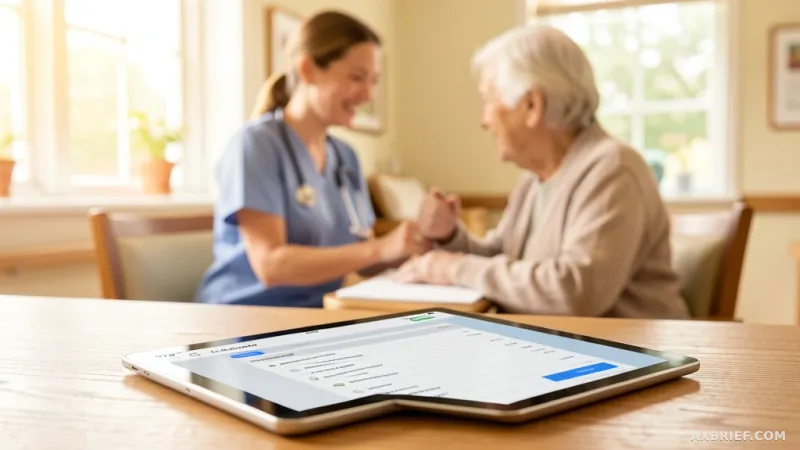
Mariamma George, a clinical care manager at a residential aged care facility in Cairns, Australia, begins her day not with a patient, but with a mountain of paper. The daily 24-hour report she faces is 68 pages long. For managers in high-capacity facilities, these documents are more than just administrative chores; they are dangerous bottlenecks. Every page contains critical data on falls, medication refusals, and the deteriorating states of patients nearing the end of life. In a facility with 97 beds, scanning through the progress notes written by frontline nurses is an exhausting exercise in high-stakes concentration. The tension is constant: the fear that a single missed sentence in a 68-page blur could lead to a clinical oversight. This is the reality of modern care management, where the burden of documentation often eclipses the act of care.
The Architecture of RegiCare Assist
To break this cycle, Regis Aged Care initiated a strategic pivot toward artificial intelligence in 2024, culminating in the launch of RegiCare Assist. This AI-driven assistant is not a small-scale pilot but a wide-scale operational deployment. Since September 2025, approximately 150 practitioners across 72 aged care facilities throughout Australia have integrated the tool into their daily workflows. The primary objective is the drastic reduction of time spent processing clinical records, allowing managers to shift their focus from the screen back to the bedside.
Developing a tool for a clinical environment requires more than just a generic LLM; it requires a bridge between medical necessity and technical execution. Regis partnered with Cognizant to define the specific pain points of the nursing staff and translate them into a functional workflow. The technical foundation of the system rests on Microsoft Copilot Studio, a low-code platform that allows for the visual design of AI agent behaviors. By treating the AI's conversational flow like a set of modular blocks rather than lines of complex code, the team was able to iterate rapidly based on direct feedback from clinical managers.
While Copilot Studio serves as the intuitive dashboard for interaction, the heavy lifting is handled by Microsoft Foundry. This infrastructure provides the high-performance Large Language Models (LLMs) necessary to process vast amounts of unstructured text. To ensure patient safety, the entire system operates within a secure, isolated environment. Strict access controls prevent the leakage of sensitive personal health information while still leveraging the reasoning capabilities of the LLM. The result is a system that does not just automate reading, but fundamentally reorders how a manager prioritizes their morning, transforming a linear reading task into a strategic triage process.
Solving the Hallucination Problem in Clinical AI
In a healthcare setting, an AI hallucination is not a minor glitch; it is a clinical risk. If an AI misses a patient's allergic reaction or invents a stable condition for a crashing patient, the consequences are catastrophic. To mitigate this, Regis moved away from relying on the internal weights of the LLM and implemented Retrieval-Augmented Generation (RAG). Instead of asking the AI to recall information from its general training, RAG forces the model to treat the process like an open-book exam. The AI must first search the Regis clinical policy and procedure knowledge base, retrieve the relevant guidelines, and then synthesize the answer based strictly on those documents. This ensures that the output is grounded in the specific clinical standards of Regis rather than general internet data.
Control extends beyond the backend to the user interface. Free-form chat interfaces often introduce ambiguity, as different nurses may use different terminology to describe the same symptom. To eliminate this variance, Regis replaced open-ended queries with a click-based interface. Users interact with pre-approved prompts and buttons, ensuring that the AI receives a standardized instruction every time. This constraint transforms the AI from a conversational partner into a precision tool, guaranteeing that any nurse, regardless of their technical proficiency, receives a consistent and safe response.
The most critical refinements occurred during the prompt engineering phase, where the team discovered that a single word could be the difference between a complete report and a dangerous omission. When the AI was asked to summarize residents requiring action, it occasionally skipped individuals to maintain brevity—a natural tendency of LLMs to be concise. The developers found that by explicitly inserting the word all into the prompt, the AI stopped summarizing for efficiency and started auditing for completeness. This simple linguistic switch forced the model to conduct a comprehensive census of the 68-page report, ensuring that no single patient was left behind in the summary. This level of precision turned a general summarization tool into a reliable clinical safety net.
From 68 Pages to 3 Pages of Insight
The tangible impact of RegiCare Assist is most visible in the physical reduction of data. The process that once required a manager to manually scan 68 pages of text is now compressed into a 3-page executive summary. This is not a simple truncation of text, but a sophisticated categorization of clinical data. The AI analyzes the massive volume of progress notes and automatically sorts information into specific, high-priority categories: immediate clinical concerns, long-term clinical trends, signs of agitation, indicators of pain or infection, and bowel movement tracking.
By assigning these digital labels to unstructured text, the AI effectively creates an index for the manager. Instead of reading chronologically and hoping to spot a pattern, the manager can jump directly to the pain or infection category to see which residents are showing early warning signs. This shift from linear reading to categorical analysis reduces the cognitive load on the manager and accelerates the speed of clinical intervention. The AI handles the pattern recognition, while the human handles the clinical decision.
Currently, the workflow involves a manual upload of the 24-hour report into the system. While effective, this remains a point of friction. The next phase of the rollout involves full integration with existing care management systems. Once integrated, the data will flow in real-time from the frontline nursing notes to the AI engine, eliminating the need for manual file transfers. This evolution aims to make the administrative overhead virtually zero, embedding the AI so deeply into the workflow that it becomes an invisible layer of support rather than a separate tool to be operated.
The Return to Bedside Care
The ultimate metric of success for RegiCare Assist is not the number of pages reduced, but the number of minutes returned to the patient. When a clinical care manager is freed from the 68-page report, they are no longer tethered to a computer monitor. They are back on the ward, making eye contact with residents and listening to their feedback. The reduction of the report to three pages has created a psychological liberation for the staff. The anxiety of searching for a needle in a haystack—the fear that a critical detail was buried on page 42—has been replaced by the confidence of a structured, AI-verified summary.
However, Regis maintains a strict boundary: AI provides the summary, but the human provides the judgment. The system is designed to flag issues, not to diagnose them. If the AI signals a change in a resident's condition, the manager uses their professional expertise to verify the state of the patient and decide on the treatment. The AI acts as a high-speed secretary, but the clinical responsibility remains firmly with the licensed professional. This partnership ensures that technology enhances human capability without eroding professional accountability.
By automating the administrative drudgery, Regis has created a virtuous cycle. Efficiency in documentation leads to psychological breathing room for the manager, which in turn leads to higher quality, more attentive care for the elderly residents. The goal of implementing low-code AI in this sector is not to replace the nurse, but to remove everything that prevents the nurse from being a nurse. When the screen disappears and the patient becomes the focus, the true value of the technology is realized.