
The notification pings on a Slack channel or a GitHub issue. A colleague or a client has asked a nuanced question, seeking a specific perspective on a complex technical hurdle. Within seconds, a response arrives. It is perfectly formatted, grammatically flawless, and structured with a polite, comprehensive list of points. Yet, the recipient immediately feels a sense of disappointment. There is a distinct, sterile scent to the prose—the unmistakable cadence of a Large Language Model. The realization hits instantly: the expert did not actually think about the problem; they simply acted as a human proxy for a prompt window.
The Junior Intern Framework for LLM Outputs
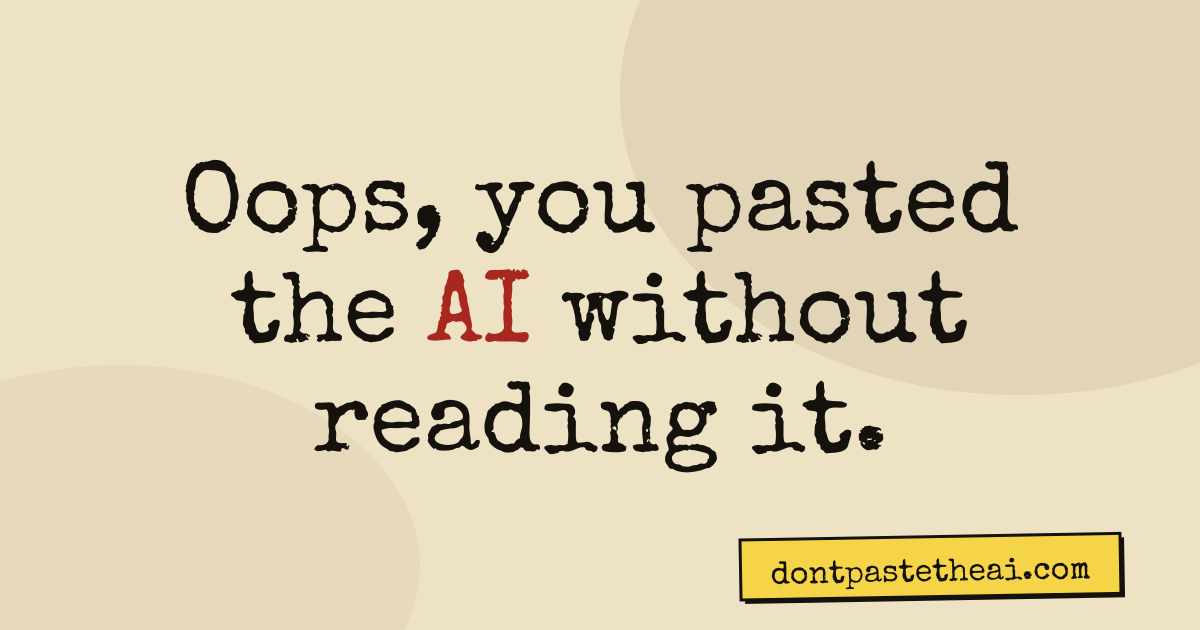
This friction has sparked a broader conversation within the developer community, recently highlighted by a satirical guide on GitHub that critiques the habit of passing off LLM responses as original professional advice. The core of the critique lies in a fundamental misunderstanding of what an LLM output actually is. In a professional context, the text generated by a model should never be viewed as a final deliverable. Instead, it must be treated as the first draft produced by a junior intern—someone who is hardworking and knowledgeable about general patterns but lacks the specific context, institutional memory, and critical judgment of a senior lead.
When a professional copies and pastes an AI response without modification, they are not increasing their productivity; they are effectively announcing that they find the asker's question unworthy of their own cognitive effort. The guide emphasizes that the value of a human expert is not the ability to retrieve information—which any user can do in four seconds with a prompt—but the ability to filter that information through a lens of experience. To avoid the trap of professional erasure, the workflow must shift from generation to curation. This involves a rigorous process of editing where the user must actively cut unnecessary fluff, disagree with the model's logical leaps or biases, and ultimately make the content their own by injecting personal anecdotes and specific project constraints.
For those looking to implement this philosophy, the discussion and practical guidelines are maintained as an open resource. The community is encouraged to remix, translate, and improve these standards, with contributions welcomed via Pull Requests to the repository at https://github.com/owner/repo. The goal is to establish a professional ethic where the tool serves the thinker, rather than the thinker serving as a conduit for the tool.
The Gap Between Helping and Pretending to Help
There is a profound difference between an act of genuine assistance and the performance of assistance. When a respondent takes a detailed query and feeds it directly into a prompt window, they create a redundant and inefficient data loop. If the asker has access to the same LLM, the middleman provides zero additive value. In fact, the process becomes a net negative. The asker is forced to filter through generic AI platitudes to find the actual answer, a task they could have performed more quickly on their own. By acting as a mere relay, the professional proves that there is no intellectual delta between their own expertise and the probabilistic guesses of a model.
True professional value is generated during the high-cognitive processing phase. This is the moment where a human reads a question, re-frames it within their own knowledge system, and derives a solution based on real-world failures and successes that do not exist in a training set. AI models operate on probability; experts operate on evidence and intuition. When these two are combined—using the AI to map the territory and the human to navigate the specific path—the result is a high-value solution. When the human is removed from the equation, the result is merely a generic summary.
Furthermore, the psychological impact on the receiver is damaging. Most experienced professionals can now identify the structural hallmarks of AI-generated text—the overly balanced conclusions, the repetitive transition words, and the lack of a strong, opinionated stance. When a recipient identifies this, they do not see efficiency; they see a lack of respect. The message received is that the respondent did not value the interaction enough to spend a few minutes of deep thought. This erodes the trust that forms the basis of professional relationships. Once a colleague views you as someone who simply proxies AI responses, your status as a subject matter expert vanishes, and you are relegated to the role of a replaceable interface.
In the current landscape, the definition of expertise is shifting. It is no longer about who possesses the most information, as information has been commoditized by generative AI. Instead, expertise is now defined by the ability to provide an irreplaceable perspective. The risk for those who rely on copy-pasting is not just a loss of reputation, but a loss of skill. The act of synthesizing an answer is where the actual learning and professional growth happen. By outsourcing the synthesis to an LLM, the professional stops growing, eventually becoming a shell of the expert they once were.
The tool must remain a subordinate. Whether it is generating a boilerplate function or drafting a project proposal, the AI provides the starting point, not the finish line. The professional's job is to challenge the AI, prune its hallucinations, and sharpen its generic edges into a precise instrument. If the final output lacks the fingerprints of human judgment, it is not a professional contribution; it is a failure of professional duty.
Professionalism in the age of AI is measured by the distance between the model's first draft and the human's final delivery.