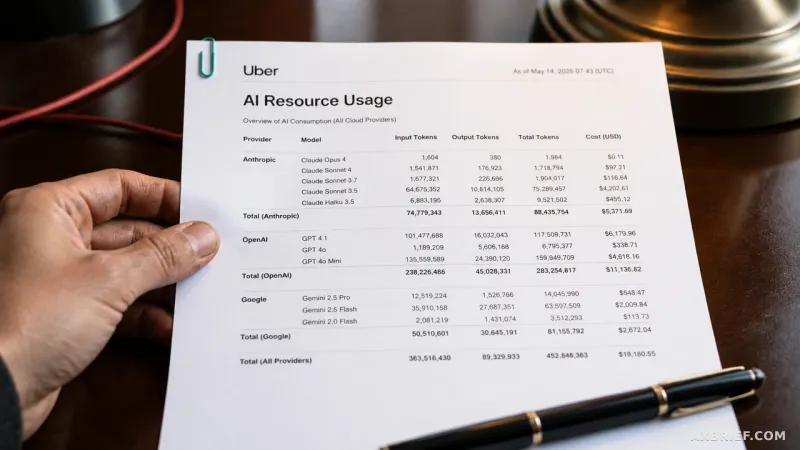
As generative AI transitions from a novelty to a core component of the software development lifecycle, the initial excitement is being tempered by the harsh reality of enterprise-scale token consumption. Uber has emerged as a bellwether for this shift, recently implementing a strict $1,500 monthly cap on token usage for AI-powered coding tools. This policy specifically targets agentic software like Cursor and Anthropic's Claude Code, marking a departure from the era of unchecked AI experimentation toward a model of rigorous fiscal oversight.
The Economics of Agentic Coding
The move reflects a fundamental misalignment between consumer-grade AI pricing and enterprise requirements. While individual users can often access advanced models for a flat monthly fee of roughly $100, the high-frequency token consumption inherent in agentic workflows creates a massive cost burden at scale. Under Uber's new guidelines, an engineer utilizing two such tools could consume up to $36,000 in annual AI budget. When measured against the $330,000 average salary for a software engineer at Uber, this AI expenditure represents approximately 11% of their total compensation, forcing companies to treat token consumption as a primary performance metric.
This shift is occurring alongside a broader industry pivot toward token-based revenue models. As companies face 'AI sticker shock' from rapidly escalating API bills, the focus has moved from simple seat-based subscriptions to granular usage tracking. In terms of technical efficiency, benchmarks have become the new currency for tool selection. Recent data shows that GPT-5.5 outperforms Opus 4.7, requiring only half the tokens and less than half the time to complete coding tasks, at roughly one-third of the cost. Meanwhile, Google is testing its own internal AI agent, 'Remy,' which integrates across Gmail, Docs, and Calendar to automate complex workflows, further emphasizing the need for internal efficiency metrics.
Benchmarking Real-World Performance
To move beyond the limitations of traditional benchmarks, which often suffer from data contamination and trivial task sets, the industry is turning to more rigorous evaluations. The DeepSWE benchmark, developed by Data Curve, simulates real-world engineering environments to measure long-term coding capabilities. In initial testing, GPT-5.5 secured the top spot with a 70% score, followed by GPT-5.4 at 56% and Opus 4.7 at 54%. The critical differentiator for these top-performing models was 'self-verification'—the ability to autonomously write and execute test code to validate their own output. Models that failed to implement this self-correction loop, such as DeepSeek V4 at 8%, struggled significantly in production-like scenarios.
This focus on efficiency has also sparked interest in local, open-source alternatives. Projects like Unsloth Studio are gaining traction by simplifying the complex implementation and dataset construction required for fine-tuning, allowing developers to run and test models locally via tools like Ollama or LM Studio. By keeping the development process in-house, companies can bypass the high costs associated with proprietary API calls while maintaining greater control over their data and performance outcomes.
The Off-Frontier Strategy
Microsoft is signaling a strategic pivot away from the race for the absolute latest model, adopting what is being called an 'off-frontier' strategy. By utilizing models that are 3 to 6 months behind the absolute bleeding edge, the company aims to capture significant cost savings while maintaining sufficient performance for most enterprise tasks. This doctrine suggests that the future of corporate AI adoption will not be defined by access to the most powerful model, but by the ability to balance performance with the economic reality of token-based infrastructure. As Anthropic reports a surge in annual recurring revenue—growing from $3 billion to $47 billion in a single year—the pressure on regulators to address the financial impact of these models is also mounting, with proposals for significant one-time taxes on frontier AI labs currently under discussion.
Uber's decision to cap spending at $1,500 per tool per month is not merely a budget constraint; it is a recognition that the era of 'free' AI productivity is over. The long-term viability of AI in the enterprise will be determined by whether these tools can deliver measurable value that justifies an 11% overhead on engineering talent.