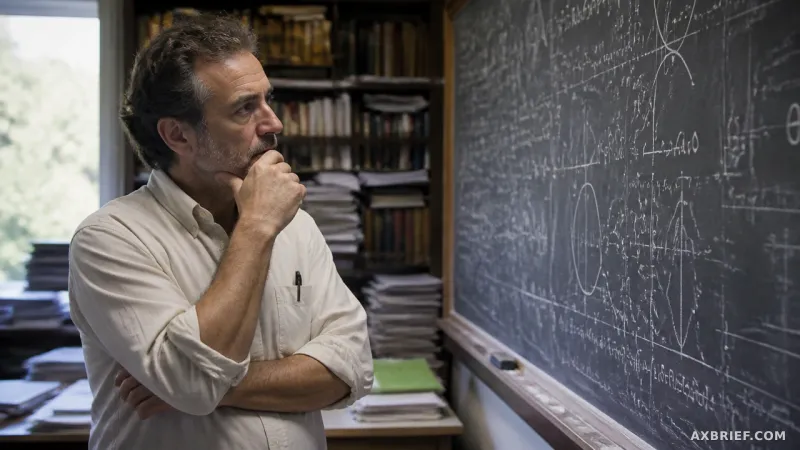
The atmosphere in university mathematics departments has shifted from skepticism to a quiet, uneasy fascination. For decades, the formal proof was viewed as the impenetrable wall separating human cognition from machine computation. While computers could crunch numbers at speeds humans could never imagine, the act of proving why a theorem holds true was considered the ultimate sanctuary of human creativity and logical intuition. This week, that sanctuary feels smaller than ever as AI models begin to dismantle mathematical hurdles that were once thought to require a lifetime of human study.
The Acceleration of Automated Reasoning
The expansion of AI into the realm of mathematics is no longer a gradual climb but a vertical spike. We are witnessing a transition where AI is moving beyond simple arithmetic and basic algebra into the territory of complex problem solving and formal verification. The speed at which these systems are identifying solutions to long-standing mathematical challenges has caught the academic community off guard. The core of this shift lies in the ability of modern models to navigate vast search spaces of logical possibilities, identifying patterns and paths to a solution that might take a human mathematician years to uncover. This rapid territorial expansion is not just about efficiency; it is about the AI's increasing capacity to handle the symbolic logic that defines the discipline. The result is a landscape where the distance between a posed problem and a verified answer is shrinking toward zero.
The Gap Between Solution and Understanding
The tension arises when we confuse the output of a model with the process of mathematics. The central warning from the mathematical community is that arriving at a correct answer is fundamentally different from conceptual understanding. AI operates through high-dimensional pattern matching and probabilistic inference, whereas mathematics is built on intuitive leaps and the rigorous construction of meaning. When a human mathematician solves a problem, they develop a mental model of the underlying structure, gaining an intuitive grasp of why a specific path is necessary. An AI, conversely, can provide the correct proof without possessing any internal representation of the mathematical truth it has uncovered. This creates a dangerous paradox where the tool becomes more capable than the user's ability to explain the tool's success. If the academic world begins to prioritize the result over the reasoning, the intellectual joy of discovery and the strictness of logical rigor risk being replaced by a blind reliance on black-box outputs.
Mathematics remains a human endeavor not because we are the fastest calculators, but because we are the only ones capable of experiencing the epiphany of a new concept.