The current atmosphere in Silicon Valley is defined by a precarious balance between aggressive scaling and the brutal reality of burn rates. For many early-stage AI companies, the difference between a sustainable runway and a sudden collapse often comes down to the cost of a single API call or the efficiency of a hosted model. This week, that balance shifted from a financial concern to a political one as a significant coalition of developers realized that their underlying infrastructure might soon be deemed a national security threat.
The Coalition Against the AI Blockade
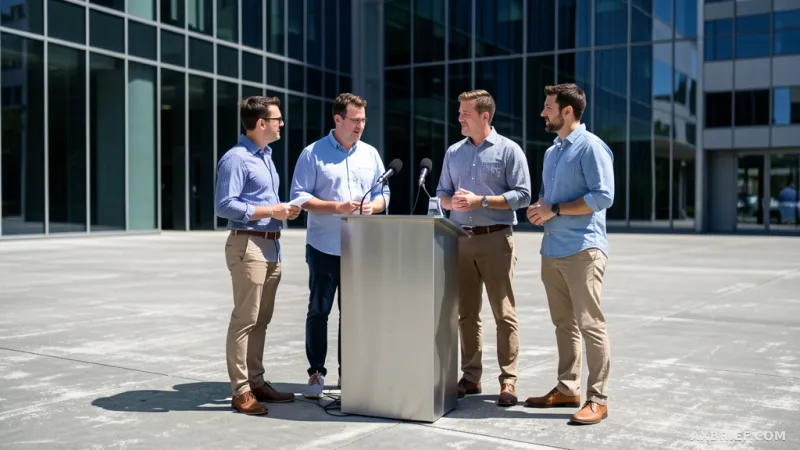
Approximately 200 Silicon Valley companies have formally petitioned the Trump administration to reconsider a potential ban on Chinese open-weight AI models. This collective action, led by the Little Tech Association—a coalition that includes high-profile participants such as Proton and the startup accelerator Y Combinator—marks the first time the US startup ecosystem has organized a unified front against the administration's AI policy. The letter was directed at the highest levels of government, including President Donald Trump, Commerce Secretary Howard Lutnick, and Michael Kratsios, the White House official for science and technology policy.
The administration's push for restrictions is rooted in allegations of intellectual property theft and illicit technology acquisition. Michael Kratsios has specifically highlighted the activities of Moonshot AI, alleging that the company developed a sophisticated internal platform designed to distill knowledge from Anthropic's Fable model to create its own K3 model. Model distillation is a process where a smaller, more efficient model is trained to mimic the behavior and performance of a larger, more complex teacher model. Beyond software, the administration has raised suspicions that Chinese firms have bypassed trade restrictions to acquire servers equipped with Nvidia GB300 chips, hardware that is explicitly banned for sale to Chinese entities.
The Economic Friction of Open Weights
At the heart of this dispute is the distinction between proprietary APIs and open-weight models. Open-weight models allow developers to download the actual parameters of a neural network, enabling them to host the model on their own hardware, fine-tune it for specific tasks, and avoid the recurring costs associated with per-token pricing. For many US startups, the open-weight models released by Chinese giants like Alibaba and Moonshot AI provide a high-performance, low-cost alternative to the expensive ecosystems managed by US-based incumbents.
While industry titans like Anthropic argue that stricter regulations are necessary to prevent the leakage of critical AI capabilities to geopolitical rivals, the startup community views this as a move that could inadvertently stifle domestic innovation. The tension lies in the cost of substitution. If access to affordable Chinese open-weight models is severed, startups will be forced to migrate their workloads to proprietary models from OpenAI or Anthropic. For a company operating on a tight budget, the jump in credit costs for these premium services can be catastrophic, potentially erasing their margins overnight.
This creates a paradoxical scenario where security policies intended to protect US leadership in AI might actually consolidate power within a few massive corporations. By removing low-cost alternatives, the government could effectively create an oligopoly where only the most well-funded AI labs can afford to build and iterate, leaving the smaller, more agile innovators unable to compete. The startups argue that a total ban is a blunt instrument that fails to address specific security vulnerabilities while imposing a heavy tax on the very companies the US wants to foster.
Despite the intensity of the debate, the immediate threat of a total blackout appears to have stalled. White House officials and cabinet members discussed the matter on Monday night, but reports indicate that a comprehensive ban on Chinese open-weight models was not seriously pursued during those deliberations. Furthermore, as of Wednesday, the Department of Commerce has not added these specific Chinese AI firms to the Entity List, the official blacklist that triggers strict export controls and licensing requirements.
For the 200 startups currently watching the headlines, the survival of their business models now depends on a single administrative list maintained by the Department of Commerce.