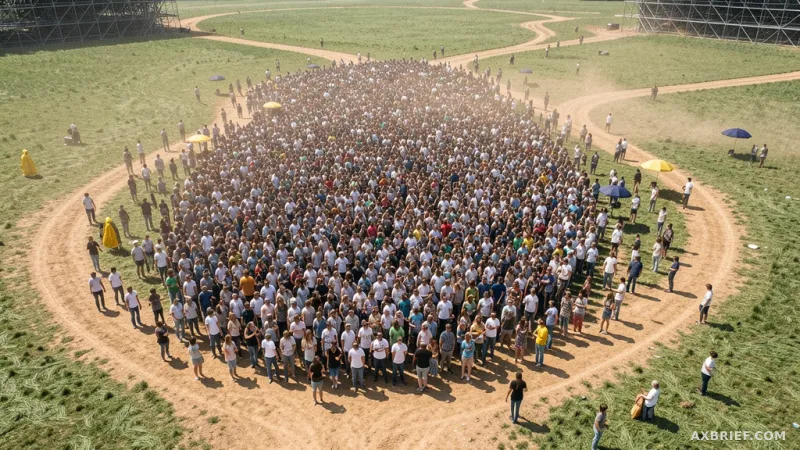
Imagine the aftermath of a major developer conference or a city-wide running crew event. The organizers upload five hundred high-resolution photos to a shared Google Drive or a massive group chat. For the participants, the experience is a tedious scavenger hunt, scrolling through hundreds of images of strangers just to find the three or four where they actually look good. For the organizers, it is a privacy minefield, as sharing raw albums often leads to complaints from attendees who prefer to keep their presence discreet. This friction between the desire for memories and the burden of manual filtering is the exact gap iwasthere aims to close.
The Architecture of Automated Privacy
Launched as a streamlined solution for event photo distribution, iwasthere removes the traditional barriers of app installation and account registration. The user journey is reduced to a single interaction: a participant clicks a shared link and takes a real-time selfie within their browser. The AI then scans the event's entire photo library, instantly filtering and presenting only the images containing that specific individual. To address the critical issue of third-party privacy, the platform employs a feature called `portraitProtection`, which automatically applies a mosaic blur to every face in the photo except for the requester.
From an operational standpoint, the service minimizes the administrative overhead for organizers. Once photos are uploaded and a link is generated, the distribution is handled autonomously. To prevent the permanent accumulation of sensitive biometric data, iwasthere includes an `archival` function. Organizers can set a specific expiration date for the event, after which the system automatically purges the original images, the masked versions, and all associated face embedding data from its storage.
Security is baked into the ingestion process to prevent identity spoofing. The system utilizes liveness verification, requiring a live camera feed to ensure that a user cannot search for someone else using a saved photograph. Technically, the platform extracts only the face embeddings from the captured frame and immediately discards the original image. The entire pipeline is secured via HTTPS, and API keys are stored using SHA-256 hashing, with access strictly governed by ownership-based control mechanisms.
Shifting from UI to Agentic Workflows
While the face-filtering utility is the immediate draw, the deeper technical significance of iwasthere lies in its adoption of the Model Context Protocol (MCP). By providing an MCP server, iwasthere moves beyond being a standalone web tool and becomes a set of capabilities that can be orchestrated by external AI agents. This represents a fundamental shift in how users interact with AI services, moving from manual UI manipulation to agent-driven task completion.
The iwasthere MCP server exposes 13 distinct tools that cover the entire lifecycle of event management, including CRUD operations for events, photo uploads, indexing status checks, and the generation of sharing links. For developers or power users utilizing MCP clients like Claude Desktop or Cursor, the entire operational flow can be condensed into a single natural language prompt. An organizer can simply tell their AI agent to create an event, upload the photo batch, and distribute the link, and the agent will execute these steps by calling the underlying MCP tools.
This design leverages Stateless Streamable HTTP and API key authentication, ensuring that AI agents can efficiently monitor the state of a task—such as waiting for a large batch of photos to finish indexing—before proceeding to the next step. By decoupling the functionality from the browser interface, iwasthere allows the management of photo events to happen within the developer's existing IDE or chatbot environment, treating the service as a programmable utility rather than just a website.
For AI practitioners, the implementation serves as a practical case study in balancing biometric utility with ethical data minimization. The decision to avoid storing selfies and to prioritize immediate embedding extraction provides a blueprint for reducing legal and ethical risks in facial recognition products. Furthermore, the granular decomposition of the MCP tools demonstrates how to effectively break down a business process into actionable primitives that an LLM can reliably trigger.
Detailed technical documentation on implementing the MCP server can be found at iwasthere.pics/docs/mcp. The service is currently refining its offering by applying paid plan features to email-verified users while actively gathering feedback from its early adopter base.
This integration of biometric AI with agentic protocols signals a future where service interfaces disappear entirely, replaced by a network of tools that AI agents coordinate on our behalf.