For years, the high-end professional laptop market has felt like a one-way street, with the MacBook Pro maintaining a near-monopoly on the intersection of extreme power and energy efficiency. Creative professionals and AI developers have largely accepted this trade-off, or alternatively, leaned heavily on cloud-based compute to bridge the gap. However, a growing tension has emerged in the developer community: the escalating cost of cloud subscriptions and the latency of API calls. As AI workflows move from experimental prompts to integrated production pipelines, the industry is hitting a ceiling where the monthly bill for tokens is becoming a significant operational burden. This week, the conversation shifted from how to optimize cloud spend to how to eliminate it entirely.
The Architecture of the N1X Powerhouse
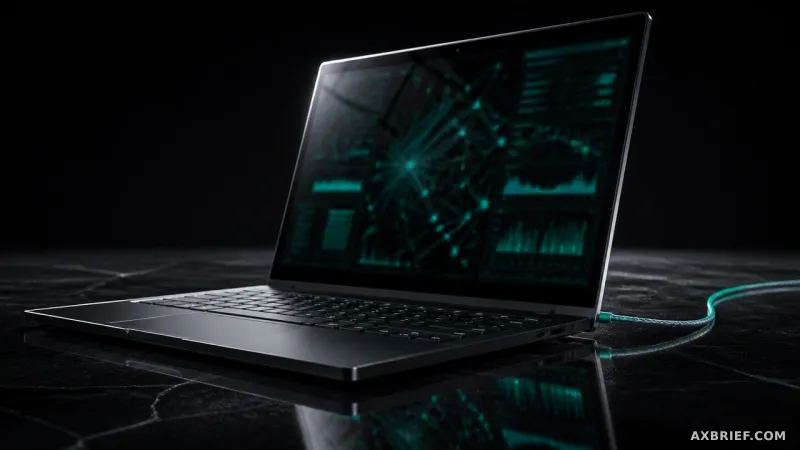
At Computex 2026, Microsoft introduced the Surface Laptop Ultra, a flagship device designed to dismantle the divide between portable computing and workstation performance. Scheduled for a fall 2026 release, the device is built on the Windows on Arm architecture, a move intended to maximize performance-per-watt while delivering raw compute power. The heart of the machine is the N1X chip, a collaborative effort between NVIDIA and MediaTek. This silicon combines a 20-core NVIDIA Grace CPU with a Blackwell-based RTX GPU, creating a unified compute engine capable of handling the most demanding professional workloads.
To ensure this hardware isn't throttled by software, Microsoft has overhauled the internal scheduling of Windows 11. The system now employs a new workload profile scheduling mechanism that intelligently distributes tasks across all 20 processor cores. By preventing bottlenecks where a single core is overwhelmed while others sit idle, the OS extracts the maximum theoretical performance from the N1X silicon. Compatibility, often the Achilles' heel of Arm-based Windows devices, is addressed through an optimized Prism emulation layer. By leveraging AVX and AVX2 instruction set extensions, the Surface Laptop Ultra can run legacy x86 applications designed for Intel or AMD chips without requiring developers to rewrite their code. This ensures that the vast library of professional Windows software remains accessible while the underlying hardware shifts to a more efficient architecture.
The Shift from Cloud Dependency to Local Sovereignty
While the raw specs are impressive, the true disruption lies in how the Surface Laptop Ultra handles Large Language Models (LLMs). For most enterprises, the cost of running high-parameter models is tied to recurring API fees and cloud infrastructure. The Surface Laptop Ultra changes this equation by integrating the NVIDIA RTX Spark platform. With up to 128GB of unified memory and a high-speed NVLink-C2C interconnect between the CPU and GPU, the device eliminates the data bottlenecks that typically plague laptop-based AI. This architecture allows the machine to run models with up to 120 billion parameters entirely on-device.
This is not merely a marginal improvement; it is a fundamental shift in capability. The device achieves 1 petaflop of AI performance locally, meaning a developer can iterate on a massive model without sending a single packet of data to an external server. This solves the dual problem of data privacy and response latency. To support this, the system utilizes a flexible RAM pooling strategy, dynamically allocating memory between the processor and the graphics card based on the immediate workload. Full support for NVIDIA's CUDA platform ensures that the computational efficiency is maximized, allowing the system to maintain stability even when the 120B parameter models push the hardware to its limits.
Security has been redesigned to accommodate this local autonomy. Because local AI agents can potentially access sensitive system files, NVIDIA and Microsoft implemented the OpenShell runtime combined with specialized security and isolation primitives. Local agents, such as Hermes or OpenClaw, are executed within a secure sandbox. This ensures that while an AI agent can analyze complex local datasets or execute system-level commands to assist the user, it remains isolated from the core operating system. This double-layered safety mechanism allows corporations to deploy autonomous agents on employee laptops without risking a total system collapse or a security breach.
Beyond the silicon, the hardware is tailored for the studio environment. The device features a 15-inch mini-LED PixelSense Ultra display with a resolution of 2880 x 1920 and a density of 262 pixels per inch. With a peak HDR brightness of 2,000 nits, the screen remains legible in direct sunlight, making it viable for field work. Microsoft has also avoided the trend of port reduction, equipping the Ultra with a full HDMI port, USB-C, USB-A, a dedicated SD card reader, and a headphone jack. This transforms the laptop from a simple computer into a self-contained production hub.
As the RTX Spark platform proves that 120 billion parameter models can live on a desk rather than in a data center, the economic incentive for cloud-only AI begins to erode. The Surface Laptop Ultra represents the moment where the power to innovate is decoupled from the monthly subscription.
The era of the cloud-tethered AI developer is ending as the workstation descends from the server rack to the laptop chassis.