The dreaded Out of Memory error is the invisible wall every local LLM enthusiast eventually hits. For those running an RTX 4080, the 16GB VRAM limit creates a frustrating paradox: you have a powerful GPU, yet you are forced to either shrink your model size or aggressively quantize your weights, sacrificing intelligence for the sake of fit. The community has long debated whether to shell out thousands for a workstation-grade card or settle for the diminished returns of 4-bit quantization. This week, a more pragmatic, albeit unconventional, path has emerged for developers who prefer hardware hacking over corporate pricing tiers.
The Economics of HBM2 and the VRAM Expansion
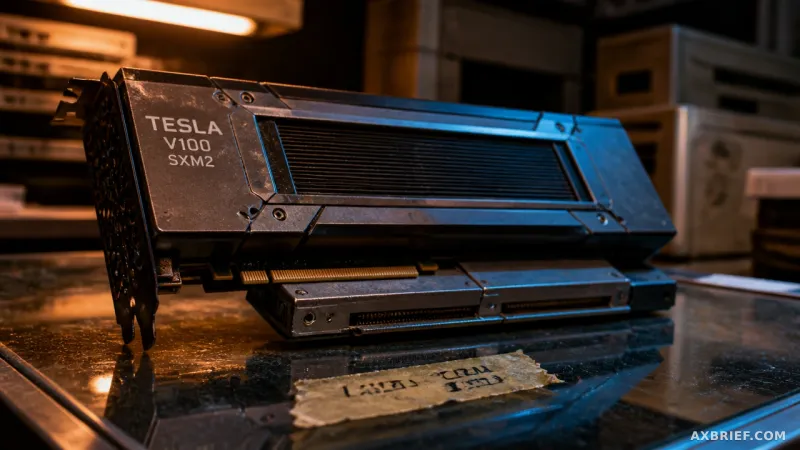
Expanding a consumer system to 32GB of VRAM typically requires a leap to the RTX 5090, which carries a price tag exceeding £2,000. However, the Tesla V100 SXM2, a data center veteran from 2017, offers a loophole. Because the SXM2 version is designed for server racks, it lacks a PCIe slot, power connectors, and display outputs, which crashes its resale value on the secondary market. By pairing a used Tesla V100 SXM2 16GB model from eBay, priced at approximately £150, with a dedicated SXM2-to-PCIe adapter costing £50, a total VRAM pool of 32GB is achievable for just £200.
This configuration is not merely about capacity; it is about the physics of memory bandwidth. The Tesla V100 utilizes a 4096-bit memory bus to deliver an HBM2 bandwidth of 900 GB/s. When placed alongside an RTX 4080, which relies on GDDR6X with a bandwidth of 736 GB/s, the V100 actually becomes the faster pipe for data. This exceeds the 614 GB/s found in the Apple M5 Max and nearly matches the 960 GB/s of the AMD RX 7900 XTX. While the RX 7900 XTX is a strong contender on paper, its £700 price point and the relative instability of ROCm for LLM inference make the V100 a more efficient choice. The V100 secures 94% of the RX 7900 XTX's bandwidth at one-fourth of the cost, all while remaining firmly within the CUDA ecosystem.
In the context of LLM inference, token generation speed is rarely limited by raw compute power; it is almost always a memory bandwidth bottleneck. By investing £200—roughly 10% of the cost of an RTX 5090—a user can bypass the physical memory constraints of consumer hardware. This allows for the fluid execution of 27B parameter models without the severe performance degradation associated with offloading layers to system RAM.
Overcoming the Noise and Driver Friction
Integrating server-grade hardware into a home environment introduces two immediate points of failure: acoustic torture and driver incompatibility. The SXM2-to-PCIe adapter comes with a fan that runs at 100% speed by default, producing a piercing 82dB of noise. To resolve this, a hardware modification is required using JST PH2.0 to 2.54mm jumper cables. By routing the fan's tachometer and PWM pins directly to the motherboard's PWM header, the fan speed can be throttled. Even at a 10% duty cycle, the V100 maintains temperatures below 50 degrees Celsius under full load, transforming the system from a jet engine into a usable workstation.
Software compatibility presents a steeper challenge. The system must simultaneously drive the Volta architecture of the V100 and the Ada Lovelace architecture of the RTX 4080. This requires a driver branch that supports both generations, specifically the 550.x series. NixOS provides the ideal environment for this level of granularity. By utilizing the `nvidiaPackages.legacy_535` configuration combined with Kernel 6.6 and CUDA 12.2, the two disparate GPUs can coexist. A critical quirk of this setup is that even in a headless server configuration, the X server must be enabled to ensure the NVIDIA kernel modules load correctly.
nix
Driver and Kernel config
boot.kernelPackages = pkgs.linuxPackages_6_6;
hardware.nvidia.package = config.boot.kernelPackages.nvidiaPackages.legacy_535;
services.xserver.enable = true;
nix
CUDA 12.2 from older nixpkgs
cuda = pkgs.nixpkgs.legacyPackages.x86_64-linux.nixpkgs24_05.cuda;
With the infrastructure stable, the performance gains become tangible. Using a Q5_K_M quantized version of Qwen3.6-27B-MTP, which occupies roughly 19GB of VRAM, the base inference speed hits 32 tok/s. By leveraging Multi-Token Prediction (MTP), this speed increases by 1.5 to 2 times, peaking at 60 tok/s. To add visual capabilities, a 928MB mmproj file is integrated. By passing the `--mmproj-offload` flag during the `llama.cpp` execution, the vision encoder is allocated to the GPU, allowing image pixels to be mapped into the LLM's token embedding space for seamless multimodal processing.
To prevent bootloader conflicts and maintain system hygiene, the OS is hosted on a Corsair MP600 MINI USB-C NVMe external drive. This allows for a physical switching mechanism: removing the drive to boot into Windows for gaming, and inserting it to boot into NixOS for AI workloads. The heavy model files are stored on a TrueNAS server and accessed via NFS mounts, with the `llama.cpp` service configured to depend on the `mnt-nas.mount` unit to ensure the models are available before the service attempts to start.
Ultimately, the success of a local LLM setup is not determined by the brand name on the box or the release date of the chipset. It is determined by the raw sum of available VRAM and memory bandwidth. By bridging the gap between discarded enterprise hardware and modern consumer GPUs, developers can break the VRAM wall without breaking their budget.