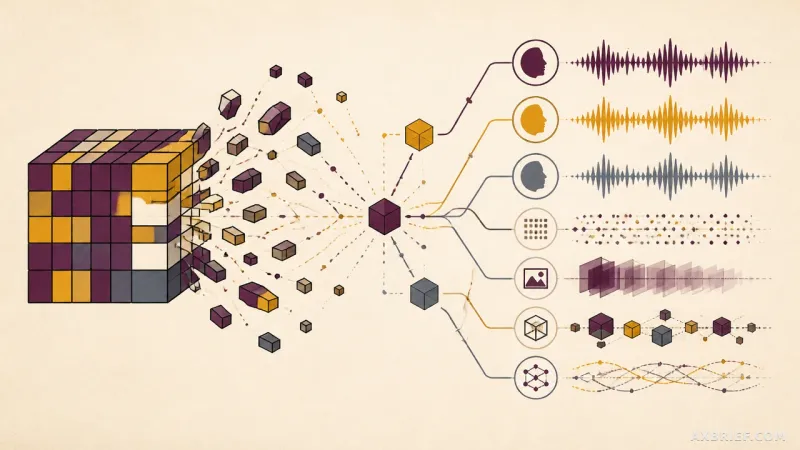
The current era of generative AI often feels like a sudden explosion, but the foundation was laid when the industry stopped obsessing over manually labeled datasets. For years, the primary bottleneck in natural language processing was the human-in-the-loop requirement, where every piece of training data needed a gold-standard label to be useful. The shift occurred when researchers realized that the structure of language itself could serve as the teacher, allowing models to learn from the vast, unlabeled expanse of the internet.
The Mechanics of Scale and Self-Supervision
At the center of this shift is GPT-2, a model built upon the Transformer architecture, a neural network design specifically engineered to capture the complex relationships between words in a sequence. The model is available in several sizes to accommodate different hardware constraints and performance needs. The entry-level version features 124 million parameters, which are the internal adjustable variables the model optimizes during training. For developers with access to more significant computing resources, the lineup extends into Medium, Large, and XL versions, each increasing the model's capacity to represent nuanced linguistic patterns.
Rather than relying on human-annotated data, GPT-2 employs self-supervised learning. This approach allows the model to find its own rules and patterns within the data itself. By processing massive amounts of text, the model learns the statistical likelihood of word sequences, effectively teaching itself the grammar, facts, and reasoning capabilities inherent in the training corpus without a human ever providing a correct answer key.
The Causal Constraint and the Masking Twist
While the scale of parameters provides the capacity, the actual intelligence of GPT-2 emerges from its objective function: Causal Language Modeling (CLM). In a standard language task, a model might look at a whole sentence to understand a word. However, for generation, this is a flaw. If a model can see the end of the sentence, it is not predicting; it is simply copying. This creates a fundamental tension between the model's need for context and the requirement that it must generate text one token at a time.
To solve this, GPT-2 implements a mask-mechanism. This technical constraint ensures that during training, the model is forbidden from looking at future tokens. By masking the data that appears after the current word, the model is forced to rely solely on the preceding sequence to predict the next word. This ensures the causality of the text generation process, transforming the model from a simple pattern recognizer into a predictive engine capable of coherent, open-ended synthesis.
This transition to self-supervision drastically lowers the cost of data acquisition. Because the model can ingest any raw text, the financial and temporal barriers to building massive datasets vanish. However, this autonomy introduces a critical risk: the model inherits every bias, prejudice, and inaccuracy present in its training data. Because there is no human filter during the self-supervised phase, the output must be rigorously validated by the practitioner to ensure the results are safe and accurate.
For those looking to implement these capabilities, the Hugging Face ecosystem has streamlined the process. The pipeline feature allows for immediate text generation without complex boilerplate code. To ensure results can be replicated across different runs, setting a seed is highly recommended. The following implementation demonstrates the basic generation flow:
from transformers import pipeline, set_seed
generator = pipeline('text-generation', model='gpt2')
set_seed(42)
generator("Hello, I'm a language model,", max_length=30, num_return_sequences=5)
When developers need to move beyond simple generation and access the underlying vector values, they can utilize embedding tasks through deep learning frameworks like PyTorch or TensorFlow. In a PyTorch environment, the implementation follows this structure:
from transformers import GPT2Tokenizer, GPT2Model
tokenizer = GPT2Tokenizer.from_pretrained('gpt2')
model = GPT2Model.from_pretrained('gpt2')
text = "Replace me by any text you'd like."
encoded_input = tokenizer(text, return_tensors='pt')
output = model(**encoded_input)
For those operating within the TensorFlow ecosystem, the `TFGPT2Model` class provides the necessary functionality:
from transformers import GPT2Tokenizer, TFGPT2Model
tokenizer = GPT2Tokenizer.from_pretrained('gpt2')
model = TFGPT2Model.from_pretrained('gpt2')
text = "Replace me by any text you'd like."
encoded_input = tokenizer(text, return_tensors='tf')
output = model(encoded_input)
Beyond the base model, the community has leveraged the model hub to share fine-tuned versions of GPT-2. These versions are optimized for specific tasks, allowing developers to bypass the expensive initial training phase and deploy specialized agents immediately.
This architectural blueprint proved that scale and causal constraints could unlock general-purpose language abilities, setting the stage for every large language model that followed.