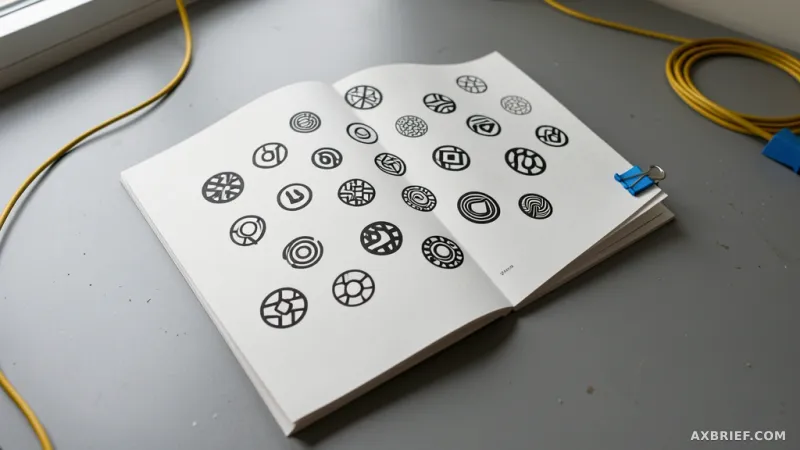
Open a folder of AI applications on a modern smartphone and a strange sense of visual deja vu sets in. Despite the fierce competition for compute and talent, the visual landscape of generative AI is remarkably stagnant. Most of the industry's heavy hitters have converged on a nearly identical aesthetic: the circular motif, the swirling hexagon, and the hollow center. It is a digital neighborhood where every house is painted the same shade of corporate minimalism, creating a sea of icons that blend into one another the moment the screen dims.
The Rise of the Swirling Hexagon
This visual convergence is not a coincidence but a documented phenomenon. In 2023, FastCompany identified this shift, reporting on the emergence of the swirling hexagon as the unofficial mascot of the AI boom. The trend is characterized by geometric shapes that suggest motion, infinity, and a certain mathematical purity. These logos typically feature a central aperture, a design choice intended to project a sense of openness and accessibility while maintaining a high-tech edge.
Anthropic's Claude provides a sophisticated example of how companies are attempting to add depth to this shared geometry. On the claude.ai website, the logo is not a static image but an interactive element. When a user clicks the logo, it triggers a specific animation where the shape contracts and expands in a rhythmic motion. This pulsing effect, which some observers liken to biological breathing or muscular contraction, attempts to inject a sense of organic life into an otherwise rigid geometric form.
OpenAI, the primary catalyst for this trend, underwent its own evolution to arrive at this aesthetic. Moving away from simple text-based marks, OpenAI adopted a precise circular logo with a void at its center and subtle gradient work. According to the company, this design represents the intersection of human-centric flexibility and technical precision. The contrast between the perfect outer perimeter and the empty core is meant to visualize the balance between technical completion and the evolving nature of human values.
The Cost of Corporate Risk Aversion
When looking at the broader market, a sharp divide emerges between the companies chasing the safe average and the outliers carving out a distinct identity. While the majority of the industry clings to the swirling hexagon, a few players have consciously rejected the template. DeepSeek and Midjourney stand out as primary exceptions. Interestingly, both companies have anchored their visual identities in themes related to the sea, prioritizing a unique brand narrative over the prevailing industry aesthetic.
This divergence reveals the underlying tension in AI branding: the conflict between the desire for differentiation and the fear of looking unprofessional. For many startups, the cost of a failed branding experiment feels higher than the cost of invisibility. Because OpenAI's branding became synonymous with the gold standard of AI capability, its visual language became a shorthand for legitimacy. For latecomers to the market, mimicking this visual grammar is a low-risk strategy to signal that they are a serious, professional AI service rather than a fleeting experiment.
This behavior is a classic manifestation of corporate risk aversion. In an environment where multiple stakeholders, investors, and board members must approve a visual identity, the process naturally filters out the radical in favor of the acceptable. The result is a feedback loop where the industry standard is reinforced not because it is the most effective design, but because it is the least likely to be criticized. By choosing the safe average, these companies are effectively trading their long-term brand equity for short-term perceived stability.
When a brand's visual identity becomes a commodity, the logo ceases to be a tool for recognition and becomes a mere category marker. If every AI tool looks like a swirling circle, the user no longer identifies the company, but simply the function. This erosion of individuality creates a vacuum that only true visual innovation can fill, as seen in the maritime themes of the industry's outliers.
True brand differentiation is decided not by how well a company fits into the current trend, but by its willingness to break it.