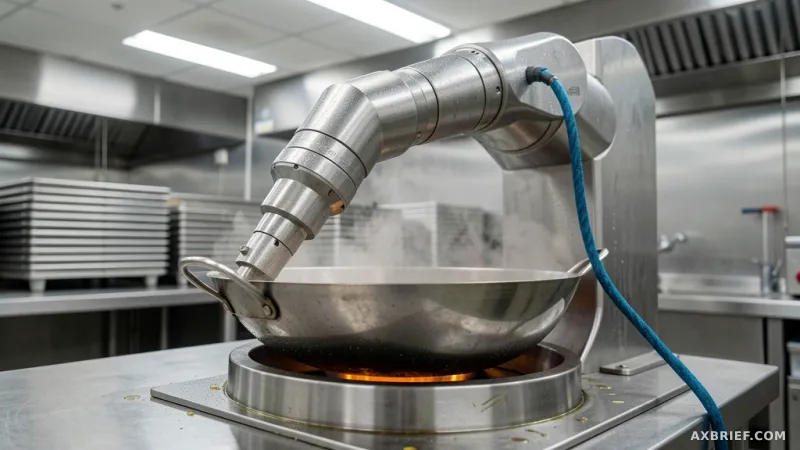
Industrial kitchens and large-scale catering facilities have long struggled with the human variable. In an environment where thousands of meals are served daily, the difference between a perfect dish and a mediocre one often comes down to the specific chef on shift or the subtle fluctuations in their mood and technique. This inconsistency is the primary friction point in scaling high-quality food services. While the industry has flirted with automation for years, most solutions focused on the mechanical ability to move a pan rather than the scientific ability to replicate a flavor profile. The conversation is now shifting from whether a robot can cook to whether a robot can guarantee the exact same taste across ten thousand plates.
The Architecture of the Q/ACPRJQR001-2026 Standard
To eliminate the variance inherent in human cooking, AICAN Group has introduced a rigorous corporate standard designated as Q/ACPRJQR001-2026. This is not a mere set of guidelines but a formal technical requirement document that governs the entire lifecycle of their cooking robots, from initial model coding and terminology to the final validation of the output. By quantifying the core technical indicators of culinary production, AICAN is attempting to turn the art of cooking into a predictable engineering process.
The standard organizes robot performance into eight distinct dimensions. These include precision temperature control, precision seasoning control, precision motion flow control, automated cleaning, smoke processing, energy efficiency, intelligent screen operation, and noise levels. By standardizing these metrics, the company ensures that every unit produced meets a baseline of industrial reliability regardless of the environment in which it is deployed.
To address different operational scales, AICAN has developed a tiered model lineup. The range begins with the ultra-small Tiansi, followed by the small Fusen, the medium Xiaoniu, and the large Yeniu. This scalability allows the technology to fit into diverse kitchen footprints while maintaining the same underlying logic. The foundation of this ecosystem is supported by a massive intellectual property portfolio, with AICAN Group holding 430 patents in the field of digital kitchen equipment. These patents specifically enable the intelligent temperature regulation and precision ingredient injection systems that make the Q/ACPRJQR001-2026 standard possible. The practical application of these standards is already visible in the real world, with these robots currently operational in the employee cafeterias of SINOPEC and GAC.
From Mechanical Motion to Quantitative Precision
For years, the benchmark for a successful cooking robot was visual. If the arm moved like a human and the food looked edible, the project was considered a success. However, AICAN is pivoting the definition of success toward quantitative reproducibility. The real innovation in the Q/ACPRJQR001-2026 standard lies in the narrow margins of error it allows, which effectively removes the concept of a bad batch from the kitchen.
Consistency begins with the raw materials. AICAN has set a strict limit on net weight deviation, requiring it to remain within 10% when repeating the same recipe. This ensures that the ratio of ingredients remains stable. Thermal management is handled with equal rigor. The internal temperature of the food must be maintained at 85 degrees Celsius or higher, while the temperature difference between any two points within the food must not exceed 10 degrees Celsius. This prevents the common industrial problem of food being burnt on the outside while remaining cold in the center.
The temporal precision of the robot is equally critical. The motion response time is capped at under 2 seconds, ensuring that ingredients are added at the exact millisecond required by the recipe to prevent overcooking or flavor loss. The wok temperature is controlled within a 5-degree Celsius deviation from the set point, a level of precision that is nearly impossible for a human chef to maintain manually over an eight-hour shift. Most importantly, the seasoning injection variance is kept under 8%, which is the primary driver of taste consistency.
Beyond the food itself, the standard addresses the operational environment. To ensure sustainability and workplace safety, power consumption during temperature maintenance is limited to 30% or less of the rated power. Noise levels are capped at 90dB to maintain a manageable acoustic environment in high-pressure kitchens. This shift in focus reveals a deeper insight into the evolution of Physical AI. The goal is no longer just to mimic human movement, but to exceed human precision through a strict adherence to numerical thresholds.
When the performance of a cooking robot is judged by the alignment of result values against a set of rigid numerical standards rather than the speed of its arms, the technology moves from being a novelty to being a reliable industrial tool. This transition marks the arrival of true Physical AI in the culinary space, where the quality of the output is a mathematical certainty rather than a culinary gamble.