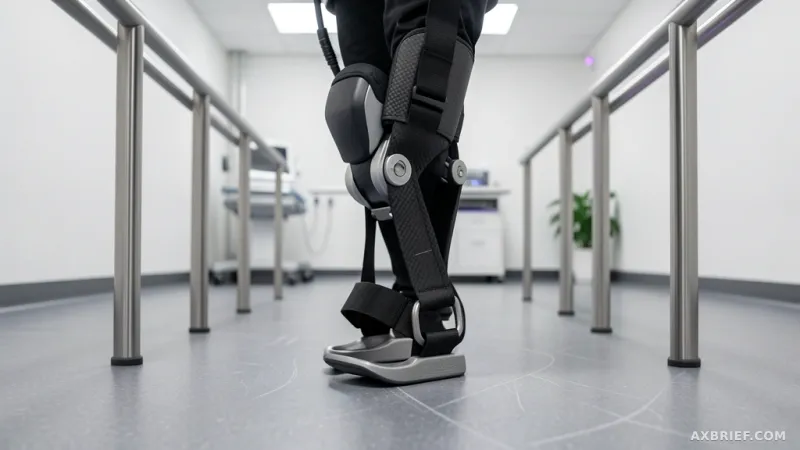
For a person living with tetraplegia, the world is often defined by the boundaries of a wheelchair and the limitations of a body that no longer responds to the mind. The gap between the intention to move and the physical execution of that movement is not just a medical failure but a profound loss of autonomy. While the tech world has spent the last few years obsessing over Large Language Models that can write code or generate art, a quieter, more visceral revolution is happening in the realm of physical AI, where the goal is to bridge the divide between human consciousness and robotic hardware.
The 23.5 Billion Won Blueprint for Neural Control
Angel Robotics has officially embarked on a massive undertaking to develop a full-stack Brain-to-Robot system, a project designed to translate neural signals directly into robotic movement. The scale of the ambition is reflected in the funding: a total project budget of 23.547 billion KRW. This financial engine is powered by a combination of 20.25 billion KRW in government grants and 3.32 billion KRW in private sector contributions. The timeline is equally rigorous, with the development cycle spanning from April 1, 2026, through December 31, 2032, representing a nearly seven-year commitment to solving one of the most complex challenges in biomedical engineering.
This is not a solo venture but a consortium of South Korea's most prestigious technical institutions. The project is managed by the Interministerial Medical Device Research and Development Program, with Angel Robotics leading a group of ten participating organizations, including the Korea Advanced Institute of Science and Technology (KAIST), the Seoul National University Research Foundation, and the Korea Testing Laboratory (KTL). For Angel Robotics specifically, the government has allocated 6.99 billion KRW in R&D funds, complemented by 2.33 billion KRW in private funding. This government support represents approximately 21.4% of the company's own equity, signaling a high level of institutional confidence in the company's ability to execute this vision.
Closing the Loop with Bidirectional Interfaces
Most existing brain-computer interfaces focus on a one-way street: reading a signal from the brain and turning it into a digital command. Angel Robotics is pursuing a more sophisticated architecture based on high-resolution intracortical electrodes. These electrodes are implanted directly beneath the brain's surface tissue to create a bidirectional neural interface. The technical distinction here is critical. The system does not simply decode intent; it creates a continuous loop of information exchange between the biological mind and the mechanical limb.
This architecture operates through two simultaneous processes: intent decoding and sensory encoding. Intent decoding translates the user's desire to move into precise robotic commands. Sensory encoding does the opposite, taking the external stimuli felt by the robot—such as the pressure of a foot hitting the floor or the tilt of a slope—and converting those signals back into neural impulses the brain can interpret. By mimicking the human motor control hierarchy—the sequence of brain, spinal cord, and muscle—the system aims to restore a natural sense of proprioception. The robot does not just move the patient; it becomes an extension of the patient's own nervous system.
However, the true bottleneck for this technology is not just the AI's ability to decode a signal, but the physical and legal reality of implantable hardware. The project places a heavy emphasis on internalizing high-reliability hardware technology and proactively establishing regulatory guidelines for implantable medical devices. The transition from a laboratory prototype to a clinical reality requires a level of hardware stability that can withstand the harsh environment of the human body for years without failure. The success of the Brain-to-Robot system depends less on the elegance of the code and more on the reliability of the electrodes and the ability to navigate the stringent safety certifications required for internal medical implants.
This shift toward integrated biological-robotic systems marks the end of the era of passive assistive devices and the beginning of true neural integration.