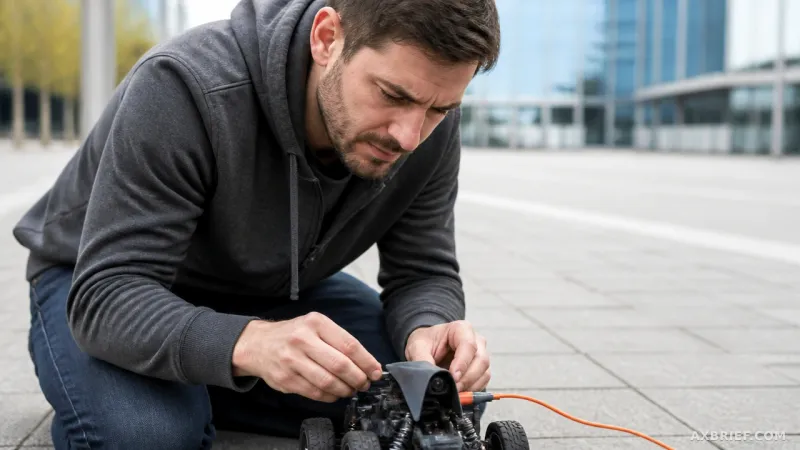
Every developer has faced the wall of dependency hell, where a critical library requires a kernel version that the hardware simply cannot support. In the world of embedded AI and robotics, this frustration is amplified when the manufacturer locks the firmware, effectively turning a powerful piece of hardware into a legacy brick the moment the official software support ends. For users of the AWS DeepRacer, this tension has been a constant struggle, as the desire to implement the latest reinforcement learning frameworks clashed with a rigid, closed-system architecture.
The End of the Software Lock
On January 26, 2026, AWS addressed this systemic bottleneck by releasing a developer bootloader and a self-managed solution for AWS DeepRacer. The AWS DeepRacer is a 1/18 scale autonomous racing car designed to teach reinforcement learning through trial and error. Until now, these devices operated under a strict security firmware regime that only executed operating systems signed by AWS. This restriction limited users to Ubuntu 16.04 and 20.04, both of which have reached the end of their primary support cycles. This software isolation meant that researchers and hobbyists were unable to leverage modern libraries, forcing a choice between using obsolete tools or replacing the hardware entirely.
By introducing the developer bootloader, AWS has shifted the device from a closed appliance to an open development platform. The new update allows developers to install custom-signed operating systems, effectively extending the hardware's lifecycle. This change enables the installation of the latest Linux distributions, the addition of custom hardware drivers, and the deployment of modern software stacks that were previously impossible to run on the device. This is not merely a version bump; it is a fundamental shift that allows for the prototyping of new vehicle algorithms and the creation of educational projects using the most current AI frameworks without the need for physical hardware upgrades.
The Shim Mechanism and the 21-Second Handshake
To achieve this openness without completely discarding security, AWS implemented a boot process based on the open-source shim project. A shim acts as a first-stage bootloader that facilitates the transition from the hardware's initial power-on state to the loading of the operating system kernel. The process begins with the bootloader attempting to verify the official AWS signature. If this verification fails, the system does not simply halt; instead, it redirects to a specific local path: `/EFI/DEVELOPER/certs/`.
If the system finds a developer-defined certificate at this location, it validates the custom kernel and proceeds with the boot sequence. This architecture maintains a secure chain of trust while providing a legitimate escape hatch for power users. To manage these certificates, AWS relies on industry-standard tools rather than proprietary software. Developers use OpenSSL for certificate generation and `sbsign` to apply digital signatures to executable files within the UEFI secure boot environment. The certificates themselves utilize the x509 DER format, a binary representation of public key infrastructure standards. By using `/EFI/DEVELOPER/certs/` as a local repository, developers can swap or update their certificates without compromising the underlying integrity of the boot chain.
This transition into developer mode is signaled through a unique hardware-level notification. Upon powering on, the bootloader uses the car's onboard lighting system to blink the phrase DEVELOPER MODE in Morse code. This visual sequence takes approximately 21 seconds to complete. For those with an HDMI monitor connected, a direct warning message appears on the screen. This 21-second window serves as a transparent security audit, informing the user whether the device is running in its factory-signed state or a custom developer environment before the bootloader hands over total control to the kernel.
Community Integration with Ubuntu 24.04 and ROS2 Jazzy
While the bootloader provides the capability, the deepracing.io community has provided the implementation. To spare developers from the tedious process of building a custom OS from scratch, the community has released a custom distribution based on Ubuntu 24.04 and ROS2 Jazzy. ROS2 Jazzy represents the latest evolution of the Robot Operating System, offering the core software stack required for modern robot control algorithms and high-performance libraries. This distribution allows users to bypass the limitations of the stock AWS environment and immediately apply state-of-the-art robotics research to their physical hardware.
To maximize the limited computational resources of the 1/18 scale car, the community distribution makes strategic trade-offs. It utilizes Cloudscape, an open-source design system from AWS, to provide a consistent and efficient user interface. More importantly, the distribution completely removes the X Window System. By stripping away the graphical windowing environment used for desktops and mice, the system frees up critical CPU and RAM resources, dedicating them entirely to real-time computation and vehicle control. Users who specifically require a desktop environment can still install one manually after the initial setup.
The installation process mirrors the existing AWS update workflow but replaces key boot files. Specifically, the `BOOTX64.EFI` file is replaced with the shim developer bootloader, and the operating system kernel is placed in the `GRUBX64.EFI` path. This allows the hardware to boot into a modern Linux environment without requiring any physical modifications to the circuitry. The complete source code and detailed installation guides are available via the GitHub repository, ensuring that even those unfamiliar with the intricacies of the UEFI boot process can upgrade their environment.
This community-led approach removes the friction of manual kernel reconfiguration and boot volume creation. Normally, a developer would need to manually encode certificates into the x509 DER format and configure the boot sequence. By providing a pre-packaged distribution, the community has shifted the developer's focus from environment troubleshooting to algorithm optimization. The result is a dramatic increase in development flexibility compared to the restrictive nature of the original factory settings.
End-to-End Flexibility and Hardware Longevity
The cost of hardware is a one-time expense, but software obsolescence is a recurring tax on productivity. By granting control over the internal software stack, AWS has enabled a truly end-to-end development pipeline. A researcher can now train a neural network in a cloud-based environment and deploy it to a physical device running the exact same version of ROS2 and Ubuntu, eliminating the version mismatch that often plagues the transition from simulation to reality.
Depending on their technical needs, users can now choose from three distinct paths. The first is the streamlined route: installing the Ubuntu 24.04 distribution from the GitHub repository for immediate access to modern tools. The second is the intermediate route: installing a third-party OS like standard Ubuntu and manually configuring the `BOOTX64.EFI` and `GRUBX64.EFI` files with custom certificates. The third is the advanced route: building a fully custom operating system from the ground up, optimizing everything from the hardware drivers to the kernel for a specific racing algorithm or educational project.
To mitigate the risk of bricking the device during these experiments, AWS maintains the Update Your Vehicle procedure. This recovery function allows users to wipe custom configurations and return the device to its factory-shipped state at any time. This safety net encourages aggressive experimentation with the software stack, as the risk of permanent hardware failure is removed.
By decoupling the hardware's utility from the manufacturer's software update schedule, AWS has effectively extended the physical life of the DeepRacer. The decision to use a specific library or a new version of ROS2 is no longer a question of whether the hardware supports it, but a technical choice made by the developer. The bottleneck has shifted from the firmware to the imagination of the researcher.
Developers can now align their research depth with the speed of the software ecosystem rather than the lifespan of a circuit board. By utilizing the developer bootloader to resolve dependency conflicts and transitioning to a modern stack, the constraints of the physical environment are finally removed.