
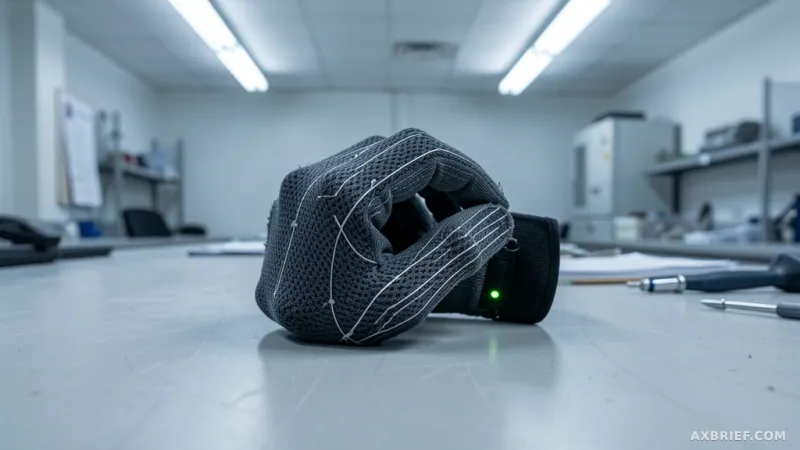
The current bottleneck in humanoid robotics is no longer just about motor torque or battery density, but the quality of the demonstration data. Engineers and AI researchers spend countless hours in the lab attempting to bridge the gap between human intuition and robotic execution, often fighting a losing battle against sensor drift and imprecise teleoperation. When training a robot to perform a task as simple as inserting a key into a lock or assembling a circuit board, a discrepancy of a few millimeters is the difference between a successful operation and a hardware failure. This struggle has turned high-fidelity data collection into the most expensive and time-consuming phase of the physical AI pipeline.
The Hardware Architecture of the Contact Glove 3 Pro
Melt Interface Technologies, the company formerly known as Diver-X, has introduced the Contact Glove 3 Pro to address this precision gap. Designed specifically for professional teleoperation and the collection of training data for AI, the glove focuses on extreme spatial accuracy. In recommended operating environments, the device achieves a median finger position error of 0.5mm, with a maximum error capped at 1.5mm. Orientation accuracy is similarly tight, recording a median error of 0.4 degrees and a maximum of 1 degree. These specifications allow the system to capture the minute nuances of finger-to-finger contact and complex assembly tasks with mathematical precision.
Beyond spatial accuracy, the device is built for the rigors of continuous industrial and research use. It maintains a communication latency of 30ms or less, ensuring that the lag between human movement and robotic response is nearly imperceptible. Power management is handled via a USB-C charging system, supporting 8 to 10 hours of continuous operation on a single charge. The Contact Glove 3 Pro is priced starting at 498,000 JPY, including tax, and is scheduled for commercial availability starting in October. To support a wide array of development pipelines, the company provides SDKs for C++, Python, ROS 2, Unity, Unreal Engine, and MotionBuilder, with full compatibility across Linux, macOS, and Windows operating systems.
From Relative Drift to Absolute Coordinate Truth
The critical distinction of the Contact Glove 3 Pro is not just the reduction of error, but the method used to achieve it. Most existing motion-capture gloves rely on relative positioning or inertial measurement units (IMUs) that calculate position based on change over time. This approach inevitably leads to drift, where small errors accumulate until the digital representation of the hand no longer matches the physical one, necessitating frequent and disruptive recalibrations. Melt Interface Technologies eliminates this failure point by employing Electromagnetic Field (EMF) technology to measure the three-dimensional position of fingertips and joints as absolute coordinates.
This shift from relative to absolute measurement transforms the glove from a simple controller into a high-precision data engine. For researchers developing Vision-Language-Action (VLA) models and imitation learning algorithms, the absence of drift means that the data collected is ground truth. When a human operator demonstrates a task, the VLA model receives a clean, stable stream of coordinates that do not shift over the course of a session. This directly reduces the cost and time associated with data cleaning and preprocessing. Instead of spending weeks filtering out noisy sensor data or correcting for drift, developers can feed high-fidelity hand-motion data directly into the training loop.
The implication is a fundamental shift in how robotic precision is calculated. By establishing a 0.5mm precision standard at the data collection stage, the industry can now quantify the efficiency of VLA model training based on the quality of the input. The hardware is no longer a peripheral; it is the primary variable in determining how quickly a humanoid robot can acquire a new manual skill.
The 0.5mm precision threshold now defines the new baseline for cost-effective VLA model training.



