The Shift Toward Portable Embodied AI
Industrial robotics is currently undergoing a significant transition, moving away from bulky, stationary platforms toward agile, human-portable systems. On the 22nd, DEEP Robotics officially unveiled the Lynx S10, a wheeled-legged robot designed to bridge the gap between high-performance industrial capability and the practical necessity of a compact form factor. As developers and facility managers look for ways to automate inspections in environments that are too tight or hazardous for traditional large-scale robots, the Lynx S10 arrives as a solution that fits into a single worker's carry, yet maintains the ruggedness required for field deployment.
Engineering Mobility in a 20kg Package
At the core of the Lynx S10 is a design philosophy that prioritizes power-to-weight efficiency. Weighing in at under 20kg including the battery, the unit is engineered for rapid deployment by a single operator. This portability is not merely a convenience; it is a functional requirement for navigating narrow industrial corridors, debris-filled disaster zones, and cramped utility tunnels where larger platforms would fail to maneuver.
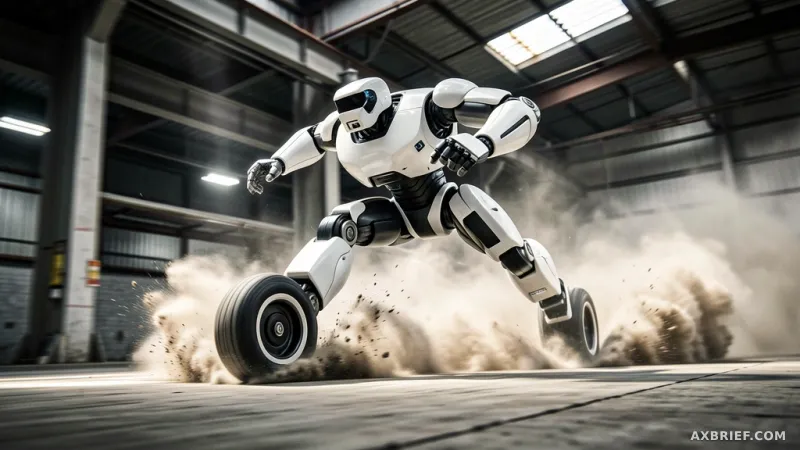
To achieve this, the robot utilizes 16 high-precision joints, each independently controlled by a next-generation AI motion control algorithm. This architecture allows the Lynx S10 to perform complex maneuvers, including standing on two legs and navigating uneven terrain with high stability. Despite its small stature, the robot reaches a top speed of 8m/s on flat surfaces and can clear obstacles up to 50cm in height. The hardware is built for longevity, with joints tested against high-frequency vibration and impact to ensure reliability during continuous operation.
Environmental Resilience and Protection
Industrial reliability is defined by the ability to function under duress, and the Lynx S10 is rated at IP66 for dust and water resistance. This rating ensures that the internal circuitry and drive components remain protected during heavy rain or in environments with high particulate matter. Furthermore, the operational temperature range of -20°C to 55°C allows the robot to handle both sub-zero winter conditions and high-heat, humid industrial settings. By meeting these standards, the platform minimizes maintenance downtime and reduces the total cost of ownership for industrial facilities that require consistent, year-round operation.
Advanced Perception and Sensor Fusion
Effective autonomy requires more than just mechanical movement; it demands high-fidelity environmental awareness. The Lynx S10 is equipped with a 3D perception architecture that combines four-way wide-angle HDR cameras with front and rear LiDAR sensors. The HDR cameras are specifically chosen to handle extreme lighting conditions, such as direct glare or deep shadows, which are common in industrial environments.
To prevent latency in decision-making, the robot features hardware-level time synchronization for all sensor data. By aligning timestamps at the hardware layer, the Lynx S10 ensures that the data fed into its path-planning and obstacle-avoidance algorithms is perfectly consistent. This synchronization allows the robot to react to its surroundings in real-time, enabling it to navigate complex, changing environments without the need for manual intervention.
Redefining Industrial Standards
The introduction of the Lynx S10 signals a move toward a new industry standard for lightweight, intelligent work platforms. By combining the speed and obstacle-clearing capabilities of larger robots with the mobility of a 20kg unit, DEEP Robotics is lowering the barrier to entry for deploying embodied AI in real-world scenarios. Whether for power grid inspections, security patrols, or emergency search and rescue, the platform provides a versatile tool that can be quickly transported to the point of need. As the industry continues to move toward autonomous, decentralized monitoring, the Lynx S10 demonstrates that high-performance robotics no longer requires a massive physical footprint.