For decades, the field of micro-robotics has been trapped in a frustrating paradox of scale. As engineers strive to shrink robots down to the size of insects or cells to perform delicate tasks, they hit a physical wall: the energy problem. Traditional propulsion requires motors, gears, and batteries, but as a robot shrinks, the volume available for power sources vanishes faster than the power requirements decrease. The result is a ceiling where robots are either too large to be useful in micro-environments or too power-hungry to operate independently. This week, the conversation shifted from how to shrink the battery to how to eliminate it entirely.
The Architecture of Sound-Driven Propulsion
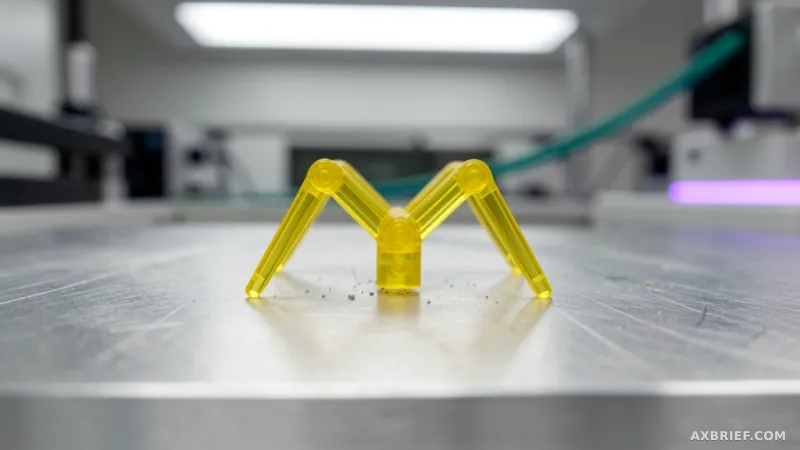
Researchers at EPFL (École Polytechnique Fédérale de Lausanne) within the MICROBS (MicroBioRobotic Systems) team have introduced a paradigm shift in micro-scale mobility. As detailed in their recent publication in Science Advances, the team has successfully implemented a flying vehicle weighing just 150 micrograms that operates without a single onboard power source. Instead of relying on internal electricity, the robot harvests energy from specific external sound frequencies, converting acoustic vibrations into physical, directional thrust.
This system functions as a wireless actuator, meaning it generates physical movement without any wired connection or internal circuitry. The core of the technology lies in a precisely engineered hollow structure, or cavity, that acts as a resonator. By removing the weight of batteries, wires, and traditional electronic controllers, the researchers have bypassed the energy density constraints that typically limit the size and duration of micro-robot missions. The scope of this propulsion system is remarkably flexible, scaling from centimeter-sized boats to the 150-microgram micro-fliers.
To achieve this, the team utilized 3D nanoprinting to create complex, bell-shaped internal geometries. These structures are crafted from various materials depending on the required application, including standard 3D-printed plastics for structural rigidity, elastic polymers for flexible movement, and transparent glass for visual verification of internal air vibrations. The geometry of the cavity—specifically its total volume and the cross-sectional area of its opening—is the primary variable that determines the robot's resonant frequency. When the external sound frequency matches the natural frequency of the cavity, the system reaches peak efficiency, maximizing the velocity and density of the resulting air jet.
From Passive Levitation to Active Propulsion
To understand why this is a breakthrough, one must distinguish it from acoustic levitation. For years, scientists have used standing sound waves to trap small particles in mid-air, but this is a passive process. In acoustic levitation, the object is essentially a prisoner of the sound wave, held in place by external forces. The EPFL robot, however, is an active agent. It does not simply sit in a wave; it consumes the sound energy to generate its own thrust, allowing it to move independently in a chosen direction.
This active movement is powered by the physics of Helmholtz resonance. This is the same phenomenon that occurs when someone blows across the top of a glass bottle, causing the air inside to vibrate at a specific frequency. In the MICROBS robot, external sound waves stimulate the air within the hollow cavity, causing it to oscillate rapidly. This oscillation creates a pressure imbalance. The air is expelled through the narrow opening as a concentrated jet, while the air flowing back into the cavity is dispersed and unfocused. Because the momentum of the exiting jet is significantly higher than that of the incoming air, a net force is created, pushing the robot in the opposite direction of the jet.
The application of this principle differs based on the medium and the goal. For water-based robots, the team used audible frequencies and tuned up to three different cavities to different frequencies. By modulating the external sound, they could trigger specific cavities to create steering and autonomous navigation. For the micro-fliers, the team shifted to ultrasonic frequencies, which are better suited for the vibration characteristics of air at a micro-scale.
These fliers operate in two distinct modes. The first is a direct-thrust model, where the cavity acts like a miniature rocket engine, pushing the craft upward through pure resonance. The second is a hybrid model that integrates the cavity with a small blade. In this configuration, the ultrasonic vibrations are converted into rotational energy, spinning the blade at speeds up to 13,000 RPM. This allows the robot to generate aerodynamic lift similar to a helicopter, providing significantly more stability and control than simple jet propulsion.
The Emergence of Robot Materials
By stripping away motors, gears, and magnets, the EPFL team has moved toward a concept known as robot materials. In this framework, the robot is no longer viewed as a collection of assembled parts, but as a single, intelligent substance where the geometry itself provides the functionality. The 3D nanoprinting process allows the entire structure to be printed as a single integrated unit, eliminating the mechanical play, friction, and wear-and-tear associated with traditional joints and assemblies.
This shift fundamentally changes the engineering workflow. Instead of calculating motor torque or gear ratios, developers now tune the robot by adjusting the diameter of a cavity or the curvature of an opening. This allows for extreme scalability and the potential for morphing robots. Because different structures within a single flexible body can be tuned to different frequencies, a single sound signal could trigger a sequence of movements—changing the robot's shape or direction—without needing a complex onboard computer or servo motors.
For practitioners in micro-robotics, this opens doors to environments where power cables are impossible and batteries are too heavy. In medical contexts, such as targeted drug delivery within blood vessels, a sound-driven robot could be steered from outside the body using ultrasonic transducers. In industrial settings, such as the inspection of semiconductor wafers, these robots could navigate the microscopic gaps of a fabrication plant, identifying defects without the risk of electrical interference or physical contamination from traditional probes.
Ultimately, the 150-microgram flier proves that the path to smaller robots is not through better batteries, but through the clever manipulation of the environment. By treating sound not as noise, but as a wireless power grid, the researchers have turned the air itself into the engine.