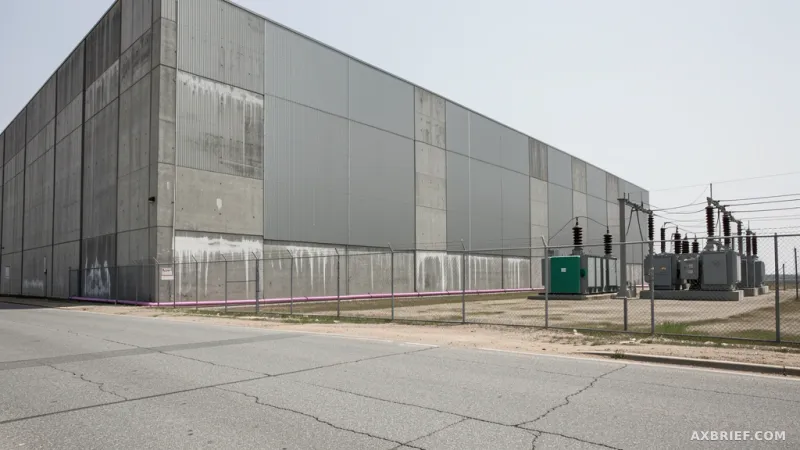
As global tech giants race to secure NVIDIA hardware, the control of computing resources has shifted from a mere operational advantage to a cornerstone of national sovereignty. France is responding to this geopolitical reality by executing an ambitious infrastructure strategy, centered on the construction of a 1.4GW AI campus and the deployment of 18,000 NVIDIA GB200 systems. This initiative represents a departure from fragmented corporate efforts, aiming instead to establish a state-backed AI factory that provides the foundational power and processing capacity necessary for a competitive domestic ecosystem.
Scaling the Infrastructure
Mistral has already taken the first step by establishing a 44MW data center in Bruyères-le-Châtel, where 18,000 NVIDIA GB200 systems are currently operational. This facility serves as the pilot for a broader European roadmap, which targets a total of 200MW in computing capacity by 2027. To achieve the larger 1.4GW vision, the French public investment bank Bpifrance has partnered with investment firm MGX and NVIDIA to launch 'Campus AI.' By centralizing these resources, the state aims to eliminate the prohibitive costs and power-grid challenges that typically prevent individual companies from accessing high-end AI hardware.
Engineering Efficiency and Supply Chains
Physical constraints, particularly power supply and cooling efficiency, remain the primary bottlenecks for modern AI clusters. To mitigate these, Scaleway has integrated NVIDIA Blackwell `B300-SXM` instances, which are optimized to maximize data throughput per watt. Simultaneously, the hardware supply chain has been localized through a collaboration between Bull and Foxconn. The companies have established a production pipeline for the NVIDIA Vera Rubin `NVL72`—a rack-scale system that functions as a single, massive accelerator. Components are manufactured and tested in Foxconn’s Czech facilities, while final assembly, integration, and performance validation occur at the Bull plant in Angers, France. Furthermore, Schneider Electric has collaborated with NVIDIA to publish design blueprints for gigawatt-scale AI factories, providing standardized guidelines for power grid architecture and precision cooling to accelerate deployment speeds for new facilities.
Industrial Adoption and Digital Twins
The impact of this infrastructure is already visible in the private sector. Orange Business has successfully deployed its Live Intelligence GenAI platform to 100,000 internal users, providing a secure, localized agentic AI solution that satisfies strict European data residency requirements. In the pharmaceutical sector, Sanofi is integrating AI agents across its entire value chain, partnering with firms like Owkin and Biolevate to accelerate drug discovery. Meanwhile, TotalEnergies is leveraging the Pangea 5 supercomputer to enhance seismic imaging and energy research. In manufacturing, Stellantis and Dassault Systèmes are utilizing the agentic 3DEXPERIENCE platform to implement digital twins, allowing for real-time operational decision-making based on live data, while L'Oréal is scaling global content production through its CreAltech platform.
Governance and Open Model Infrastructure
To reduce the burden of fine-tuning and operational costs, France is shifting toward a state-led open model infrastructure. NVIDIA Nemotron is being utilized as a standard tool to accelerate training-to-deployment workflows, minimizing developer friction. The strategy is evolving toward a 'continuous model infrastructure' where models autonomously curate data and generate synthetic environments for reinforcement learning. This open approach, managed by the AI Factory France (AI2F) initiative under GENCI, provides startups like Pleias, Nebula, and Ryax Technologies with access to the Jean Zay supercomputing resources. By prioritizing open models and energy-efficient infrastructure, France is building a governance framework that reduces reliance on closed-source APIs and ensures that organizations maintain full control over their AI systems.
France’s commitment to 1.4GW of power capacity and the mass deployment of GB200 systems provides the physical bedrock for European AI sovereignty. This state-led infrastructure effectively lowers the technical and financial barriers for enterprises, shifting the focus of AI competitiveness from individual model performance to the efficient utilization of large-scale, sovereign computing resources.