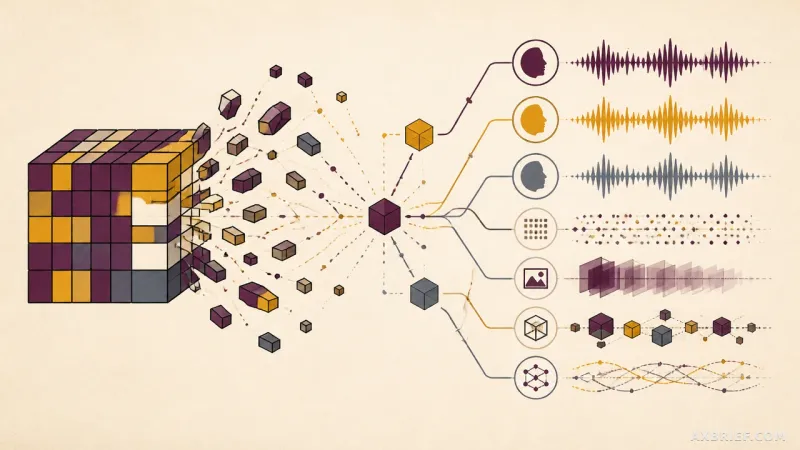
Every developer who has spent a late night wrestling with a prompt knows the frustration of the hallucination. You provide a clear instruction, the model seems to understand the context, and then it confidently asserts a fact that is entirely fictional. For a long time, this felt like a glitch in the matrix or a mysterious quirk of the AI's personality. But for those who look under the hood, these failures are not random. They are the predictable result of where the model sits in its architectural evolution. The transition from a raw sequence predictor to a reliable enterprise tool is not a single leap, but a series of five distinct engineering milestones that have redefined how machines process human language.
The Architecture of Intelligence and the Scale of Context
The foundation of every dominant model today, from GPT-4 and Claude to Llama and Gemini, is the Transformer architecture. Before the landmark Attention Is All You Need paper, the industry relied on Recurrent Neural Networks (RNNs) and Convolutional Neural Networks (CNNs). These older systems processed data sequentially, meaning they often forgot the beginning of a sentence by the time they reached the end. The Transformer changed this by introducing the self-attention mechanism. Instead of reading left-to-right, the model looks at every token in a sequence simultaneously, calculating a weighted importance for each. This allows the model to resolve complex linguistic dependencies, such as knowing exactly which noun a pronoun refers to, regardless of how many words separate them.
This process is powered by multi-head attention, where multiple attention heads capture different contextual features in parallel, ensuring that nuanced meanings are not lost. To maintain the order of words, positional encoding is used to inject numerical coordinates into the tokens. This structural shift enabled a phenomenon known as in-context learning. When GPT-3 arrived with 175 billion parameters, it demonstrated that a model could perform a task it was never explicitly trained for simply by seeing a few examples in the prompt. This removed the need for the traditional deep learning pipeline where developers had to collect tens of thousands of labeled examples and perform expensive fine-tuning for every new task. A single model could now pivot from translating French to writing Python code based solely on the input window, shifting the industry's focus from model training to prompt engineering.
The Bridge from Next-Token Prediction to Utility
Despite the power of the Transformer, a base model is essentially a sophisticated autocomplete engine. If you ask a base model to summarize a report, it might not summarize it at all; instead, it might imagine a second report that follows the first one, because its only goal is to predict the most probable next token based on internet data. This gap between probabilistic prediction and human intent is where alignment comes in. The first step is Supervised Fine-Tuning (SFT), where humans provide high-quality pairs of questions and ideal answers. This teaches the model the format of a helpful response, but SFT is limited by the sheer cost and time required to write perfect answers for every possible query.
To scale this, developers implemented Reinforcement Learning from Human Feedback (RLHF). Rather than writing answers, humans rank multiple model-generated responses from best to worst. This ranking data trains a reward model, a separate discriminator that learns to quantify what a human considers a safe, accurate, and helpful answer. The LLM then updates its weights to maximize the score it receives from this reward model. This is the precise moment a base model transforms into an assistant. It stops merely predicting text and starts following instructions.
However, the pursuit of intelligence also hit a wall of economics. The Scaling Laws revealed that model performance improves predictably as you increase parameters, data, and compute. While this justified the massive GPU clusters built by big tech, it created a sustainability crisis for enterprises. A company cannot realistically retrain a trillion-parameter model every time a corporate policy changes or a new product is released. This is why Retrieval-Augmented Generation (RAG) became the critical final piece of the puzzle. RAG decouples the reasoning engine from the knowledge base. By using a dense retriever based on vector similarity, the system finds relevant document snippets from an external index and feeds them into the prompt as a reference. The model no longer has to rely on its frozen internal weights for facts; it can read the provided text and synthesize an answer.
This architectural choice solves the hallucination problem by forcing the model to cite its sources. It allows businesses to maintain a state-of-the-art reasoning engine while keeping their proprietary data in a controllable, up-to-date index. The economic shift is profound: instead of spending millions on retraining, companies now spend their resources on data curation and retrieval precision.
The path to a production-ready AI follows a strict technical hierarchy. It begins with the Transformer's structural capacity, expands through scaling, is refined via alignment, and is finally grounded through RAG. Skipping any of these steps leads to failure; a RAG system built on a model with poor reasoning capabilities will still produce incoherent results. For the modern AI practitioner, the goal is no longer to find the biggest model, but to master the precision of the data connection and the control of the alignment layer.