For decades, the final stage of metal fabrication has been a bottleneck defined by a frustrating trade-off. Shop owners often find themselves trapped in an outsourcing cycle, sending their finished parts to third-party painting vendors because the cost of bringing automation in-house is prohibitive. The barrier is not just the price of the robot, but the crushing weight of the infrastructure required: dedicated paint cells, massive ventilation overhauls, and the need for specialized programmers who speak a language the average shop floor worker does not. This dependency means a fabricator loses control over their own delivery schedules, profit margins, and the final quality of the finish, leaving them at the mercy of a vendor's timeline.
The Convergence of Beacon and FANUC Hardware
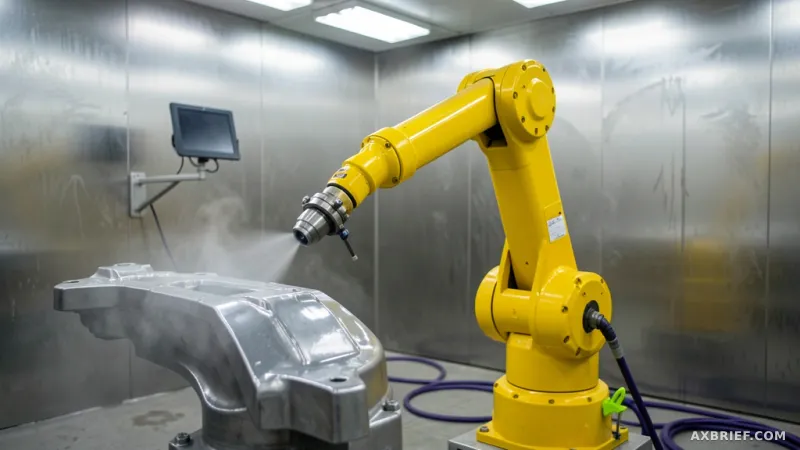
To break this cycle, Nashville-based Hier Robotics has partnered with FANUC to release the Cobot Painter. This solution integrates Hier Robotics' proprietary no-code platform, Beacon, with the FANUC CRX-10iA/L Paint, a specialized piece of explosion-proof hardware designed specifically for the volatile environments of industrial painting. Founded in 2015, Hier Robotics has already established a footprint in the metalworking industry by applying the Beacon platform to its Cobot Welder and Cobot Cutter lines. The Cobot Painter is the next evolution of this strategy, targeting manufacturers who deal with high-mix, low-volume production where traditional, rigid automation lines fail to be cost-effective.
According to Matt Bush, CEO of Hier Robotics, the goal was to marry world-class explosion-proof hardware with an interface that requires zero coding knowledge. The result is a system that allows welders and machinists to implement automation without spending months learning a proprietary programming language. By focusing on flexibility, the Cobot Painter addresses the specific needs of shops that cannot justify a multi-million dollar fixed automation line but can no longer rely on the inconsistency of manual spray work.
Removing the Robotics Expert from the Equation
The true shift in this technology is not the robotic arm itself, but the removal of the technical intermediary. Traditional industrial robots require a robotics engineer to write lines of code to define every coordinate, angle, and speed of the spray head. The Cobot Painter replaces this with a click-and-teach interface accessible via any tablet or smartphone. A worker simply guides the robot through the desired painting path once, and the system records the movement. The cobot then repeats that exact cycle with mechanical precision, maintaining the same speed, distance, and angle every single time.
This transition from text-based coding to physical guidance changes the power dynamic on the shop floor. Because the system is designed for users with no prior robotics experience, the dependence on external consultants or expensive in-house specialists vanishes. When a new part arrives or a painting path needs adjustment, the operator makes the change in minutes using the tablet, rather than waiting days for a programmer to update the script. This eliminates the quality variance that typically occurs between different human operators, ensuring a flawless finish that is repeatable across every unit.
Beyond the software, the hardware is built for the harsh realities of a paint booth. The FANUC CRX-10iA/L Paint features a working radius of 141.7cm and is certified for use with liquid paints, powder coatings, and gels. Because it is explosion-proof, it can operate safely around flammable materials without requiring the massive, isolated safety enclosures that usually define industrial paint cells. This allows the robot to be deployed directly into existing manual spray booths, utilizing the ventilation and space the shop already has.
By stripping away the need for dedicated cells and complex programming, Hier Robotics has compressed the deployment timeline from several months to just a few days. Dave Wagenhauser, Manager at FANUC America, notes that this system effectively brings the safety and precision of explosion-proof automation into the standard manual painting environment. For the small-to-medium enterprise, this means the ability to internalize the painting process, regain control over lead times, and stop the leak of profit to outsourcing partners.
While the current system focuses on stationary painting where the part remains fixed in the booth, the roadmap includes a significant expansion into dynamic environments. Hier Robotics plans to introduce line tracking capabilities in future versions, allowing the robot to follow parts moving along a conveyor belt in real-time. This will push the no-code philosophy beyond the static booth and into fully integrated, moving production lines, further lowering the barrier to entry for physical AI in manufacturing.