The modern healthcare landscape is currently facing a silent crisis where the demand for elderly care far outpaces the available human workforce. In many care facilities and private homes, the friction is not just a lack of hands, but a failure of communication. Most current AI assistants are trained on clean, standardized datasets, leaving them unable to comprehend the slow cadence, repetitive phrasing, or thick regional dialects common among the elderly. This gap in understanding often turns a promising technological tool into a source of frustration for the very people it is meant to serve.
The Dual-Track Approach to Physical AI
Holdtec has entered this space with a strategic two-pronged hardware rollout designed to bridge the gap between clinical rehabilitation and domestic companionship. The first pillar of this strategy is the GR-150, a specialized rehabilitation and mobility assistance robot developed in collaboration with West China Hospital of Sichuan University. Designed specifically for medical institutions and nursing homes, the GR-150 utilizes Simultaneous Localization and Mapping (SLAM) combined with multi-sensor fusion to navigate complex indoor environments autonomously. By mapping unfamiliar spaces in real-time, the robot provides critical mobility support for patients with limited movement. To ensure clinical viability, Holdtec is currently pursuing Class II medical device registration in China.
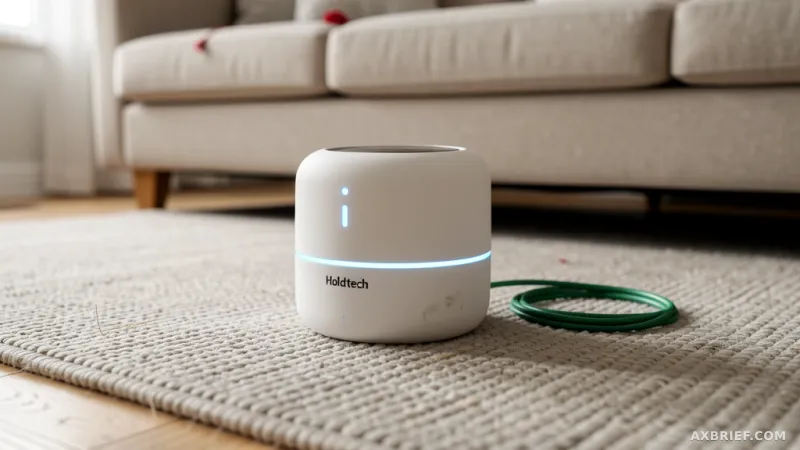
Parallel to the clinical GR-150 is a line of home-based care robots focused on safety and emotional stability. These units act as proactive guardians, detecting when a user returns home to offer vocal greetings and monitoring for nighttime falls or abnormal activity patterns that trigger emergency alerts. Beyond safety, the hardware integrates a dedicated screen for medication reminders and the playback of music and video, transforming the robot into a cognitive support hub that manages the daily logistics of aging in place.
Solving the Edge Cases of Human Communication
While the hardware provides the physical presence, the true differentiation lies in how Holdtec handles the nuance of human interaction. Standard voice recognition often collapses when faced with the linguistic idiosyncrasies of senior citizens. To solve this, Holdtec implemented a proprietary Natural Language Processing (NLP) engine specifically optimized for slow speech patterns, imprecise pronunciation, and the heavy use of regional dialects. By training the model to recognize repetition and non-standard syntax as meaningful communication rather than noise, the system maintains a continuous conversational flow that general-purpose AI typically lacks.
This specialization extends into the realm of health monitoring through a sophisticated sensor fusion of bio-radar and infrared technology. Unlike wearable trackers that require constant charging and user compliance, bio-radar uses radio waves to detect physiological movements without physical contact. This allows the system to perform non-invasive sleep apnea screenings and analyze Heart Rate Variability (HRV), sending immediate health warnings if anomalies are detected. The emotional intelligence of the robot is further augmented by a multimodal model that synthesizes voice emotion, text analysis, and the detection of micro-expressions. By analyzing fleeting facial changes alongside vocal tones, the robot can discern the user's actual emotional state, moving beyond simple keyword recognition to genuine affective computing.
Production is moving in phased increments to ensure reliability. Holdtec expects to finalize the product design by the third quarter of this year, followed by small-batch production in the fourth quarter. A transition to full-scale mass production is slated for next year.
The success of this ecosystem now depends on whether the precision of bio-radar and the adaptability of the dialect-optimized NLP can withstand the unpredictable variables of real-world home environments.