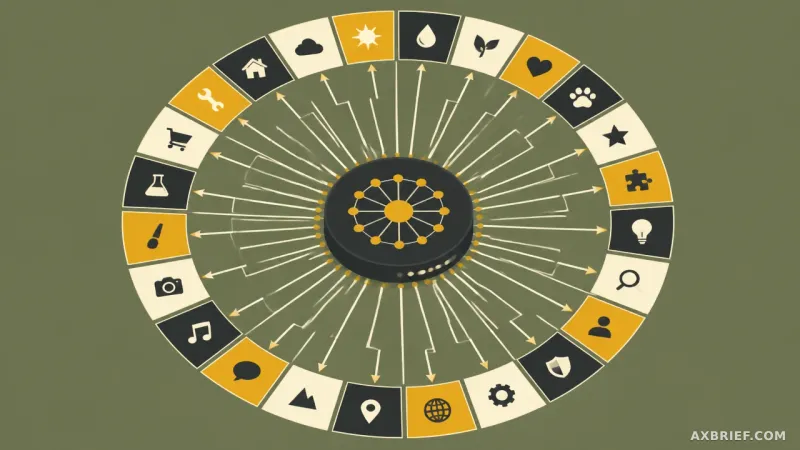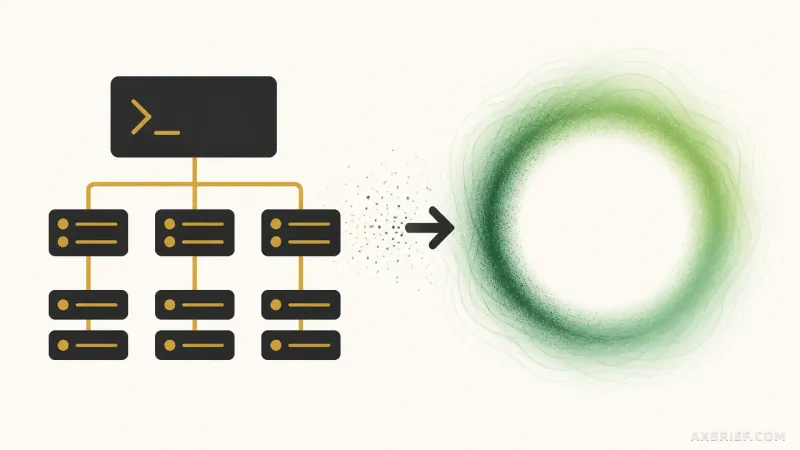
Developers building AI agents currently spend a disproportionate amount of time acting as manual switchboard operators. Every time a new capability is required, the workflow is the same: locate a Model Context Protocol (MCP) server address, open a configuration file, hardcode the URL, and restart the session. While this installation-first approach works for a handful of core tools, it collapses under the weight of a production environment where an agent might need to choose from thousands of specialized functions on the fly. The friction of manual plugin management has become the primary bottleneck in scaling agentic workflows.
The Architecture of Agentic Resource Discovery
To break this cycle of manual configuration, a coalition including Microsoft, Google, GoDaddy, and Hugging Face has developed the Agentic Resource Discovery (ARD) open standard. ARD is not a proprietary product or a closed marketplace, but a shared specification designed to allow agents to search for and utilize functions at runtime. The core of the standard relies on federated registries—distributed repositories where tools and agents are cataloged and indexed. Instead of requiring a tool to be pre-installed, ARD enables an agent to explore the ecosystem and call the necessary service the moment the need arises.
Hugging Face has integrated this standard directly into its Hub by leveraging its existing semantic search infrastructure. By applying an `agents=true` flag to Hub Space searches, the system generates results ranked by agent-oriented metadata. These search results are then converted into ARD catalog entries, effectively turning the Hugging Face Hub into a live directory of executable skills. This mirrors the way a human uses a web browser to find information, but applies it to the programmatic discovery of AI capabilities.
The implementation supports three distinct media types to ensure compatibility across different client requirements: `application/skill`, `application/mcp-server`, and `application/generic`. When a client requests `application/skill`, the Discover Tool performs an additional transformation by reading the `agents.md` file stored within a Space. This file contains the interaction logic and descriptions, which the tool then wraps in a front-matter format. This package includes the tool name, description, Space ID, Hub URL, app URL, and the original `agents.md` source URL, allowing any skill-aware client to load and execute the tool immediately.
For tools tagged as MCP servers, the adapter creates a catalog entry pointing to the Gradio MCP endpoint using HTTP transport. The system prioritizes the runtime domain provided by the Hub, falling back to the standard `.hf.space` slug convention if a dedicated domain is unavailable. This ensures that the connection between the agent and the tool is standardized and predictable, regardless of how the Space was deployed.
Moving Beyond the Context Window Trap
Until now, the industry's primary alternative to manual installation was the context-stuffing method. Developers would feed the descriptions of every available tool directly into the LLM's context window, hoping the model could select the right one. This approach creates a fundamental tension between scale and precision. As the number of tools increases, the context budget is consumed, and the model begins to suffer from the lost-in-the-middle phenomenon, where critical information is ignored in favor of the beginning or end of the prompt.
Even when developers implement a basic retrieval-augmented generation (RAG) layer to filter tools, the lack of structured metadata often leads to ambiguity. If two tools have similar natural language descriptions, the LLM frequently selects the wrong one, leading to execution errors and increased token costs. The failure point is that the tool selection process remains inside the LLM's reasoning loop, which is probabilistic rather than deterministic.
ARD solves this by decoupling tool discovery from the LLM's inference process. By moving the selection to an external registry, the system can index rich signals that go beyond simple descriptions, such as publisher identity, representative queries, compliance certifications, and specific tags. In an enterprise setting, this allows administrators to enforce strict controls, ensuring agents only discover and call tools that meet specific compliance proofs. The agent no longer guesses which tool to use based on a prompt; it queries a structured registry via a REST endpoint and receives a precise, validated resource.
This shifts the operational paradigm from a static catalog to intent-based discovery. The agent analyzes the user's requirement, performs a natural language search against the registry, and invokes the optimal tool in real-time. This removes the need to hardcode server addresses or maintain exhaustive lists of plugins, allowing the agent's capabilities to expand dynamically as new tools are published to the federated network.
Implementation and Technical Integration
For practitioners, the transition to a discovery-first workflow is handled through a set of standardized endpoints and CLI tools. Hugging Face has integrated these capabilities into the HF CLI, allowing developers to explore the ecosystem without leaving the terminal.
hf discoverThe global catalog is hosted at a standardized URL following the `.well-known` web convention, making it machine-readable and easily discoverable by any compliant agent:
`https://huggingface.co/.well-known/ai-catalog.json`
Beyond the CLI, the system is accessible via a REST API or by connecting an MCP client directly to the following endpoint:
`https://huggingface-hf-discover.hf.space/mcp`
This design ensures that the discovery and execution phases are entirely separate. Any client capable of standard HTTP REST communication can browse and acquire external functions without needing to install proprietary libraries. It essentially extends the reach of existing MCP clients by expanding their search horizon from a local config file to the entire Hugging Face Hub.
To facilitate interoperability between different service providers, ARD introduces three federation modes: `auto`, `referrals`, and `none`. These modes determine how a search in one registry can trigger a search in another, allowing an agent to aggregate tools from multiple hosting providers into a single session. This prevents the fragmentation of the AI ecosystem into isolated silos, as a single query can potentially surface a tool hosted on Hugging Face and another hosted on a private corporate registry.
Future updates will introduce support for static `ai-catalog.json` manifests within user and organizational profiles. This will allow Space publishers to publicly announce their capabilities via the standard well-known URI mechanism, creating a fully autonomous discovery loop. Organizations will be able to publish their internal toolsets in a standardized format, allowing authorized agents to recognize and utilize those tools automatically without a single line of configuration code.
The era of treating AI tools like software plugins—where installation must precede utility—is ending. By combining semantic search with the ARD standard, Hugging Face is turning the act of adding a capability into a simple search query.