For millions of stroke survivors, the journey back to walking is a grueling marathon of repetitive, exhausting movements. Traditional gait rehabilitation is often a slow process, relying heavily on the physical strength of therapists and the sheer willpower of patients who must fight against their own neurological deficits. In the developer and medical communities, the push for robotic assistance has long been the promised solution, yet the transition from laboratory prototypes to bedside standards has been stalled by the sheer bulk and rigidity of existing hardware.
The Strategic Alliance with RSPON
Hurotics has moved to bridge this gap by entering a formal partnership with the Rumah Sakit Pusat Otak Nasional (RSPON), Indonesia's premier national brain hospital. On the 10th, the two entities signed a Memorandum of Understanding (MOU) focused on clinical research and the evaluation of H-Medi, a wearable rehabilitation robot. This is not a mere pilot program; RSPON is a Type A national hospital operating under the Indonesian Ministry of Health. As a Type A institution, it serves as the apex of the country's neurological care hierarchy, responsible for establishing the national clinical guidelines and treatment protocols for brain-related disorders.
The partnership follows a successful medical showcase held in Indonesia late last month, where the H-Medi system demonstrated its utility to local practitioners. The response was immediate and tangible, resulting in an official invitation for Hurotics to present at major Indonesian medical conferences this coming July. Under the terms of the MOU, Hurotics and RSPON will conduct joint clinical studies to evaluate the efficacy of H-Medi in gait rehabilitation, using the hospital's high-volume patient base to validate the robot's impact on recovery timelines and patient outcomes.
Beyond Hardware: The Pivot to Systemic Integration
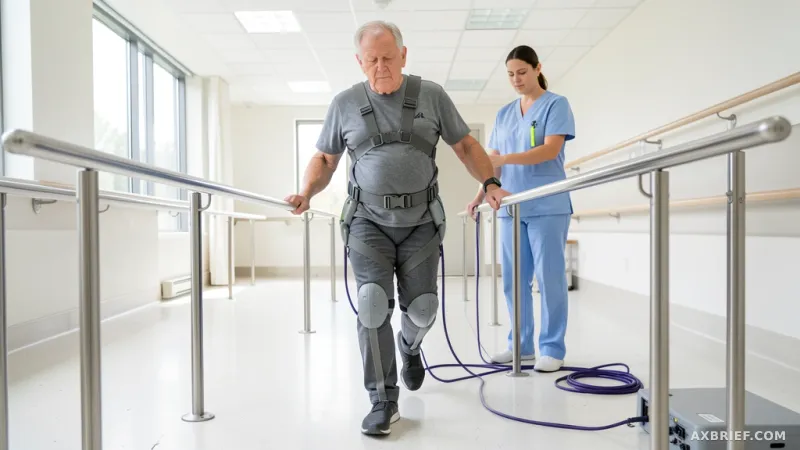
While the medical community often focuses on torque and battery life, the real tension in the wearable robotics market lies in the conflict between rigidity and autonomy. Most traditional exoskeletons utilize a rigid frame—essentially a wearable machine that forces the limb into a predetermined path. While effective for some, these heavy structures often create a psychological and physical burden for the patient, sometimes hindering the very neuroplasticity the therapy intends to trigger. Hurotics has pivoted away from this approach by implementing soft exosuit technology in the H-Medi. By utilizing flexible materials and actuators that induce voluntary movement rather than forcing it, the soft exosuit reduces the physical load on the user and encourages the patient to actively engage their own muscular system.
However, the most critical shift in Hurotics' strategy is not the move from rigid to soft hardware, but the move from product sales to institutional integration. The company is collaborating with RSPON to conduct research into medical reimbursement—the process of getting the government or insurance providers to assign a specific payment code to robotic rehabilitation. In the world of public healthcare, a device's technical specifications are secondary to its reimbursement status. If a treatment is not covered by the national health system, it remains a luxury tool for a few; if it is integrated into the medical fee schedule, it becomes the standard of care.
By targeting the reimbursement framework of a Type A national hospital, Hurotics is attempting to dismantle the primary institutional barrier that prevents Physical AI from scaling. The goal is to transform the H-Medi from a piece of advanced equipment into a public health utility, ensuring that the cost of robotic rehab is absorbed by the healthcare system rather than the patient.
This strategic maneuver suggests that the victory for Physical AI in the medical sector will not be won by the most powerful motor, but by the company that successfully navigates the bureaucracy of public health pricing.