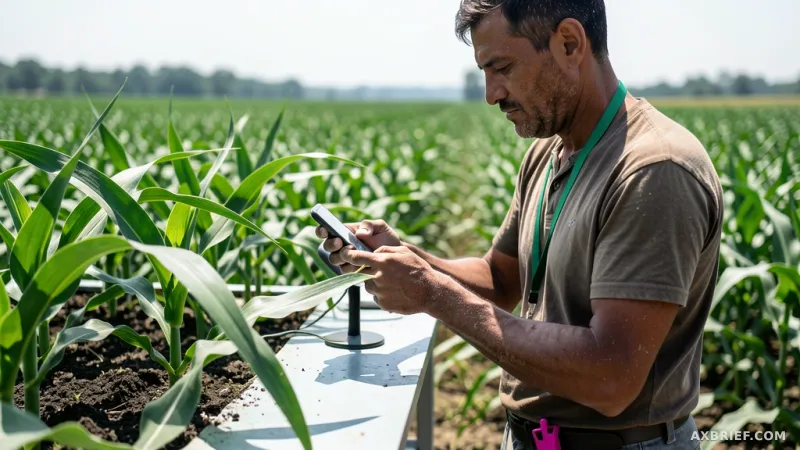
For generations, the primary tool for assessing crop health has been the farmer's own two feet. The daily ritual involves walking several kilometers across vast acreage, visually scanning leaves for discoloration or soil for dryness, and relying on intuition to decide where water or fertilizer is most needed. It is a grueling, manual process where a single missed patch of blight or a hidden irrigation leak can jeopardize an entire season's yield. This physical grind has remained largely unchanged until the introduction of satellite-driven intelligence, which is now shifting the burden of surveillance from the farmer's boots to the cloud.
The Architecture of Precision Agriculture
İmeceMobil, an AI-powered agricultural platform developed by a subsidiary of Turkey's İşbank, has transformed this manual labor into a data-driven operation. The platform currently serves 150,000 monthly active users (MAU), providing them with a high-resolution window into their fields via satellite image analysis. By combining orbital data with artificial intelligence, the system diagnoses crop health and moisture requirements in real time. Farmers no longer need to traverse every inch of their land to identify thirsty zones or nutrient deficiencies; instead, they receive precise coordinates of where intervention is required, reducing the average field inspection time from four hours to just 45 minutes.
Beyond basic diagnostics, the platform integrates a suite of hyperlocal weather alerts and expert agronomic advice. This precision is critical for chemical applications; for instance, certain fungicides must be applied immediately after rainfall to be effective. By utilizing hyper-local forecasts, farmers can time their return to the field with surgical precision, ensuring that expensive inputs are not wasted. The ecosystem extends into the commercial and financial realms as well, featuring a marketplace for comparing prices on machinery and fertilizers, and an integrated loan application system for both short-term and long-term agricultural financing. This creates a seamless loop where the farmer can diagnose a problem, purchase the solution, and secure the funding for it within a single interface.
The project began as a conceptual initiative in 2019, with the current production version launching three years ago. Since then, it has evolved from a simple monitoring tool into a comprehensive management system. By merging external satellite data with proprietary AI analysis models, İmeceMobil has established a benchmark for how cloud infrastructure can be used to eliminate physical labor and drive productivity in traditional industries.
The Leverage of Managed Services and Vertical AI
While many enterprises attempt to scale by aggressively hiring more engineers, the team behind İmeceMobil took a different path, prioritizing toolchain automation over headcount. The entire platform is built and maintained by a lean team of six: three developers, one manager who doubles as the architect, one testing specialist, and the CTO. To manage a user base of 150,000 with such a small staff, the team leaned heavily into a cloud-native environment powered by Microsoft Azure.
By utilizing Azure App Service, the team adopted a Platform as a Service (PaaS) model. This strategic choice allowed them to bypass the complexities of managing physical server hardware, operating system patches, and intricate network configurations. Instead of spending engineering hours on infrastructure maintenance, the team focused entirely on refining the service logic and AI models. The inherent scalability of Azure ensures that as traffic spikes during planting or harvest seasons, resources expand automatically, maintaining stability without requiring manual intervention from the small team.
Security for this massive data flow is handled through an enterprise-grade stack consisting of Microsoft Defender for Cloud and Microsoft Sentinel. Defender for Cloud manages data protection and privacy risks, while Sentinel provides real-time security monitoring across the entire system. Typically, these tools are reserved for large corporations with dedicated security operations centers. By integrating these managed services directly into their workflow, the six-person team effectively automated the role of a full-time security department, ensuring that farmer data remains private and the system remains resilient against threats without needing a resident security expert.
This technical efficiency translates into tangible survival for farmers facing environmental collapse. For farmer Oguzan Ozakar, the app is not just a convenience but a necessity. In his region, the groundwater table has plummeted from 150 meters in 2014 to 245 meters in 2017, and finally to 400 meters in 2024. As the water table drops, the electricity cost to pump water to the surface skyrockets. By using İmeceMobil to prevent over-irrigation and precisely track nitrogen needs, Ozakar has reduced his field inspection time by nearly 80% and minimized energy waste. Similarly, Yazberries, a blueberry operation, expects a harvest of 80 metric tons this summer, a result they attribute to the ability to remotely monitor irrigation systems and time fungicide applications via satellite views.
The broader implication of this model is the rise of Vertical AI—AI tailored to the specific constraints of a single industry. IDC predicts that AI investment in Turkey, the Middle East, and Africa will reach $14.6 billion by 2028, contributing to a global AI economic impact exceeding $19.9 trillion by 2030. The İmeceMobil case demonstrates that the highest value is created when AI is combined with domain-specific strategic interests. In this case, the synergy is between banking and farming. By providing farmers with tools to increase productivity, İşbank reduces the risk of loan defaults, as healthier crops lead to more reliable repayments. The bank is no longer just a lender; it is a productivity partner that uses AI to hedge its own financial risk while empowering the producer.
For AI practitioners, this highlights a critical shift: the competitive edge in the next era of AI will not come from the size of the model, but from the quality of the data pipeline. By connecting financial credit data with real-world crop production metrics, İmeceMobil has lowered the barrier to entry for a conservative industry. The success of the platform proves that when AI is injected into the core metrics of a physical industry, it ceases to be a digital novelty and becomes essential infrastructure.
The transition from a four-hour walk to a 45-minute data review is a signal that precision control has finally reached the field. By leveraging a sophisticated cloud stack to maintain a massive user base with a skeleton crew, İmeceMobil proves that the ability to select and orchestrate the right tools is more valuable than the size of the engineering team.