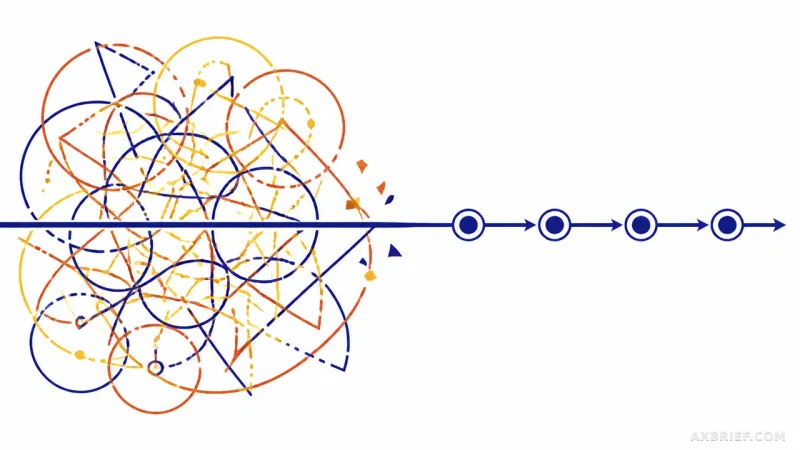
The modern social media feed has become a minefield of uncanny valley imagery and synthetic narratives. Users scrolling through short-form video platforms frequently encounter a specific brand of digital noise known as AI slop: hyper-realistic but soulless clips, repetitive patterns, and generated stories that lack any grounding in human experience. This saturation of synthetic content has created a tension between the efficiency of generative tools and the fundamental human desire for authentic connection. As the novelty of prompt-based creation wears off, platforms are beginning to realize that an infinite supply of effortless content actually diminishes the value of the attention economy.
The New Boundary Between Tool and Creator
Snapchat is drawing a hard line in the sand regarding how synthetic media interacts with its ecosystem. The company has announced that videos generated entirely by AI will no longer be eligible for recommendations within Spotlight, the platform's short-form video discovery service. More critically, the financial incentive structure is shifting, as fully AI-generated content will no longer receive monetary rewards. This policy change is a deliberate attempt to prioritize human creativity, original perspectives, and the raw value of personal storytelling over the algorithmic output of generative models.
However, the policy does not ban AI entirely. Snapchat is maintaining a clear distinction between generative creation and generative enhancement. Creators are still permitted to use AI tools for editing and refining content that was originally captured by a human. For instance, using AI to improve color grading, remove background noise, or perform detailed edits on a filmed sequence remains acceptable. The platform is not targeting the technology itself, but rather the absence of human intent. By separating technical generation from tool-based utility, Snapchat aims to ensure that the core of every recommended video is a real human experience, even if that experience was polished with a digital brush.
This shift fundamentally alters the economic calculus for creators. The strategy of using AI to mass-produce generic videos to farm rewards is now a dead end. Instead, the platform is forcing a transition toward a hybrid workflow where AI serves as a supportive layer to human-led production. By restricting the visibility and profitability of fully synthetic media, Snapchat is redefining the identity of its content feed as a place for genuine human interaction rather than a gallery for model outputs.
The Industry-Wide War on AI Slop
Snapchat's move is not an isolated incident but part of a systemic correction across the major social and professional networks. The industry is currently grappling with the realization that unchecked AI generation leads to a degradation of platform trust. LinkedIn has already responded to the surge of synthetic noise by introducing a reporting button specifically for AI slop, allowing users to flag low-quality, mass-generated posts. Similarly, Substack has implemented tools to help readers distinguish newsletters written by humans from those generated by AI, acknowledging that the value of a subscription is tied to the unique voice of the author.
This trend extends into the most lucrative corners of the creator economy. YouTube has tightened its monetization policies to target inauthentic content based on repetitive templates. The platform is specifically cracking down on low-quality AI content that mimics generic formats, with a particular focus on sensitive niches. AI personas providing advice on health or finance are now explicitly targeted for demonetization. The logic is simple: when AI replicates a template without expert human oversight, it creates a risk of misinformation and a decline in overall content quality that threatens the platform's viability.
Even Meta has had to retreat in the face of user backlash. Instagram previously introduced a feature that allowed users to modify photos from public accounts using AI, but the function was completely removed after users protested the distortion of original intent and the infringement of creative rights. This reversal highlights a critical friction point: while AI offers unprecedented convenience, it cannot override the user's desire for authenticity and ownership. When AI tools are used to overwrite human reality without consent, the resulting loss of trust outweighs any technical benefit.
Beyond content quality, platforms are also tightening the screws on safety and privacy to protect vulnerable demographics from the risks of an AI-saturated environment. Snapchat recently implemented a control mechanism for users aged 13 to 15, restricting their ability to share Spotlight posts to only those with whom they have a mutual follow relationship. This measure is designed to prevent doxxing and the unauthorized spread of personal information, recognizing that younger users are more susceptible to the viral nature of both AI-enhanced and human-generated content.
As the digital landscape shifts, the era of prompt-to-profit is rapidly closing. The current trajectory suggests a future where the most valuable asset on any platform is not the ability to generate content, but the ability to prove that a human was behind it.