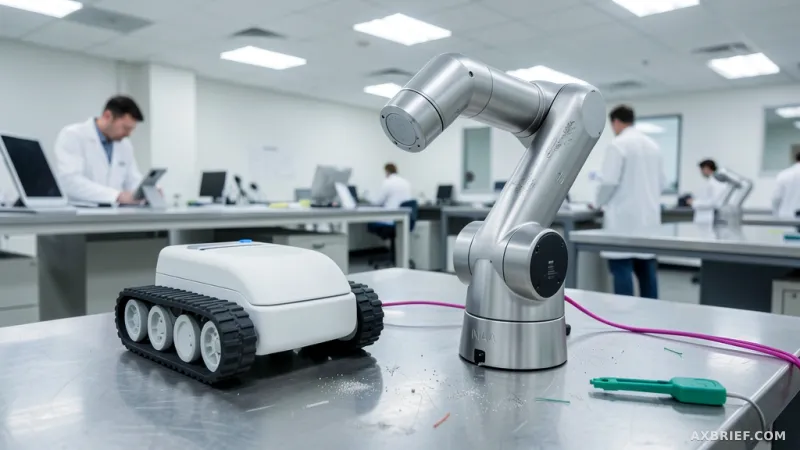
Industrial engineers often face a frustrating paradox when upgrading their facilities. The desire to automate is high, but the physical reality of the factory floor is uncompromising. In most existing plants, every square inch is already claimed by legacy machinery, leaving almost no room for the bulky footprints typically associated with industrial robotics. This friction between the need for modernization and the constraints of brownfield sites creates a significant barrier to entry for many firms.
The Blueprint for Low-Barrier Automation
To address these practical hurdles, INA Group hosted the INA Robotics Lab Day on June 19 at the INA Oriental Motor Seoul office. This event marked the second iteration of a regular series, following an initial session in January, designed specifically to bridge the gap between theoretical automation and on-site implementation. Approximately 20 industry professionals, selected through a pre-application process, participated in a structured three-stage program consisting of hands-on robot experiences, technical education, and personalized consulting.
A central component of the experience was the use of MRC Studio, a simulation software that allows engineers to virtually implement robot movements before committing to physical installation. Participants used this tool to test the operational flow of KOVR robots, reducing the risk associated with deploying hardware in cramped environments. The technical seminars provided a deep dive into specific application cases, complemented by a physical exhibition of the current robot lineup.
The hardware showcased spanned several specialized categories. The KOVR series from INA Oriental Motor is designed as a small, lightweight solution specifically for the narrow gaps between existing equipment. For the semiconductor industry, the JEL GTFR from the INA Tech & Co CORP division provides high-speed stability for transporting wafers, which are the thin circular disks used as substrates for integrated circuits. For tasks requiring human-robot interaction, INA MCT provided the Doosan Robotics M Series and A Series, which are collaborative robots designed for ease of use and safety in shared workspaces. Additionally, INA MCT presented its Linear Motion System (LMS), a system designed to move objects in a straight line across various logistics environments.
Beyond the lab day, INA Group is expanding its outreach through the 2026 Seminar Fair. This series of events will focus on the evolution of the automation industry and the integration of robotics with motion control. The seminars are scheduled for July in Seoul, Cheonan, Suwon, and Incheon, followed by sessions in September in Daejeon, Daegu, and Busan.
Shifting from Hardware Acquisition to Strategic Deployment
While many companies approach automation as a simple purchase of hardware, the INA Robotics Lab Day highlights a shift toward a selection matrix based on environmental constraints. The tension in modern automation is no longer about whether a robot can perform a task, but whether that robot can physically exist within the current workflow without requiring a total facility overhaul. By contrasting the KOVR's compact footprint with the high-speed precision of the JEL GTFR and the versatility of the Doosan cobots, the event forced a realization that the robot must fit the space, not the other way around.
The real value provided during the 1:1 consulting sessions was the establishment of a decision-making framework. Engineers were encouraged to evaluate their needs against three specific variables: the size of the installation space, the characteristics of the transport object (such as the fragility of a semiconductor wafer), and the available budget. This approach transforms the procurement process from a catalog search into a strategic deployment plan. When an engineer can simulate a movement in MRC Studio and then map it to a specific model like the LMS or a Doosan A Series based on these three variables, the perceived risk of automation drops significantly.
This methodology solves the primary pain point of the field engineer: the fear of installing an expensive system that ultimately fails due to a lack of clearance or an unforeseen stability issue during high-speed transport. By providing the tools to validate the fit before the purchase, the barrier to entry is lowered from a high-risk capital expenditure to a calculated operational upgrade.
The convergence of precise motion control and adaptable robotic forms is redefining the boundaries of the smart factory.