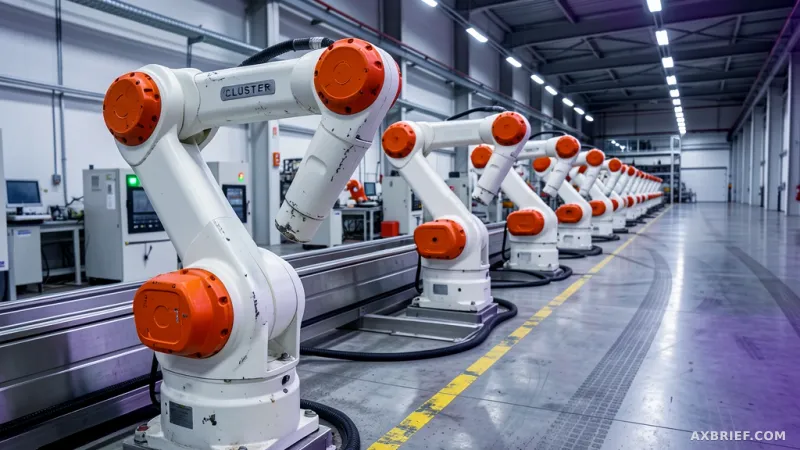
Across South Korea, regional governments are locked in a high-stakes race to attract robot factories and hardware infrastructure. Most cities are playing a volume game, competing to see who can lure the most manufacturing plants or build the largest industrial parks. However, a different philosophy is emerging in Incheon. Rather than chasing sheer quantity, the city is pivoting toward industrial efficiency and the integration of intelligence into the physical world, signaling a shift from simple robotics to what they term Physical AI.
The Efficiency Engine of Incheon's Robot Sector
On July 3, Incheon formalized this vision with the launch of the Incheon Robot Industry Innovation Strategy Council at Songdo Convensia. The move is backed by a striking disparity in the city's industrial data. According to the 2025 Incheon Robot Industry Survey, the city is home to 239 robot-related companies. While this represents only 9.5% of the total number of robot firms nationwide, these companies generate approximately 1.5 trillion KRW in revenue, accounting for 24.4% of the national total. This ratio suggests that Incheon's robot ecosystem is significantly more productive per entity than the national average.
To capitalize on this efficiency, Incheon is establishing a Physical AI Cluster, centered around the national project known as Incheon Robot Land. The city defines Physical AI as the fusion of virtual intelligence and physical entities, creating a system where AI does not just process data in a cloud but interacts meaningfully with the material world. The goal is to merge logistics infrastructure with a robust component ecosystem to directly accelerate corporate growth. To steer this transition, the newly formed council consists of 26 members, including six government officials and 20 experts spanning five critical domains: the robot industry, talent development, future city planning, cultural content, and robot entrepreneurship.
Beyond Hardware: The Logistics and Ecosystem Pivot
While other regional hubs like Daegu and Gyeongnam have focused heavily on attracting hardware-based facilities, Incheon is leveraging its unique geography to create a competitive moat. The city is not competing on the number of factories, but on the ease of movement and the quality of the surrounding environment. By utilizing the Incheon International Airport and Incheon Port as primary logistics gateways, the city aims to slash distribution costs and streamline the global supply chain for robot components.
This strategy is further supported by the residential and professional appeal of Cheongna International City, which helps solve the chronic talent acquisition problems facing robot firms in more remote industrial zones. The physical layout of the cluster is designed to connect the material, component, and equipment-dense regions of Seo-gu, Namdong-gu, and Yeonsu-gu. This creates a tight loop where core robot parts are supplied and assembled within a small geographic radius, maximizing operational efficiency.
This technical capability is currently being showcased through a series of exhibitions held from July 2 to July 5 in conjunction with RoboCup 2026 Incheon. Nine prominent robot companies are demonstrating their latest Physical AI integrations, including Now Robotics, The K-Bolt, Roboworks, Makeware, Brills, SPG, Yujin Robot, NRT, and Canebi Mobility. These firms represent the practical application of the cluster's goal: moving beyond the assembly of machines to the deployment of intelligent, autonomous systems integrated into the city's logistics fabric.
The ultimate success of the Physical AI Cluster will depend on whether Incheon can transform its logistical advantages into a seamless, organic infrastructure where parts and intelligence flow without friction.