
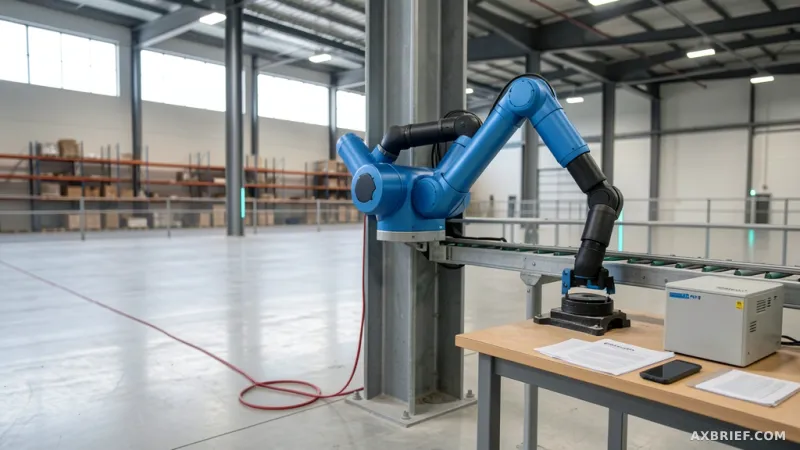
Walk into any traditional automotive plant or heavy-duty warehouse, and the first thing you notice is the steel. Massive yellow safety fences and interlocking cages define the geography of the floor, creating a hard border between the humans who manage the process and the industrial robots that execute it. These barriers are a necessary evil; when a robotic arm moves at high velocity, any human intrusion into its workspace is potentially fatal. For decades, the trade-off has been binary: you either choose the raw speed of industrial robotics behind a cage, or the slow, cautious pace of collaborative robots, known as cobots, that can share a room with people.
The Industrial Power of the MR-X
Mantis Robotics is attempting to collapse this dichotomy with the introduction of the MR-X, a biomimetic dual-arm robot designed to operate at industrial speeds without the need for physical partitioning. Unveiled at Automate 2026 between June 22 and June 25, the MR-X is not a tentative step toward collaboration but a high-performance machine. The robot boasts a maximum payload capacity of 31.7kg, allowing it to handle significant industrial components, and it can move at a staggering maximum speed of 10.6m/s.
This performance is not a standalone experiment but an evolution of the company's existing technical foundation. The MR-X builds upon the safety architecture of the MR-1, which already secured international safety certifications under ISO 10218 and ISO 13849. By scaling these certifications to a dual-arm configuration, Mantis Robotics has created a system capable of complex, high-speed tasks such as dual-arm assembly, rapid material transfer, and high-volume parcel sorting. According to CEO Jerry Banupellen, the MR-X is engineered to outperform both traditional cobots and emerging humanoid robots in the critical intersection of operational velocity and workplace safety.
The Shift from Barriers to Reflexes
The fundamental question facing any engineer is how a machine moving at 10.6m/s can be safely deployed next to a human without a steel wall. The answer lies in the Mantis SafetyCore, a proprietary platform that replaces static safety zones with a dynamic reflex system. Traditional safety systems rely on external sensors—like light curtains or laser scanners—that trigger a hard stop the moment a perimeter is breached. This results in costly downtime and a jerky, inefficient workflow where the robot is constantly freezing and restarting.
Mantis SafetyCore operates differently by treating safety as a real-time computational problem rather than a binary trigger. Instead of stopping the entire operation when a human enters its path, the MR-X uses the SafetyCore to perceive the environment and autonomously adjust its trajectory in milliseconds. It is a shift from a stop-and-go safety model to a fluid, reflexive model. This allows the robot to maintain industrial-grade speeds while ensuring that it never makes contact with a human operator, effectively digitizing the safety fence.
Beyond the hardware, the platform addresses the friction of deployment. The MR-X supports both fixed installations and mobile manipulator configurations, where the dual arms are mounted on a mobile platform for warehouse navigation. To further lower the barrier to entry, Mantis Robotics has implemented no-code programming. This allows floor managers to reconfigure the robot's behavior and operational settings to match changing logistics needs without writing a single line of code. The tension in the industry has long been between the cost of safety infrastructure and the need for speed; by moving the safety logic into the core software, the MR-X removes the infrastructure cost entirely.
The metric for successful robot deployment is no longer about how much floor space a safety cage consumes, but how quickly a high-speed system can be integrated into a human workspace.



