
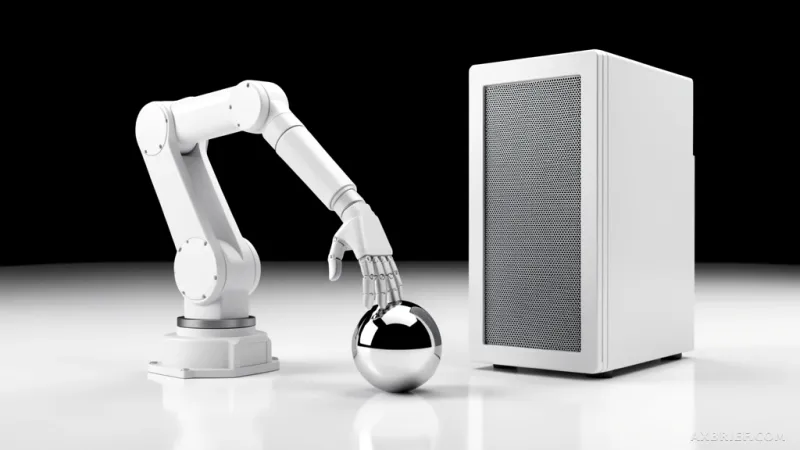
A platform engineer stands over a robotic assembly line, watching a high-speed actuator stutter. The AI model has already processed the sensor data and issued a stop command, but the machine continues to move for a fraction of a second too long. In the world of industrial automation, this micro-delay is not a mere glitch; it is a critical failure. When a robot is tasked with precision assembly or human-collaborative movement, the gap between a digital decision and a physical action can be the difference between a perfect weld and a catastrophic collision. This latency is the invisible wall that has long separated the intelligence of AI from the reliability of hardware.
The Integration of Intel Core Ultra Series 3 and Movensys
On May 29, at the Intel Edge Solution Summit 2026 in Taiwan, Movensys is set to demonstrate a technical breakthrough that addresses this exact bottleneck. Invited by Intel to showcase their capabilities on a global stage, Movensys, a specialist in software-based motion control, will present a real-time control architecture designed specifically for Physical AI. Physical AI refers to artificial intelligence that interacts directly with the physical environment, requiring a level of responsiveness that traditional cloud-based or distributed AI cannot provide.
The centerpiece of this demonstration is a single PC powered by the Intel Core Ultra Series 3 processor. Traditionally, the process of perceiving an environment, deciding on an action, and executing that action requires a chain of different hardware components. Movensys has engineered a way to collapse this chain. By leveraging the hardware acceleration and computational power of the Intel Core Ultra Series 3, the company has integrated the AI's decision-making process and the robot's execution logic into one unified hardware environment. This eliminates the need for data to travel across external networks or through separate controllers before reaching the motor.
This approach transforms the PC from a mere calculation engine into a real-time controller. In this setup, the AI's inference results are converted into hardware control signals internally and output immediately to the robot's actuators. For developers, this means the brain of the AI and the nervous system of the robot now operate on the same chipset. Detailed technical specifications and further information regarding this implementation are available via the Movensys official website.
Collapsing the Latency Gap and the End of Jitter
To understand why this integration is revolutionary, one must look at the inherent flaws of distributed control systems. In a conventional setup, the architecture is fragmented. A high-performance server runs the AI model, which analyzes camera feeds or sensor data. Once a decision is made, that command is sent over a network to a separate hardware controller, such as a Programmable Logic Controller (PLC), which then triggers the motor. Every step in this journey—from the server to the network switch, and from the switch to the PLC—introduces milliseconds of delay.
This delay creates what is known as the latency gap. In high-speed environments, a delay of even 0.1 seconds can lead to overshoot or collisions. Furthermore, these systems suffer from jitter, where the time it takes for a command to travel varies slightly from one cycle to the next. Jitter is the enemy of precision; it makes the robot's movement unpredictable and prevents the achievement of sub-millimeter accuracy during high-speed operations.
Movensys solves this by moving the entire control loop inside the Intel Core Ultra Series 3 PC. By removing the external network hops and the separate PLC, the communication distance is reduced to the internal bus of the processor. The software-based control technology ensures that the timing of these commands remains constant, effectively killing jitter. The result is a system where the AI's decision is translated into physical motion almost instantaneously. The transition from a distributed model to an integrated model means that the control loop cycle is significantly shortened, allowing the robot to react to external stimuli in true real-time.
From Hardware-Centric to Software-Defined Motion
For decades, the industrial world relied on dedicated hardware controllers because general-purpose PCs were not stable enough to guarantee real-time responses. The OS scheduling of a standard PC would often interrupt critical control tasks, leading to the aforementioned jitter. This forced companies to invest in expensive, proprietary PLC hardware to ensure safety and precision. However, the arrival of the Intel Core Ultra Series 3 marks a tipping point where the raw computational power and hardware acceleration of a single chip can now handle both high-load AI inference and precision motion control simultaneously.
This shift represents a move toward software-defined motion control. When the control logic is handled by software on a powerful general-purpose processor rather than being hard-coded into a dedicated controller, the entire system becomes more flexible. Developers can update AI models or change motion trajectories via software updates without needing to rewire hardware or replace expensive controllers. This reduces the Bill of Materials (BOM) for robot manufacturers and lowers the barrier to entry for deploying Physical AI in the field.
Moreover, the simplification of the hardware stack directly translates to higher operational efficiency. With fewer components to fail and a shorter path for data to travel, the reliability of the system increases. The ability to run AI and control on one device means that the robot can perform more complex tasks—such as adaptive grasping or real-time obstacle avoidance—with a level of fluidity that was previously impossible. The hardware is no longer a bottleneck; it has become an enabler.
The Global Validation of Software-Based Control
Intel's decision to invite Movensys to the Edge Solution Summit 2026 is a significant validation of the shift toward software-based motion control. By placing a Korean software firm at the center of its edge computing showcase, Intel is signaling that the future of robotics lies in the synergy between high-performance silicon and intelligent control software. The ability to execute Physical AI on a single PC proves that the industry is moving away from the rigid, hardware-heavy architectures of the past.
As AI continues to move from the screen into the physical world, the demand for zero-latency execution will only grow. Whether it is in autonomous warehouses, precision medical robotics, or advanced manufacturing, the goal is the same: the total synchronization of thought and action. By eliminating the time lag between the AI's brain and the robot's body, Movensys and Intel are providing the blueprint for the next generation of autonomous machines. The era of the separate controller is ending, replaced by a streamlined, integrated architecture where intelligence and motion are one and the same.



