For years, the industrial automation journey has been defined by a frustrating fragmentation. A factory manager identifies a need for automation and begins a two-pronged search: first, for a hardware vendor capable of providing reliable robotic arms, and second, for a system integrator who can actually make those arms function within a specific production line. This gap between the product and the implementation often leads to costly delays, communication breakdowns, and a misalignment between the robot's theoretical specifications and the reality of the factory floor. The industry has long accepted this friction as the cost of doing business, but the operational logic is shifting.
The Three-Pillar Infrastructure of NowRobotics
NowRobotics is attempting to erase this friction by consolidating the entire lifecycle of industrial robotics into a single, integrated infrastructure. The company recently announced the completion of its FA (Factory Automation) Center, marking the final piece of a strategic three-hub operational system. In total, NowRobotics now operates across a land area of approximately 21,488 square meters, or roughly 6,500 pyeong, creating a closed-loop ecosystem from research to deployment.
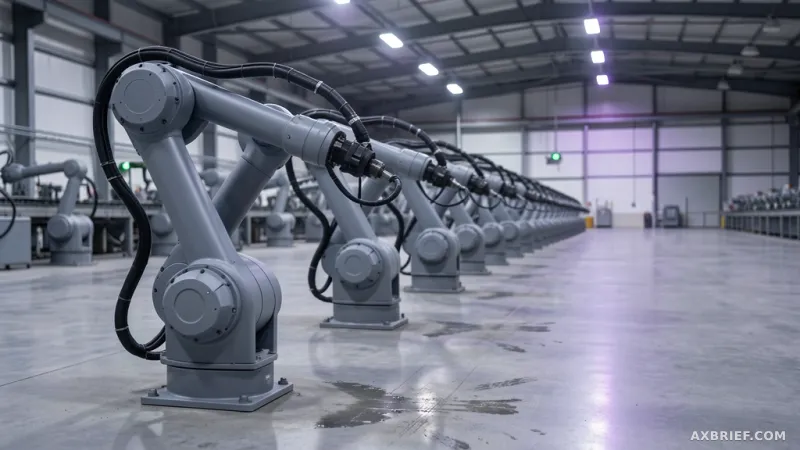
This system is divided into three specialized centers, each handling a distinct phase of the value chain. The Core Center serves as the intellectual engine, focusing on next-generation robot technology development, product planning, and core R&D. Once a concept is validated, it moves to the RM (Robot Manufacturing) Center. Spanning approximately 5,000 pyeong, the RM Center is the heavy-lifting arm of the company, dedicated to the actual manufacturing and mass production of industrial robots. Here, the company produces three primary categories of hardware: Cartesian robots for precise linear movement, SCARA robots for high-speed horizontal rotation, and articulated robots that mimic the multi-axis flexibility of a human arm.
The newly completed FA Center, covering about 1,000 pyeong, completes the circuit. This facility is dedicated exclusively to the design, fabrication, assembly, and execution of factory automation systems. Rather than simply shipping a robot and leaving the installation to a third party, the FA Center allows NowRobotics to design automation solutions tailored to the specific production environment of the client and execute large-scale projects internally.
From Hardware Vendor to Deployment Engine
On the surface, this looks like a simple expansion of real estate, but the strategic shift is deeper. The real tension in industrial robotics is not the lack of capable hardware, but the time it takes to move from a purchase order to a functioning production line. By linking the Core Center's development, the RM Center's mass production, and the FA Center's system integration, NowRobotics has effectively collapsed the supply chain.
In the traditional model, the hardware vendor and the system integrator operate with different incentives and different timelines. The vendor wants to sell a unit; the integrator wants to bill for hours of installation. When these two entities are separate, the risk of integration failure increases. NowRobotics removes this middleman by owning the entire process. The design team at the FA Center knows exactly how the robots from the RM Center are built, and the R&D team at the Core Center receives direct feedback from the FA Center's field installations to inform the next generation of hardware.
This integration transforms the company's value proposition. NowRobotics is no longer just selling a Cartesian or SCARA robot; it is selling a reduction in deployment time. For a manufacturer, the ability to source design, mass production, and system implementation from a single provider means that the window between deciding to automate and seeing a return on investment is significantly narrowed. The scale of the 21,488 square meter infrastructure is not just about capacity, but about the speed of response. When the design and the factory are under one roof, the iteration cycle for a custom automation solution drops from months to weeks.
As industrial automation becomes a necessity for survival rather than a luxury for the few, the criteria for choosing a partner are changing. The focus is shifting away from the individual specifications of a robot arm and toward the total capacity of the provider's supply chain. The ability to integrate the entire pipeline is now the primary determinant of how quickly a factory can modernize.
This consolidation of R&D, manufacturing, and system execution signals a move toward a more holistic, service-oriented approach to industrial robotics.