
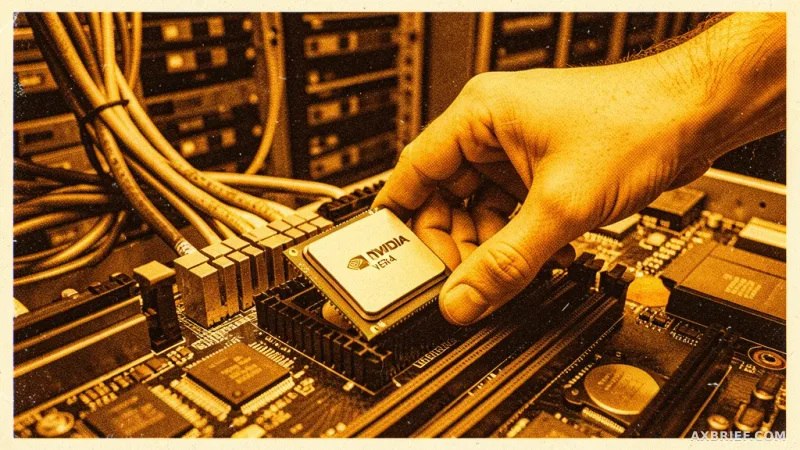
The modern data center is hitting a wall where traditional x86 architecture struggles to keep pace with the demands of agentic AI. As developers push for more complex sandbox environments and real-time tool orchestration, the bottleneck is no longer just raw compute, but the ability to move data efficiently. NVIDIA is now addressing this shift with the introduction of its Vera CPU, a processor built specifically to handle the high-concurrency, memory-intensive requirements of AI factories.
Hardware Specs: 88 Olympus Cores and LPDDR5X Efficiency
The NVIDIA Vera CPU centers on 88 custom Olympus cores integrated onto a single die, designed for full compatibility with the Armv9.2 instruction set. This architecture is purpose-built for the branch-prediction-heavy tasks inherent in agentic AI, such as executing code in isolated sandboxes and managing complex logic flows. By utilizing the 2nd Generation NVIDIA Scalable Coherency Fabric, the chip ensures consistent performance across all 88 cores, minimizing the latency that typically plagues large-scale orchestration tasks.
Efficiency is the defining characteristic of the Vera design. Operating within a 450W TDP, the CPU leverages an LPDDR5X memory subsystem to achieve a massive 1.2TB/s of memory bandwidth. This configuration is a significant departure from traditional server CPUs, which often consume over 100W just to manage memory. By keeping memory power consumption under 30W, Vera achieves a power-to-performance ratio that allows it to outperform 128-core x86 processors by 1.5x. In STREAM TRIAD benchmarks, the chip maintains 90% of its theoretical peak bandwidth, providing four times the memory bandwidth per core compared to standard x86 alternatives.
Parallel Processing for Agentic AI
Agentic AI requires constant, simultaneous interaction with tools and databases, making the 2nd Generation NVIDIA Scalable Coherency Fabric a critical component. This fabric manages the data flow between the 88 Olympus cores, preventing bottlenecks during sequential data processing or rapid sandbox code execution. Because Vera is designed as a monolithic die, it avoids the latency issues often found in chiplet-based designs, ensuring that branch prediction remains highly accurate even under heavy parallel loads.
This structural choice directly impacts the reliability of AI agents. In environments where an agent must call multiple tools and synthesize results in real-time, the consistency of response times is as important as raw speed. Vera’s architecture ensures that even as the number of parallel workloads increases, the memory latency remains stable. This predictability is what separates Vera from general-purpose CPUs, which often suffer from irregular response times when handling high-thread counts.
Benchmarking Against the x86 Standard
Recent testing via Phoronix highlights the generational leap Vera represents, showing a 1.6x performance improvement over the previous Grace CPU. When pitted against a 128-core x86 processor, Vera demonstrated a 1.5x performance advantage in overall throughput. In practical developer tasks, such as Linux kernel compilation, the single-socket Vera configuration outperformed the AMD EPYC 9575F by an average of 10%.
These results suggest that the non-x86 architecture is moving from a niche alternative to a viable mainstream contender for data center infrastructure. The combination of LPDDR5X memory and the Olympus core architecture allows Vera to maintain high efficiency without the need for the extreme clock speeds or power draw typical of the x86 ecosystem. For cloud providers and infrastructure managers, this provides a clear path to optimizing operational costs while increasing the density of their AI agent workloads.
Real-World Productivity and Infrastructure Impact
In practical Linux kernel compilation tests, Vera completed tasks in just 20 seconds, proving to be the fastest processor currently available for such data center workloads. On a per-core basis, it is twice as fast as 128-core x86 processors, a difference that fundamentally changes the productivity of CI/CD pipelines and AI agent runtime environments. Detailed technical specifications are available on the NVIDIA Vera official page.
As the industry prepares for the rollout of Vera in the second half of the year, the focus is shifting toward how these chips will integrate into existing data centers. With support for both air and liquid cooling, the hardware is designed to scale from high-density supercomputing centers to standard enterprise environments. By prioritizing memory bandwidth and power efficiency over traditional x86 scaling methods, NVIDIA is positioning Vera as the primary engine for the next generation of AI-driven infrastructure.



