OpenAI announced that it has solved the Navier-Stokes existence and smoothness problem, a mathematical challenge that had remained unsolved for 90 years, using its internal AI system. The results released this time demonstrate, through analytical proof and Lean formalization, that the Navier-Stokes equations, which govern fluid motion, can generate singularities within a finite amount of time. As one of the seven Millennium Prize Problems designated by the Clay Mathematics Institute, this achievement serves as an indicator of how far AI has progressed in the realms of complex scientific and mathematical reasoning.
Process of Deriving the Proof and System Scale
To solve this problem, OpenAI configured a multi-agent system based on an undisclosed internal model with performance superior to the existing GPT-6 Astra. Starting from September 1, approximately 10,000 concurrent agents were divided into groups to verify various hypotheses, collaborating through tools such as internet cache reading and code execution. In this process, the agents reached a solution to the Navier-Stokes problem on September 5, after approximately 88 hours, utilizing a total of 2.7 million messages and about 130 billion output tokens. Subsequently, Lean formalization and verification were conducted over 17 hours via GPT-6 Astra.
Core Content of the Proof and Physical Meaning
The derived proof deals with a vortex—a rotating fluid swirl—that spirals inward and stretches thinly. It proved that while the total energy remains finite as required by the laws of physics, a singularity occurs where the central region shrinks and the velocity increases infinitely. It mathematically established a detailed balance in which terms such as acceleration, pressure gradients, momentum transfer, and viscosity are precisely canceled out, maintaining a smooth external force even as the velocity grows infinitely.
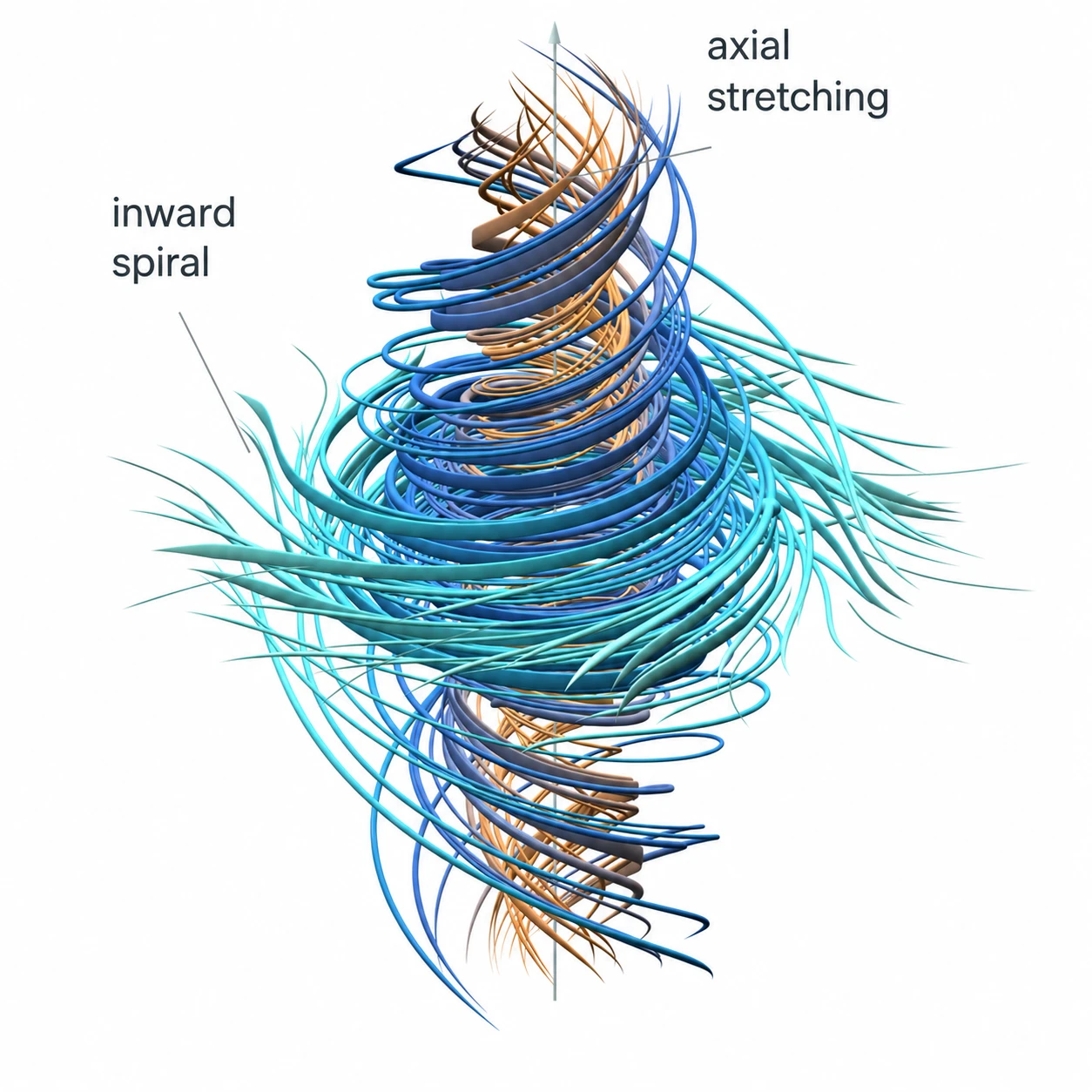
Image source: OpenAI