For many patients, the decision to undergo surgery is not merely a medical choice but a psychological battle against the fear of the aftermath. The prospect of permanent scarring and the grueling reality of long recovery periods often act as the primary deterrents to life-saving procedures. This tension between the necessity of intervention and the trauma of the incision has created a critical opening for a new generation of medical technology that seeks to remove the scalpel from the equation entirely.
The Capital Push for Non-Invasive Robotics
Petal Surgical has officially crossed the $25 million mark in cumulative funding, signaling strong investor confidence in the shift toward incisionless medicine. This milestone was reached following a funding round in March that pushed the company's total capital beyond the $25 million threshold. The trajectory of this growth was established last autumn when the company secured a $10 million Series A round led by Blue Pool Capital, which brought its total funding to $20 million at that time. The broader investment syndicate includes Salience Capital, A&E Investment, Time Ventures, and Actions Capital, formerly known as K50 Ventures.
The company is now deploying this capital to accelerate its research and development pipeline and finalize the rigorous preparations necessary for its first human clinical trials. The primary objective is to eliminate the pain and physical trauma associated with traditional incisions, thereby drastically reducing recovery times and improving patient outcomes. By focusing on the pre-clinical phase, Petal Surgical aims to prove that the removal of tissue can be achieved without breaking the skin.
From Mechanical Cutting to Physical AI
What separates Petal Surgical from traditional robotic surgery is the move from mechanical cutting to acoustic liquefaction. The company utilizes a technology called Millisecond Pulse Histotripsy, which employs high-intensity focused ultrasound to destroy tumors. Unlike traditional ultrasound, which might use heat to cauterize, this method creates vapor-filled cavities that physically disintegrate hard tissue into a liquid state. This process effectively turns a solid tumor into a fluid that the body can naturally absorb or clear.
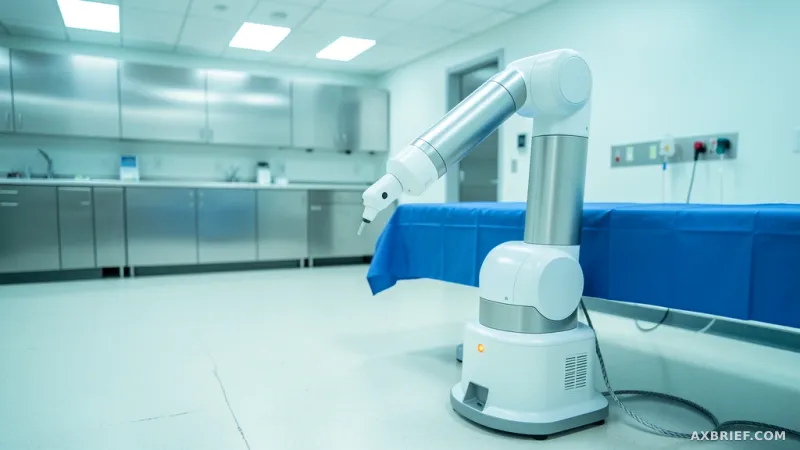
To achieve this, Petal Surgical has integrated robotics, real-time image processing, and AI-based control into a single architecture. This approach is conceptually similar to the Edison Histotripsy system developed by HistoSonics, but Petal Surgical is pushing the boundaries of Physical AI—artificial intelligence that interacts directly with the physical environment to execute precise movements. The system analyzes imaging data in real-time to control the exact location and intensity of the ultrasound pulses, ensuring that only the target tissue is affected while surrounding healthy organs remain untouched.
The pedigree behind the system adds significant weight to its viability. The design process involves some of the most influential names in surgical robotics, including Dr. Fred Moll, a co-founder of Intuitive, and Ronny Abovitz, the founder of Marco Surgical. By combining this industry expertise with Physical AI, the company is attempting to solve the problem of reproducibility. In traditional surgery, the outcome often depends on the tactile intuition and steady hand of the surgeon; here, the outcome depends on the mathematical precision of an AI-driven pulse.
The transition from the surgeon's fingertip to the AI's calculation marks a fundamental shift in how we define an operation. If Petal Surgical can prove the reproducibility of these ultrasound pulses in a clinical setting, the non-invasive approach could move from a niche alternative to the global standard of care.