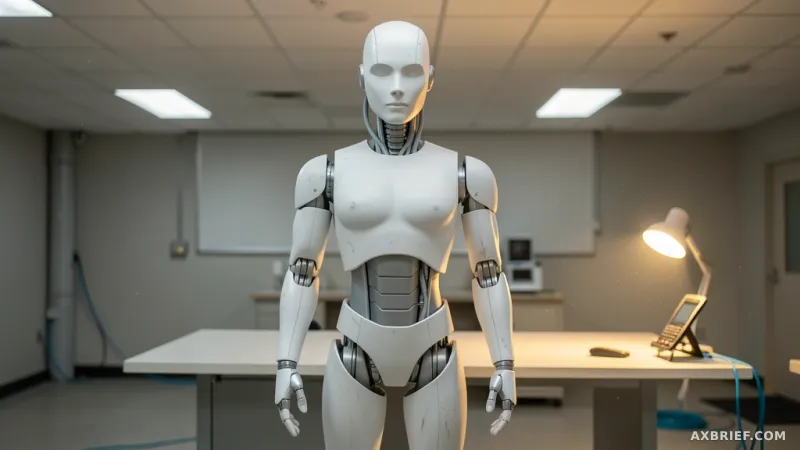
The current state of humanoid robotics is defined by a series of impressive, yet hollow, physical milestones. We have seen machines that can navigate complex terrains, manipulate delicate objects with precision, and mimic human gait with uncanny accuracy. Yet, for all their agility, these robots remain sophisticated puppets. They execute commands with mathematical precision but possess no internal narrative, no sense of continuity, and no understanding of their own existence within a space. The industry has largely treated the robot as a hardware problem to be solved with better servos and faster inference, leaving the ghost in the machine entirely absent.
The Architecture of Machine Identity
Dutch AI company RAI is attempting to bridge this gap by shifting the focus from physical execution to cognitive foundation. The company has announced the development of a machine intelligence system designed to provide humanoids with a persistent sense of self, which it plans to showcase at the World Robot Conference 2026. Rather than focusing on the mechanics of movement, RAI is building a cognitive layer based on four critical pillars: Memory, Identity, Beliefs, and Long-Term Development.
This framework allows a robot to do more than just process a stream of sensor data in real-time. By integrating a memory system, the robot can store individual experiences and retrieve them to inform future actions. The identity and belief components allow the machine to define its own state and establish a set of internal principles that govern its behavior. This creates a trajectory for long-term development, where the robot does not simply update its weights via a cloud server but evolves its intelligence based on its own lived history. Detailed technical specifications and the company's vision are available through the official RAI website.
From Physical Precision to Cognitive Utility
For years, the benchmark for a successful humanoid was its ability to perform a task without falling over. This era of Physical AI focused on the how: how to balance, how to grasp, and how to move from point A to point B. However, RAI is arguing that the industry has hit a plateau of utility because it ignored the why. A robot that can walk perfectly but does not understand its purpose or its relationship to its environment is merely a tool, limited by the specificity of its programming.
The shift RAI is proposing moves the value proposition of robotics from the hardware spec sheet to the cognitive architecture. When a robot possesses a belief system and a stable identity, its utility is no longer capped by the precision of its actuators. Instead, its value is derived from its ability to autonomously interpret its role and adapt its behavior based on a consistent internal identity. This means the difference between a machine that follows a script and an agent that understands its objective. The tension in modern robotics is no longer about who has the best motor control, but who can build a mind capable of sustaining a sense of self.
This transition suggests that the next frontier of machine intelligence will not be found in larger datasets or more powerful GPUs, but in the software layers that simulate the fundamental components of consciousness. The ability of a humanoid to function as a true partner in human environments depends entirely on whether it can maintain a coherent identity over time.