Facility managers at international airports and corporate headquarters often face a frustrating paradox. They possess the budget and the physical space for massive automation, yet their Chief Information Security Officers block the deployment of autonomous robots. The reason is rarely the robot's inability to clean a floor; rather, it is the robot's need to communicate with an external cloud. In environments where data leakage is a national security risk or a corporate catastrophe, a robot that sends mapping data to a remote server is not a tool, but a vulnerability. This invisible wall of IT security has long stalled the adoption of large-scale service robotics in the most critical infrastructures.
The Strategic Integration of the C55 Portfolio
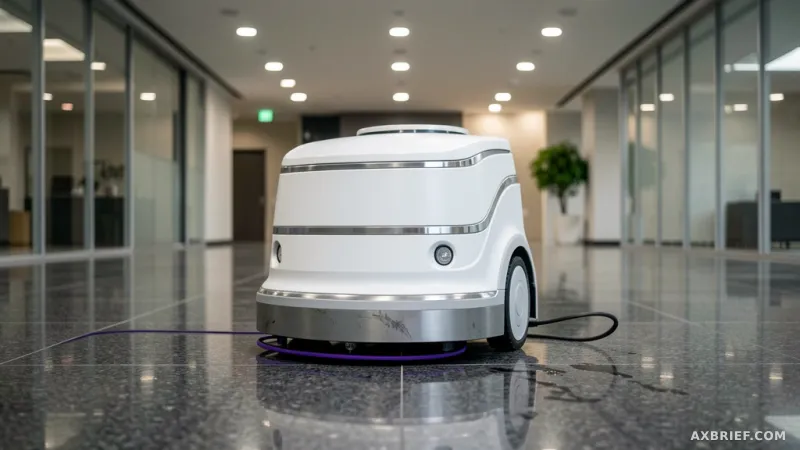
To dismantle this barrier, Rhinos has entered into a strategic partnership with global service robot leader Keenon Robotics, officially launching the C55 large-scale cleaning robot in the Korean market on June 29. This collaboration is not a simple distribution deal. It is a full-stack operational integration where Keenon Robotics provides the C55 hardware and core robotics technology, while Rhinos manages the entire domestic lifecycle. This includes business development, site-specific operational design, server architecture, security policy implementation, and long-term maintenance. The partnership was formalized during a visit by Keenon Robotics COO Wan Bin to the Rhinos headquarters, signaling a concerted effort to target high-security, large-area facilities such as railway stations, industrial complexes, logistics centers, and public institutions.
For Rhinos, the C55 represents the final piece of a comprehensive cleaning portfolio. Previously, the company expanded its market presence through the Wheelie brand, which focused on small and medium-sized robots tailored for commercial and educational spaces. By adding the C55, Rhinos now offers a scalable spectrum of hardware. While Wheelie handles tight corridors and complex foot-traffic patterns, the C55 is engineered for the grueling demands of expansive indoor floors. The robot employs a dual-action system of sweeping to remove debris and scrubbing to deep-clean surfaces using brushes and detergents. It operates via autonomous navigation, generating its own spatial maps and detecting obstacles in real-time to ensure uninterrupted service. Managers can monitor battery levels and current positioning via remote control, transforming the cleaning process from a manual chore into a managed data stream.
From Cleaning Tool to Secure IT Terminal
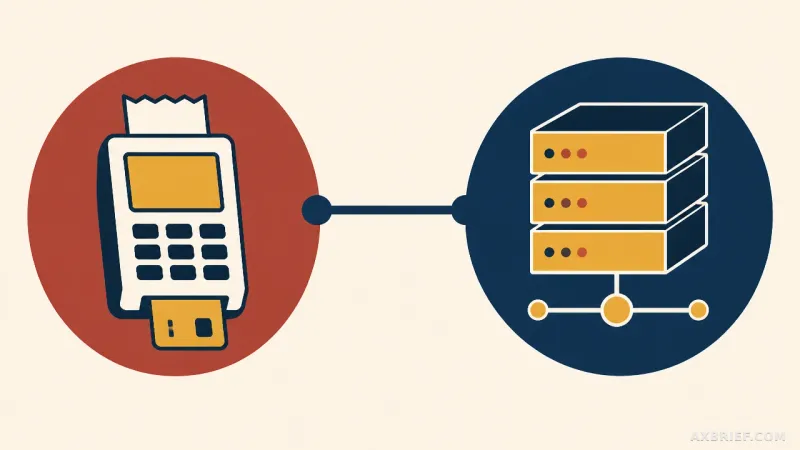
The true shift in the C55's value proposition lies in the transition from viewing a robot as a cleaning appliance to treating it as an IT terminal. Modern commercial robots are essentially mobile sensor arrays equipped with cameras, LiDAR, and operational logs. In a high-security environment, the question is no longer how well the robot scrubs the floor, but where the resulting map is stored, who has access to the user accounts, and how software updates are pushed. The tension exists between the need for remote efficiency and the requirement for total data isolation.
Rhinos resolves this tension by decoupling the robot's physical function from its data architecture. Instead of a one-size-fits-all cloud approach, they offer two distinct server models based on the client's security grade. For standard commercial enterprises, Rhinos provides a dedicated server model managed within Korea. This ensures that while the system remains efficient and manageable, the data stays within national borders and adheres to specific corporate access policies. However, for air-gapped facilities or those with strict closed-network requirements, Rhinos provides a full on-premise server solution. In this configuration, every piece of sensitive information—including spatial maps, operation logs, user permissions, and reporting data—is stored exclusively on the client's internal servers. By eliminating external cloud dependencies, the C55 becomes viable for research facilities and government installations where any external ping is a security breach.
This architectural flexibility is supported by a rigorous pre-deployment diagnostic process. Rhinos does not simply ship a unit; they analyze floor materials, contamination types, traffic patterns, and water supply infrastructure before the robot ever touches the ground. This ensures that the robot's operational parameters—such as cleaning frequency and administrator permissions—are baked into the facility's existing management system, maximizing the actual utilization rate of the hardware.
The success of deploying Physical AI in sensitive zones depends entirely on the alignment between the robot's server structure and the client's security policy. As Lee Dong-yeop, Director of the Rhinos Research Institute, notes, the final decision to deploy a robot in a secure zone is rarely about the hardware specifications, but about whether the server operation model satisfies the IT security department. By unifying the communication channel for both hardware failures and network conflicts, Rhinos and Keenon Robotics have created a support system where physical defects are handled by Keenon's technical expertise and network issues are resolved instantly by Rhinos on-site. This integrated approach transforms the C55 from a piece of machinery into a secure, manageable component of critical infrastructure.