For years, the barrier to deploying autonomous robots in real-world environments has been the sensor tax. To navigate a simple office or a warehouse, developers typically rely on a costly stack of LiDAR sensors, depth cameras, and multi-camera arrays that can drive hardware costs into the thousands of dollars. Even with this hardware, the process remains tedious, requiring engineers to spend days or weeks building precise digital maps of the environment before a robot can move a single inch without colliding with a wall. The industry has long accepted this trade-off, believing that precision measurement is the only way to ensure safety and reliability in indoor navigation.
The Architecture of Visual Reasoning
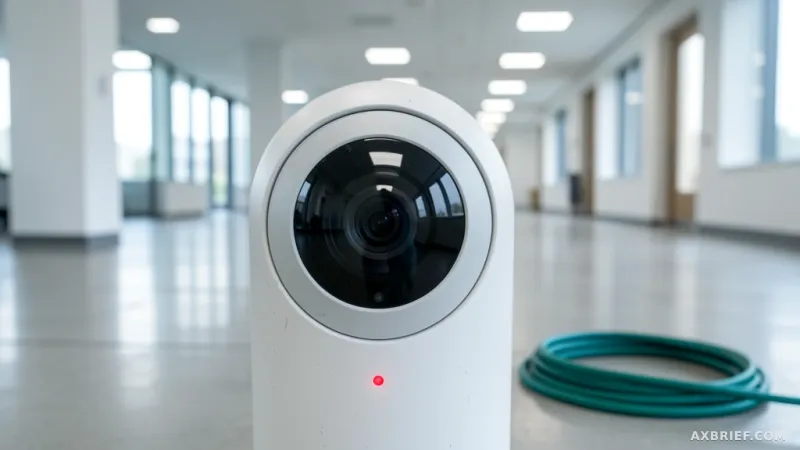
Mistral AI is challenging this hardware-centric paradigm with the release of Robostral Navigate. This new 8B parameter vision-language model (VLM) transforms how robots perceive and interact with their surroundings by replacing specialized sensors with a single, standard RGB camera. Instead of relying on laser-based distance measurements or pre-installed maps, Robostral Navigate processes raw visual data and natural language instructions to determine its path. A user can simply tell the robot to go to the kitchen, and the model analyzes the live video feed to identify landmarks and navigate toward the destination in real time.
By stripping away the need for LiDAR and depth cameras, Mistral AI has created a system that is agnostic to the robot's physical form. Whether the hardware is a wheeled delivery bot, a legged quadruped, or a flying drone, the underlying 8B model provides the necessary spatial intelligence. This reduction in hardware complexity does more than just lower the bill of materials for manufacturers; it eliminates the entire mapping phase of deployment. Robots equipped with Robostral Navigate can be dropped into an unfamiliar environment and begin operating immediately, as they generate their paths on the fly based on visual cues rather than a static coordinate system.
From Precise Measurement to Visual Intelligence
The most significant revelation of Robostral Navigate is that removing hardware does not necessarily mean sacrificing performance. In the robotics community, there is a persistent belief that a single camera is insufficient for complex navigation compared to multi-sensor fusion. However, the data from the Room-to-Room Continuous Environment (R2R-CE) benchmark suggests otherwise. In these tests, Robostral Navigate outperformed other single-camera models by 9.7 percentage points. More strikingly, it surpassed models that utilize depth sensors and multi-camera systems by 4.5 percentage points.
This performance leap is driven by the integration of pointing-based navigation and reinforcement learning (RL). Rather than simply matching pixels to a map, the model uses RL to learn from trial and error, optimizing its behavior based on the success of its movements. The twist here is a fundamental shift in the philosophy of robotics: the system is no longer trying to measure the world with millimeter precision; it is reasoning about the world visually. By treating navigation as a language and vision problem rather than a geometry problem, the model can handle the unpredictability of indoor environments more fluidly than a rigid LiDAR-based system.
This capability opens immediate doors for industries where deployment speed is critical. In logistics and hospitality, the ability to deploy a fleet of robots without first mapping every corridor of a hotel or warehouse represents a massive operational advantage. The bottleneck for autonomous scaling has shifted from the precision of the sensor to the efficiency of the visual inference.
Robotics is moving away from the era of expensive hardware dependencies and toward a future defined by embodied AI that sees and understands the world as humans do.