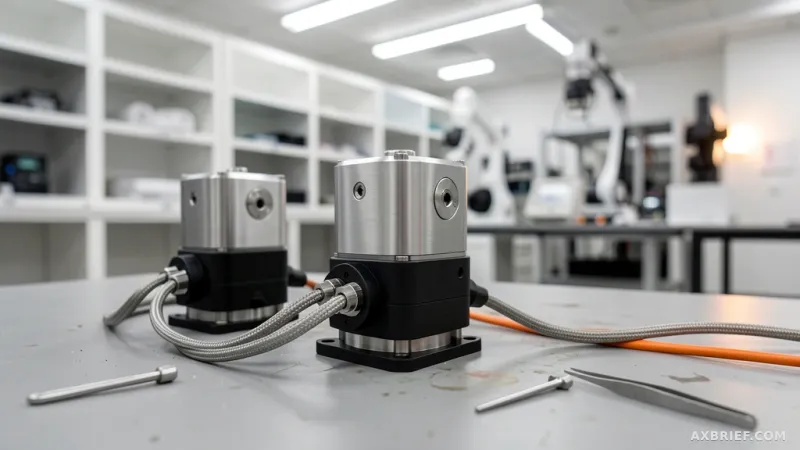
The race to build a functional humanoid robot has shifted from a software challenge to a brutal hardware bottleneck. While the world watches Tesla's Optimus and Figure AI demonstrate increasingly fluid movements, the industry is quietly grappling with a fundamental physics problem: how to pack immense torque, precision, and durability into a joint the size of a human wrist. For years, the gap between a laboratory prototype and a mass-produced machine has been the lack of a standardized, scalable actuator stack that can handle the diverse stresses of human-like motion.
The AXLON Full-Stack Hardware Strategy
On July 8, 2026, during its Marketing Communication Day, Samhyun addressed this bottleneck by unveiling AXLON, a dedicated brand of joint actuators designed specifically for humanoid robots. Rather than offering a single multipurpose motor, Samhyun has developed a comprehensive lineup of 12 different actuator models. This strategy allows humanoid manufacturers to select specific modules based on the anatomical requirements of different body parts, effectively creating a plug-and-play hardware ecosystem for robot OEMs.
To ensure these components could survive the rigors of real-world deployment, Samhyun subjected the lineup to over 20,000 hours of durability testing. The company has also secured 14 patents covering the core hardware architecture. This technical foundation is designed to facilitate immediate entry into the supply chains of top-tier North American Big Tech firms and robotics OEMs who are currently transitioning from small-batch prototypes to industrial-scale production. By providing a full stack of mass-producible joint modules, Samhyun is positioning itself as the primary hardware layer for the next generation of Physical AI.
Engineering the 3-in-1 Integration and Specialized Drive Logic
What separates AXLON from traditional robotic components is the shift toward a 3-in-1 integrated architecture. By fusing the motor, the reducer, and the controller into a single unit, Samhyun has significantly reduced the overall footprint and weight of the joints. This integration does more than save space; it increases torque density and sharpens control response times, which are critical for maintaining balance in bipedal robots.
The technical differentiation becomes clear when examining the specific series within the AXLON family. For rotary joints, the AXLON-I series splits into two distinct paths. The IH series utilizes harmonic reducers to achieve the extreme precision required for fine motor tasks, such as manipulating small objects. In contrast, the IP series employs planetary reducers to enable back-drivability, allowing the joint to yield naturally to external forces—a necessity for safety and fluid interaction in human environments.
Beyond standard rotation, Samhyun introduced specialized drive mechanisms to handle complex physics. The AXLON-O series implements a Quasi-Direct Drive (QDD) system. By lowering the gear ratio, this system allows the motor to respond almost instantaneously to external impacts, providing the high-fidelity torque control needed for dynamic stability. For the high-load requirements of the lower body, the AXLON-L series utilizes a reverse roller screw mechanism, converting rotational motion into powerful linear movement to support the robot's total weight during locomotion.
This hardware sophistication is backed by a manufacturing capability that mirrors the complexity of the product. Production is centralized in the Global Autonomous Manufacturing (AX) Factories at Plants 2 and 3. These facilities have achieved a 92% automation rate in their production processes. This level of automation ensures that Samhyun can scale from a few hundred units to thousands without the quality degradation typically associated with rapid scaling in precision robotics.
By internalizing the entire pipeline from design to mass production, Samhyun has removed the friction between engineering a high-performance joint and delivering it at scale. This infrastructure allows the company to meet the stringent precision and durability demands of North American tech giants who can no longer rely on artisanal hardware for their AI ambitions.
The industry is moving past the era of the experimental humanoid and into the era of the manufactured humanoid.