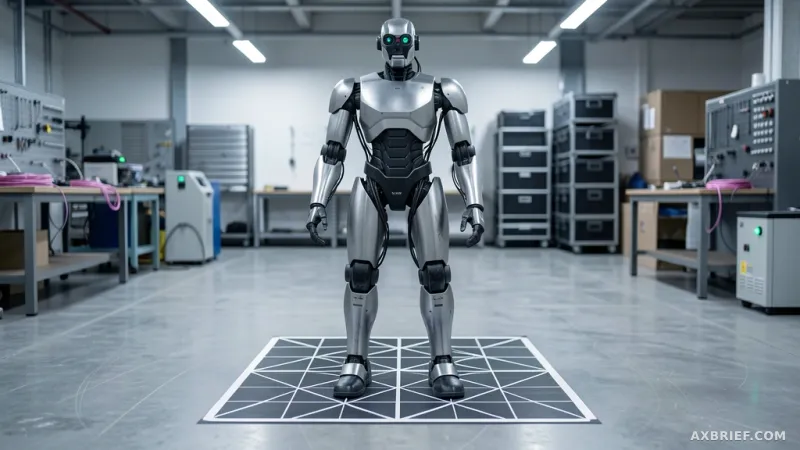
For years, humanoid robots have existed primarily as high-budget spectacles, confined to the sterile environments of research labs or the choreographed stages of tech exhibitions. They were curiosities—marvels of engineering that could wave a hand or walk a straight line, but lacked the autonomy to survive a chaotic factory floor or a cluttered living room. This week, however, the conversation shifted from demonstration to deployment. The era of the robot as a prop is ending, and the era of the robot as an industrial asset has begun.
The 3M Strategy and the M.AX Alliance
South Korea is moving to capitalize on this transition with an aggressive state-led offensive. During a public report meeting held at the Blue House Yeongbin-gwan, the Ministry of Trade, Industry and Energy unveiled a comprehensive roadmap to bridge the gap in the global AI robot market. The ambition is stark: the government intends to catapult its global humanoid robot market share from a mere 1 percent last year to 20 percent. This is not merely a growth target but a bid to establish the nation as one of the top three global powers in AI robotics.
To achieve this, the government introduced the 3M strategy, a tripartite framework consisting of M.AX (Manufacturing AI Transformation), Master (securing core element technologies), and Mass Production (establishing large-scale production systems). The first pillar, M.AX, focuses on creating a symbiotic relationship between Korea's existing manufacturing dominance and the emerging robotics sector. At the heart of this effort is the M.AX Alliance, a massive consortium comprising approximately 1,500 institutions across robotics, AI, and demand-side manufacturing.
Rather than pursuing general-purpose robots in a vacuum, the M.AX Alliance is tasked with developing specialized AI robots tailored to specific industrial sectors. The government has committed to deploying more than 1,000 of these specialized units into actual manufacturing sites every year. This approach transforms the factory floor into a living laboratory, allowing the state to move beyond theoretical simulations and gather real-world operational data to refine robot performance in real-time. By integrating AI robots into the production line, the government aims to push national manufacturing productivity to the top of the global rankings by 2030.
From Digital Intelligence to World Models
While the deployment of hardware is critical, the true bottleneck for humanoid robotics has always been the brain. Most current AI operates in a digital vacuum, processing text or pixels without any inherent understanding of gravity, friction, or spatial resistance. This is where the government's shift toward Physical AI becomes a strategic pivot. Physical AI refers to artificial intelligence capable of judging and moving within a physical environment autonomously. To power this, South Korea plans to develop a proprietary Physical AI foundation model within the next three years.
This foundation model is designed to allow robots to plan complex tasks and execute them with human-like autonomy. However, training such a model requires a volume of data that is nearly impossible to collect through manual operation alone. To solve this, the government is investing heavily in World Models. A World Model acts as a physics-based simulator capable of generating massive amounts of synthetic data. By creating a virtual environment that adheres to the laws of physics, the state can simulate millions of iterations of a task—such as grasping a fragile object or navigating a crowded warehouse—before the robot ever touches a physical surface.
This transition from fragmented data collection to a centralized, synthetic data infrastructure represents a fundamental change in strategy. By aggregating data across different ministries and industries, the government intends to build a full-stack Physical AI platform. This platform will not only serve the manufacturing sector but will extend into healthcare, agriculture, public safety, and national defense, eventually becoming a high-value export product.
Beyond the software, the government is addressing the hardware vulnerabilities that have historically left the industry dependent on foreign imports. The strategy targets the localization of three critical components: actuators, robot hands, and sensors. Actuators, which convert electrical energy into physical motion, are the muscles of the humanoid. By increasing the domestic production rate of these components, Korea aims to insulate its supply chain from external shocks and reduce the overall cost of robot production, making the final products more competitive on the global market.
To support this hardware push, the government is establishing ten industry-specific data factories. These facilities will specialize in producing and aggregating high-quality motion and situational data from actual industrial sites. This move is specifically designed to reduce reliance on foreign foundation models, which often carry risks of data leakage and may not be optimized for the unique nuances of Korean manufacturing processes.
The Infrastructure of Mass Production
Recognizing that China is already moving toward the mass production of humanoids, South Korea is accelerating its own industrialization timeline. The centerpiece of this effort is the creation of a robot foundry and component cluster in Saemangeum. This initiative, catalyzed by investments from the Hyundai Motor Group, is designed to create a one-stop system that spans from initial design to final assembly.
By establishing a robot foundry—a contract manufacturing facility that produces robots based on external designs—the government aims to lower the barrier to entry for small and medium-sized enterprises (SMEs). These companies can now develop innovative robot designs without the crushing capital expenditure required to build their own factories. Simultaneously, the government is supporting automotive and home appliance component manufacturers in the Daegu-Gyeongbuk region to pivot their expertise toward robotics, ensuring a steady supply of specialized parts.
This industrial shift is being paired with a massive investment in human capital. The government has selected specialized graduate schools to train 10,000 AI robot experts over the next five years and aims to nurture at least 30 specialized firms capable of sophisticated model design and data management. To ensure these robots have a market upon arrival, the state will act as the first customer, implementing a demand-creation strategy by purchasing robots for use in education, national defense, and disaster response.
Financial support will be funneled through the National Growth Fund, providing the necessary capital for companies to scale their operations from the R&D phase to full-scale mass production. This integrated approach—combining synthetic data, localized hardware, and state-backed procurement—is designed to turn the theoretical promise of Physical AI into a tangible industrial reality.
The success of this roadmap depends on whether a state-led alliance can move faster than the fragmented, venture-backed labs of Silicon Valley.