
The modern factory floor is often a place of immense potential stalled by administrative friction. For most operations managers, the path to automation begins not with a robot, but with a series of frustrating delays. They identify a bottleneck in their palletizing line, contact a specialized engineering firm, and then enter a weeks-long waiting period for initial quotes and preliminary CAD drawings. This dependency on external experts creates a high barrier to entry, where the cost of the design phase and the risk of miscommunication often outweigh the perceived benefits of the hardware itself.
The Architecture of Autonomous Design
To dismantle this bottleneck, igus is introducing the RBTX Machine Planner and the Fairino FR20 palletizing collaborative robot. These solutions will be showcased at Automate 2026, taking place in Chicago from June 22 to June 25. The centerpiece of this ecosystem is the RBTX Machine Planner, a 3D web-based online configurator that shifts the power of machine design from the consultant to the end-user. By utilizing a library of verified machine templates and compatible components within the RBTX online marketplace, users can specify their requirements and build a complete automation system directly in their browser.
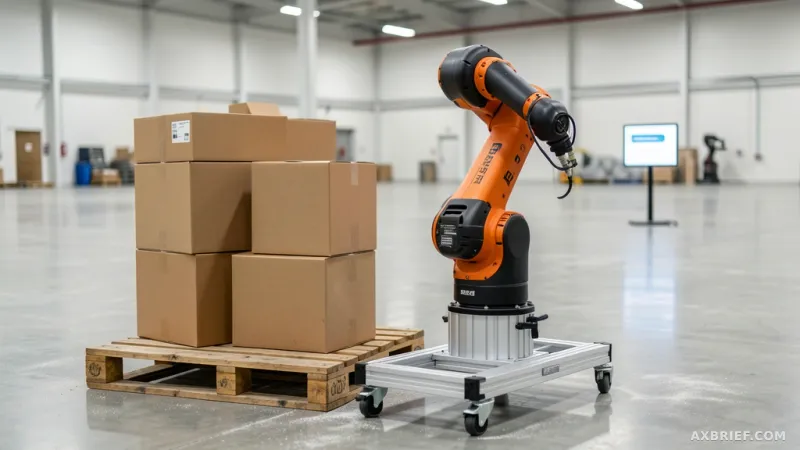
The output of this process is not a vague proposal, but a concrete technical package. The planner provides immediate pricing, downloadable CAD data, and the necessary CE certification documentation. This eliminates the traditional lag time associated with waiting for a professional designer to finalize technical drawings. Complementing this software is the Fairino FR20, a cobot specifically engineered for packaging, logistics, and machine loading. When equipped with the optional lifting column, the FR20 supports a payload of approximately 20kg and can reach stacking heights of roughly 2.4m.
Shifting the Barrier from Cost to Verification
While the hardware specifications of the FR20 are competitive, the true disruption lies in the intersection of the RBTX planner and the robot's control interface. Traditionally, deploying a palletizing robot required a specialized programmer to write complex scripts and define coordinate systems. The Fairino FR20 replaces this with a drag-and-drop programming logic accessible via touchscreens, web applications, and mobile devices. This allows floor operators to configure robot movements by moving visual elements rather than writing lines of code.
This transition represents a fundamental shift in the automation value chain. The primary obstacle to robot adoption is no longer the high cost of outsourced engineering or the scarcity of robotics experts. Instead, the challenge has moved to a practical level of operational verification. By providing a compact, mobile chassis that a single person can move and a design tool that generates instant technical data, igus is reducing the risk of the initial deployment phase. The tension is no longer about whether a company can afford the design, but how quickly they can validate the layout on their own floor.
The result is a democratization of industrial automation where the technical data is a commodity and the implementation is a matter of configuration rather than creation.
Industrial automation is evolving from a bespoke engineering service into a scalable, user-driven product.



