The world is already accustomed to the rhythmic hum of robotic vacuum cleaners and the predictable paths of automated serving bots in restaurants. These machines are efficient, but they are essentially sophisticated appliances operating within rigid constraints. However, a subtle but profound shift is occurring in the robotics community this season. The conversation has moved away from what a robot can do in a controlled lab environment toward how many units can be deployed into the wild. The industry is crossing the threshold from experimental prototypes to scalable products, and the latest surge in demand suggests that the market is finally ready for a general-purpose physical presence.
The Scale of the U1 Deployment
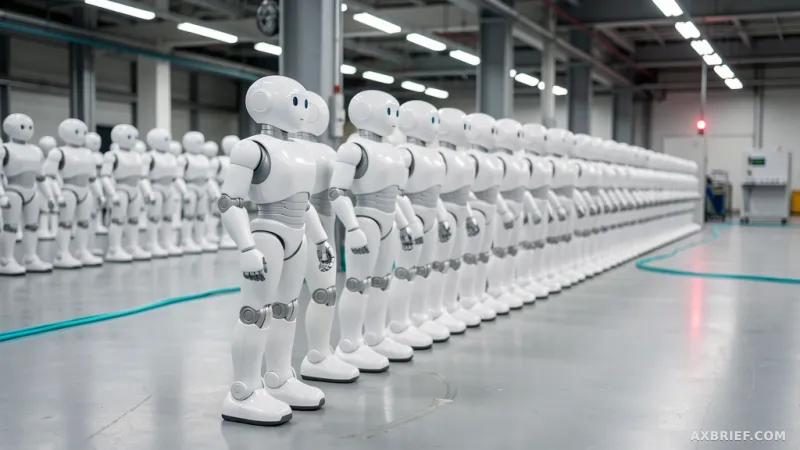
On June 30, at the U-World launch event held within the Shenzhen Convention Center, UBTECH unveiled the U1 series, a bionic humanoid designed for a world beyond the laboratory. The event, themed Endless Love, served as a platform for the company to reveal a staggering shift in market demand. UBTECH announced that its humanoid robot orders for the current year have skyrocketed to 11,000 units, representing a tenfold increase compared to the previous year. This is not merely a projection but a reflection of active market appetite, with over 5,000 units already secured through a pre-sale window that opened on June 2.
James Jou, the founder and CEO of UBTECH, framed this growth as the dawn of a new industrial revolution. During his keynote, Jou emphasized that the convergence of humanoid hardware and embodied intelligence provides a historic opportunity for Chinese enterprises to secure a dominant position in the global market. The company has established a concrete supply chain objective to deliver all 11,000 ordered units to consumers within the calendar year. This timeline is critical because it signals that the U1 is not a conceptual demo but a commercial product ready for immediate field deployment. By moving from R&D to mass production, UBTECH is attempting to prove that the humanoid form factor can be manufactured at a scale that justifies the investment in the underlying AI.
From Lab Pets to Embodied Intelligence
To understand why the U1 represents a departure from previous humanoid efforts, one must look at the distinction between a tool and a platform. Most humanoid robots to date have functioned as lab pets—impressive in a viral video but impractical in a living room or a factory. The U1 breaks this cycle by integrating bionic design, which mimics the biological structures and functions of humans to achieve more natural movement and a less jarring physical presence. This physical fidelity is paired with a specialized emotional AI computation system. According to Tian Xiaoyun, Director of the Overseas Business Department, this system allows the U1 to process and respond to human emotions, a capability evolved from UBTECH's previous work with the Mengyeyo and Wukong companion models.
This integration of emotion and biology transforms the robot from a machine that executes commands into an entity capable of emotional resonance. By offering the U1 in both male and female bionic versions, UBTECH is betting that the success of humanoids depends as much on psychological acceptance as it does on mechanical precision. The company is pursuing a three-axis business strategy that segments the market into industrial humanoids, commercial service robots, and home companion or care robots. This strategy manifests in four specific service scenarios: reception and guidance, health assessment and registration, emotional companionship and home care, and psychological healing for adolescents.
This approach shifts the value proposition of the humanoid. It is no longer about replacing a single task, such as moving a box, but about filling a social or cognitive gap in the service economy. This is the essence of embodied intelligence—the concept that AI reaches its full potential only when it can interact with, learn from, and manipulate the physical world through a body. When a robot can assess a patient's health or provide emotional support to a teenager, it is no longer a tool; it is a participant in a human-machine symbiosis. This model aims to fundamentally restructure economic productivity by blending human creativity and empathy with robotic calculation and efficiency.
Underpinned by the Chinese government's designation of embodied intelligence as a national strategic industry, the U1 is the first major test of whether this vision can scale. The metric for success has shifted. The industry is no longer asking if a humanoid can walk or speak, but rather how quickly 11,000 units can be integrated into the workforce. By transitioning from a manufacturer to an AI-based robot platform, UBTECH is positioning itself to solve the systemic pressures of aging populations and chronic labor shortages through the sheer volume of deployable intelligence.
The era of the humanoid prototype is over, and the era of the shipping manifest has begun.