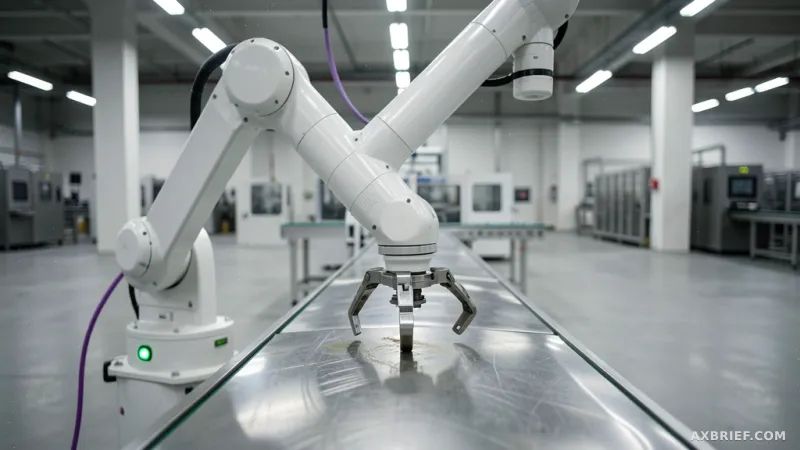
Walk into any mid-sized manufacturing plant in the American Midwest today, and you will notice a subtle but profound shift in the ambient noise. For decades, the rhythmic clanging of the automotive assembly line was the heartbeat of US industrialization. But lately, that sound is being joined by the high-frequency whir of robotic arms in places they never used to be: commercial kitchens, food processing plants, and electronics warehouses. The desperation for skilled labor has reached a tipping point, forcing a pivot in how American companies view automation. It is no longer just about replacing a welder in a car plant; it is about keeping the food supply chain moving and the electronics lines running in an era of chronic workforce shortages.
The Diversification of American Automation
According to the latest data released by the International Federation of Robotics (IFR) on the 18th, the United States has successfully navigated a period of industrial volatility to achieve a significant recovery. In 2025, the number of industrial robot installations in the US reached 38,000 units, marking an 11% increase over the previous year. While the headline growth is impressive, the internal composition of these numbers reveals a structural transformation in the US economy. For years, the automotive industry was the sole engine of robotic adoption, but that dominance is fading. Automotive installations actually dipped by 1% year-over-year, falling to 13,500 units, suggesting a plateau in the sector's current automation cycle.
In stark contrast, the food and beverage industry has emerged as the new growth frontier. Installations in the food sector skyrocketed by 30% over the last year, reaching approximately 3,000 units. This surge has effectively pushed the food industry into the same league as the metal, machinery, and electrical-electronics sectors in terms of adoption scale. This shift is a direct response to the volatility of labor in perishable goods handling, where the cost of human error and the scarcity of workers have made the ROI on robotics undeniable.
This broader adoption is reflected in the US robot density, which measures the number of robots per 10,000 employees. The US now maintains a density of 307 robots per 10,000 workers, climbing two spots to rank 8th globally. While this puts the US ahead of China, which sits at 166 robots per 10,000 workers, it highlights a massive gap compared to the global leaders. South Korea continues to dominate with a staggering 1,220 robots per 10,000 workers, followed by Germany at 449 and Japan at 446. The IFR suggests that the momentum for North American automation will remain positive, fueled by the dual pressures of aggressive reshoring initiatives and a persistent lack of available technical labor.
The Clash of Volume and Policy
When zooming out to the global stage, the narrative shifts from sectoral growth to a geopolitical arms race between two fundamentally different strategies: China's sheer volume and the United States' institutional framework. The scale of China's deployment is nearly incomprehensible by Western standards. In 2024, China installed 295,000 robots, capturing 54% of the entire global market. IFR estimates that by 2025, China's installation volume will be roughly ten times that of the United States.
China is not just buying robots; it is integrating them into a state-mandated technological evolution. Through its 15th Five-Year Plan (2026-2030), the Chinese government has officially designated AI research in physical applications as a core driver of economic growth. Physical AI refers to the integration of advanced AI algorithms directly into the movement and control systems of mechanical hardware, moving beyond pre-programmed paths toward autonomous, adaptive machine intelligence. By treating robotics as a national strategic asset, China is attempting to lock in a global monopoly on the hardware of the future.
The United States is responding not with a matching volume of hardware, but with a comprehensive overhaul of its regulatory and economic environment. The Association for Advancing Automation (A3), the largest automation trade group in North America, has formally submitted a National Robot Strategy Vision to the US Congress. This proposal seeks to create a federal-level support system that moves beyond fragmented state incentives. The A3 vision calls for the establishment of a National Robotics Council and the implementation of market-friendly tax incentives to lower the barrier to entry for small and medium enterprises.
Furthermore, the A3 strategy emphasizes the human element of the transition, proposing expanded retraining programs for the technical workforce and a modernization of safety standards to accommodate more collaborative human-robot environments. Perhaps most critically, the proposal suggests mandates for the procurement of domestic robot technology to secure the supply chain against foreign dependencies. The tension is now clear: China is betting on the brute force of Physical AI and massive deployment, while the US is betting on institutional efficiency, reshoring, and a strategic policy framework to close the productivity gap.
As the industry looks toward the next phase of this competition, all eyes are on the upcoming Automate 2026 exhibition in Chicago on the 24th. Jane Hefner, Vice President of the IFR, is expected to release preliminary figures on North American installations that will indicate whether the US is accelerating its pace. The ultimate winner of this race will not be decided by who installs the most arms today, but by who can most effectively integrate intelligence into the physical world to drive sustainable productivity.