The tech industry is currently witnessing a pivot from generative AI that lives in a browser to embodied AI that operates in the physical world. For years, the promise of robotics was hampered by a fundamental gap: the inability of AI to translate complex reasoning into precise physical movement without thousands of hours of costly, manual trial and error. Developers have spent decades building automation that is rigid and fragile, where a single misplaced object on a conveyor belt can halt an entire production line. This week, the conversation has shifted toward a more integrated approach where the intelligence of the model and the physics of the hardware are developed in a single, unified loop.
The Blueprint for a Unified Physical AI Ecosystem
NVIDIA and the LG Group are attempting to solve the embodiment problem by constructing what they term an AI Factory. This is not a traditional manufacturing plant, but a vertically integrated infrastructure that merges robotics, autonomous mobility, and GPU-accelerated data centers into a single organic entity. The scale of this collaboration is massive, involving a cross-section of LG's most critical subsidiaries, including LG Electronics, LG Innotek, LG CNS, LG Uplus, and LG Energy Solution. By aligning these entities, LG is moving beyond simple technical partnerships toward a full-stack vertical integration of physical AI, from the initial silicon design to the final deployment of a service robot in a customer's home.
The operational core of the AI Factory is a seamless workflow designed to eliminate the friction between virtual design and physical execution. The process begins in a high-fidelity virtual environment where AI models are developed and the necessary physical data is generated. These models then undergo rigorous simulation and training before being optimized for edge deployment on hardware. Once deployed, the system is monitored and controlled via a factory-scale digital twin, creating a real-time feedback loop. This structure ensures that design data from the virtual world is translated into physical action almost instantaneously. By leveraging NVIDIA's full-stack AI platform, LG aims to drastically shorten the development cycle of physical AI, turning the iterative process of model training and physical application into a closed-circuit system.
The ultimate objective is the realization of an autonomous manufacturing ecosystem where every stage, from raw material procurement to final customer delivery, is linked by real-time data. LG is combining its decades of production expertise and process know-how with NVIDIA's accelerated computing and digital twin technologies. In this vision, the moment raw materials enter a facility, AI optimizes the production flow, logistics, and delivery in real-time. This integrated approach is designed to set a new global standard for smart factories, significantly reducing the prohibitive costs and lengthy setup times associated with deploying fragmented AI tools across different stages of production.
Breaking the Bottlenecks of Data and Power
Historically, the primary bottleneck for robotics has been the data requirement. Training a robot to perform a complex task usually requires tens of thousands of physical repetitions, which is slow, expensive, and risks damaging the hardware. LG is bypassing this limitation by integrating the NVIDIA Isaac Sim and Isaac Lab open robotics frameworks into its development workflow. By creating physically accurate virtual spaces, LG can simulate every movement of its home cobots, filtering out collisions and control errors before a single piece of hardware is ever built. This parallel processing architecture allows thousands of robots to be trained simultaneously in the cloud, consuming the time and capital costs of trial and error in a virtual environment rather than on the factory floor.
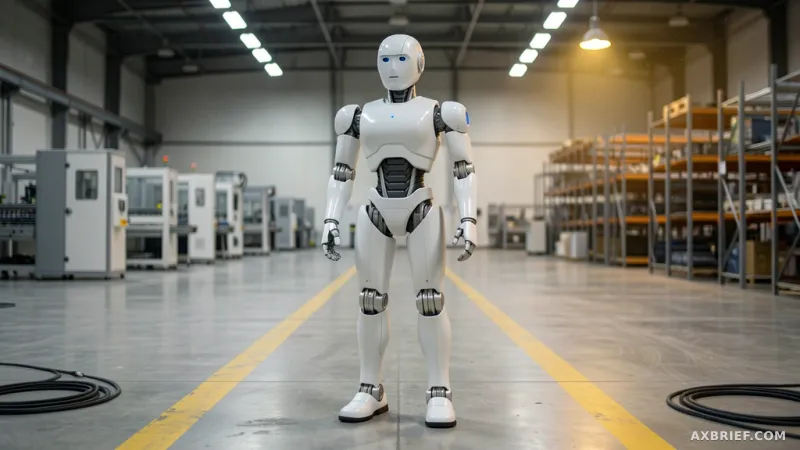
To move beyond simple repetitive tasks, LG is incorporating NVIDIA Isaac GR00T into its CLoiD home robots and modular robotics platforms. GR00T is a Vision-Language-Action (VLA) model, which represents a fundamental shift in how robots perceive the world. Instead of following a hard-coded script, a robot powered by GR00T can perform human-level reasoning, planning complex tasks autonomously, and understanding the context of its surroundings. This allows the robot to adapt to the unstructured and unpredictable environments of a typical home. LG and NVIDIA are co-developing reference robots to ensure perfect alignment between the hardware and the software, creating a modular structure where robot capabilities can be expanded via software updates without needing to replace the physical chassis.
When real-world data is unavailable or too dangerous to collect, the partnership utilizes the NVIDIA Cosmos world foundation model to generate synthetic data. This effectively turns raw computing power into high-quality training sets, creating a physical AI data factory. By simulating rare edge cases and hazardous scenarios that would be impossible to capture in reality, the Cosmos model fills the data gaps that typically stall AI deployment. This data factory is intended to serve not only LG but also other global enterprises, lowering the barrier to entry for physical AI by providing standardized, high-quality synthetic training sets that accelerate the path to commercialization.
This transition from automation to autonomy is further realized through LG CNS and its PhysicalWorks industrial robot platform. By combining PhysicalWorks with the Isaac framework and GR00T, LG is replacing fragmented automation—where different machines use different protocols—with a unified control loop. In traditional setups, a human manager must manually adjust the settings of a second machine based on the output of the first. In the AI Factory, the entire workflow from raw material to finished product is a single data loop. The intelligence of the system is no longer measured by the speed of a single process, but by the flexibility and optimization of the entire flow. This allows the system to handle exceptions autonomously, reducing downtime and eliminating the reliance on the manual skill of a few expert operators.
However, the intelligence of the model is limited by the physical capacity of the hardware. Modern GPUs have reached a power density that exceeds the limits of traditional air-cooling systems. To solve this, LG Electronics is collaborating on modular prefab designs based on the NVIDIA DSX AI factory design platform. By pre-manufacturing data center components in a factory and assembling them on-site, LG reduces construction errors and deployment time. They are implementing liquid cooling solutions, utilizing Cooling Distribution Units (CDU) and cold plates to manage chipset heat more efficiently than air. This hardware standardization is critical because the speed of physical infrastructure deployment has become the primary bottleneck for AI service launches.
Energy efficiency is being addressed through a shift in voltage standards. LG Energy Solution is developing 800V DC data center energy solutions that adhere to NVIDIA's Battery Energy Storage System (BESS) guidelines. By increasing the voltage, the system minimizes energy loss during transmission and reduces the number of voltage conversion steps, which maximizes overall efficiency and lowers operational costs. This high-voltage infrastructure is a prerequisite for operating the massive GPU clusters required for the next generation of physical AI.
Finally, to avoid the escalating costs of external API calls and ensure data sovereignty, LG AI Research has deployed NVIDIA Blackwell GPUs to power its own sovereign AI strategy. Using the NVIDIA NeMo framework and Nemotron open datasets, LG is training its EXAONE models on industry-specific and Korean-language data. This removes the reliance on general-purpose external models and significantly cuts long-term operating expenses. To ensure these models are commercially viable, LG uses TensorRT-LLM to build high-performance inference engines, reducing response times and server costs. These optimized models are then deployed via ChatEXAONE across the LG Group, evolving from simple chatbots into agentic AI that can autonomously control complex corporate workflows.
This vertical integration extends to the very sensors the robots use. LG Innotek is developing sensing solutions optimized specifically for the NVIDIA GPU architecture. By ensuring that the path from sensor data collection to model inference is free of bottlenecks, LG is increasing the real-time reaction speed of its robotics. When the components, the hardware, and the models all operate on the same architectural standard, the cycle of development and verification shrinks, allowing LG to bring enterprise AI solutions to market faster than competitors relying on fragmented ecosystems.