For years, the robotics industry has lived in the era of the curated demo. We have all seen the viral clips: a humanoid performing a perfect backflip or folding a shirt with surgical precision, only for the fine print to reveal the movement was teleoperated by a human in a motion-capture suit or simulated in a sterile environment. This gap between a polished marketing video and a robot's ability to navigate the chaos of the real world has become the primary friction point for the adoption of Physical AI. The industry is no longer impressed by what a robot can do when it is being told exactly how to move; the new benchmark is whether the machine can perceive, decide, and act on its own.
The Shift to Autonomous Athletics
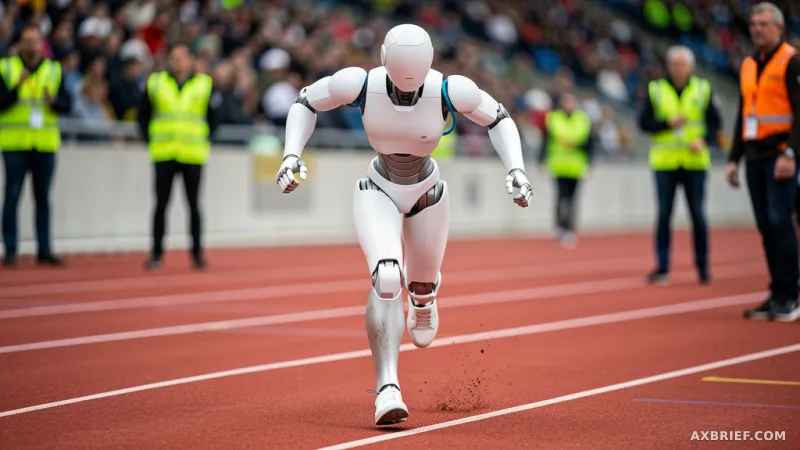
From August 22 to 26, the National Speed Skating Oval in Beijing will host the second World Humanoid Robot Games, an event designed to strip away the safety net of remote control. The core evolution of this year's competition is the transition to full autonomous driving for its primary athletic events. In the 400m, 1500m, and 4x100m relay, robots will be required to find their own paths and maintain their course without any external guidance or human intervention. This shift transforms the event from a test of mechanical engineering into a rigorous examination of situational awareness and real-time decision-making.
The competition consists of 50 events in total, including 21 categories focused on daily life applications and three newly introduced competitive disciplines. While previous iterations focused on the ability to complete a course, the current judging criteria for obstacle courses have shifted. Instead of awarding points based on the method of control, judges will now evaluate the robots solely on their actual ability to clear high-difficulty sections autonomously. Furthermore, the addition of table tennis and autonomous fighting introduces a layer of dynamic interaction. These events force robots to react to an external opponent in real time, requiring the simultaneous coordination of multiple joints and rapid sensory processing to execute complex, reactive movements.
From Sporting Spectacle to Deployment Pipeline
While the track events capture the headlines, the true strategic pivot of the World Humanoid Robot Games lies in its transition from a competition to a live procurement fair. The organizers have introduced nine specific practical scenarios to bridge the gap between laboratory performance and commercial viability. These tests cover home cleaning, hotel services, industrial production, emergency rescue, library management, supermarket retail, office services, garden management, and vehicle charging. By forcing robots to operate in these simulated real-world environments for extended periods, the event seeks to validate the feasibility of actual deployment rather than mere demonstration.
This focus on utility culminates in a comprehensive pentathlon. In this event, robots must sprint a 100m track while simultaneously performing five distinct tasks that include precision manipulation, seamless transport, and the handling of heavy objects. The evaluation metrics are strictly tied to the robot's ability to maintain precision while accelerating and its capacity for physical environmental perception and overall motor coordination. This is no longer about the grace of the movement, but the efficiency of the labor.
The most significant twist is the integration of a direct commercial pipeline. The event is not merely for spectators; it is attended by stakeholders from factories, hotels, universities, and cultural tourism sectors. The structure is designed so that these representatives can witness the performance of a model in a specific scenario and sign procurement contracts on the spot. This creates a high-stakes environment where the ability to perform a task autonomously leads directly to a business contract, effectively turning the stadium into a living showroom for the next generation of the workforce.
This transition marks the end of the era of the robotics demo and the beginning of the era of the deployed agent.