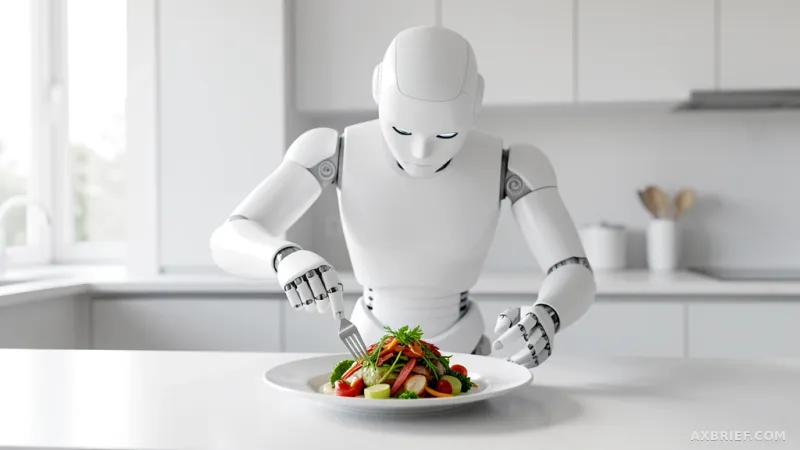
Imagine the sensory overload of a high-volume commercial kitchen during the dinner rush. A chef does not operate on a fixed grid; they react to the hiss of a searing steak, the pungent aroma of garlic hitting its peak, and the slight shift of a frying pan on a greasy burner. For decades, robotics in this environment meant rigid arms performing the same arc a thousand times, failing the moment a spatula slipped two centimeters to the left. This inherent unpredictability is where most automation dies, but it is exactly where the next generation of physical AI is being forged.
The Hardware Architecture of Zest and the One Kitchen Ecosystem
At the 2026 National Restaurant Association (NRA) Show in Chicago, Robotable transitioned from providing single-task automation to unveiling Zest, a dual-arm humanoid platform designed specifically for the volatility of food and beverage environments. Zest is not a general-purpose robot attempting to mimic a human in every scenario; it is a domain-specific machine built on the Openarm open-source manipulator framework. Each arm possesses 8 degrees of freedom (8-DOF), granting the robot a total of 16 controllable joints. This high-DOF configuration is a deliberate engineering choice to handle the complex angular adjustments required for precision tool manipulation, such as the nuanced wrist flick needed to sauté ingredients in a pan.
The true sophistication of Zest, however, lies in its multimodal sensory integration. While most humanoid robots rely heavily on vision, Zest integrates RGB cameras and depth cameras with thermal imaging to monitor the state of ingredients in real-time. To bridge the gap between seeing and experiencing, Robotable equipped the platform with an electronic nose (e-nose) and high-definition microphones. This allows the robot to process olfactory and auditory signals—such as the specific scent of burning oil or the changing frequency of a deep-fryer's sizzle—which are critical indicators of doneness that visual data alone cannot capture.
This hardware does not operate in isolation. Robotable presented Zest alongside the One Kitchen concept, an integrated robot kitchen platform governed by the ONE Kitchen OS. This operating system acts as a central nervous system, unifying various specialized robots—those handling soups, noodles, and fried foods—into a single manageable entity. More importantly, One Kitchen serves as a data factory. By deploying these robots across 30 existing installations at major Korean F&B firms like CJ Foodville, VIPS, and Lotte, Robotable has turned actual commercial kitchens into massive, real-world laboratories. The data flowing from these sites is fed back into the ONE Kitchen OS, creating a closed-loop system where real-world failures and successes directly inform the training of the Zest humanoid.
VLA Models and the Shift from Rule-Based Automation
To move beyond the limitations of traditional industrial robotics, Zest abandons rule-based programming. In a rule-based system, a robot follows a pre-defined set of coordinates; if the pan moves, the robot continues to stir empty air. Zest instead utilizes a Vision-Language-Action (VLA) model. This architecture allows the robot to take visual inputs and linguistic commands and translate them directly into physical actions. Instead of following a script, Zest perceives the current position of a spatula and the state of the onions in a pan, then generates the optimal movement trajectory in real-time.
Achieving this level of fluidity required a departure from standard AI training methods. Robotable found that traditional simulators like NVIDIA Isaac Lab or Google DeepMind's MuJoCo struggle to replicate the chaotic physics of cooking. The way a vegetable shrinks under heat, the viscosity of a thickening sauce, and the subtle changes in material properties during frying are nearly impossible to model mathematically with high fidelity. To solve this, Robotable used teleoperation data—actual human movements recorded in real kitchens—to fine-tune the VLA model. This ensures the robot learns the intuitive, non-linear movements of a human chef rather than the sterile, linear paths of a simulation.
The operational logic of Zest is managed through a hybrid architecture consisting of the VLA model, a correction layer, and a task orchestrator. The VLA model provides the high-level behavioral direction based on visual context. The correction layer then steps in to handle real-time physical errors, adjusting the grip or angle of a tool to ensure precision. Finally, the task orchestrator manages the sequence of the entire cooking process, ensuring that the transition from searing to plating happens in the correct order. This hierarchical approach mitigates the probabilistic uncertainty of deep learning, providing the reliability and safety required for a professional kitchen.
During live demonstrations, Zest successfully gripped a spatula and sautéed onions, generating the motion from scratch based on the environment rather than repeating a recorded loop. This capability represents a fundamental shift in physical AI: the move from coordinate-based control to task-based orchestration. By focusing on a narrow domain, Robotable is betting that a specialized model with high-density physical data will reach commercial viability far faster than a general-purpose humanoid trying to learn everything from folding laundry to flipping pancakes.
This strategic focus on domain-specific Physical AI suggests that the future of automation is not a single robot that can do everything, but a series of highly optimized models that master the specific laws of physics within their own environment. For the developer and the operator, this means the complexity of the code is shifting upward, moving away from low-level motion functions and toward high-level task planning and domain-specific weight tuning.