The global race for artificial intelligence has moved past the era of the standalone chip. For the last few years, the industry focused on the raw TFLOPS of a single GPU, but the conversation in the developer community has shifted toward the rack. Engineers are no longer asking what a single card can do, but how ten thousand cards can communicate without bottlenecking. This shift toward rack-scale computing is the only way to sustain the appetite of frontier models that require an almost incomprehensible amount of power and interconnectivity to function.
The Architecture of Helios
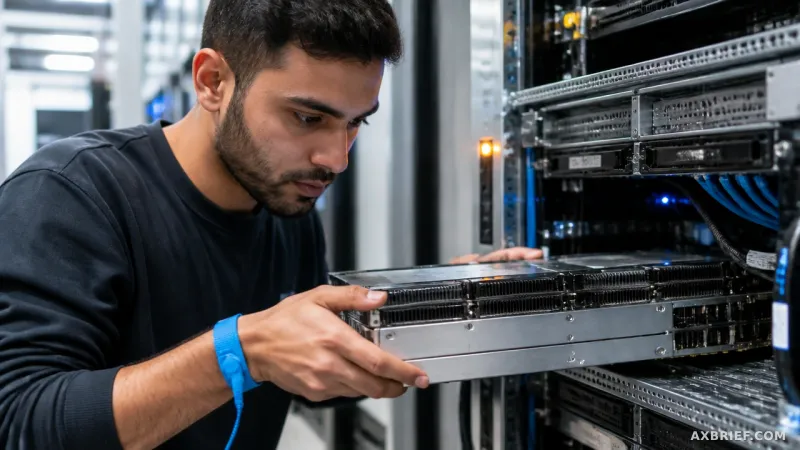
At the Advancing AI conference in San Francisco, AMD introduced Helios, a next-generation AI rack system designed to treat an entire cluster of processors as a single, high-performance unit. Rather than selling individual components and leaving the integration to the data center, Helios provides a rack-scale solution optimized specifically for the training and execution of the world's largest frontier models. The system is scheduled to begin shipping by the end of this year, targeting the most compute-hungry organizations in the world.
The initial adoption list for Helios reads like a directory of the AI elite. Microsoft has already confirmed that Helios will be integrated into the expansion of its Azure infrastructure to support growing cloud AI demands. OpenAI, Meta, and Oracle have also signaled their intent to deploy the system. The most striking detail, however, is the strategic partnership with Anthropic. The two companies have agreed to deploy Helios rack systems on a scale that could reach 2 gigawatts (GW) of GPU capacity. This level of power consumption is unprecedented for a single hardware deployment, signaling a move toward utility-scale AI factories.
To ensure these racks do not suffer from the traditional bottlenecks of data movement, AMD is also expanding its CPU roadmap. The company introduced Venice-X, a CPU specifically engineered for high-performance computing workloads. While Helios handles the heavy lifting of the GPU clusters, Venice-X will provide the necessary efficiency and orchestration to keep the system balanced. Venice-X is slated for release in 2027, creating a long-term hardware trajectory that pairs immediate GPU availability with future CPU optimization.
The Agentic AI Catalyst
For years, NVIDIA has held a virtual monopoly on the rack-scale market with its Grace Blackwell and Vera Rubin systems. AMD is not merely releasing a competing product but is betting on a fundamental shift in how AI is used. The tension in the market has moved from simple generative responses to what AMD CEO Lisa Su calls Agentic AI. Unlike standard chatbots that provide a single answer to a single prompt, AI agents must perform multi-step reasoning, call external tools, and iteratively access data to solve complex problems. This process requires a massive increase in GPU resources because the model is essentially thinking in loops rather than a straight line.
This transition to agentic workflows creates a step change in computing demand. According to reports from The Register, Helios is already showing performance metrics that surpass NVIDIA's Vera Rubin in specific benchmarks, suggesting that AMD has found a way to optimize for these iterative workloads. The financial stakes are equally massive. AMD forecasts that the AI accelerator market will reach approximately 1.4 trillion dollars by 2030, a figure that rivals the size of the entire current semiconductor market. The core of this competition is not just raw power, but programmability. Because AI algorithms are still in their infancy and workloads are shifting rapidly, the flexibility of the GPU architecture becomes the deciding factor in which system wins the data center.
For AI practitioners and infrastructure architects, the arrival of Helios breaks the forced dependency on a single vendor. The ability to choose between NVIDIA and AMD based on actual performance metrics and delivery timelines introduces a necessary volatility into the supply chain that could drive down costs. The Anthropic deployment serves as a live test case for whether gigawatt-scale infrastructure can actually reduce the time it takes to train a frontier model or lower the cost of inference at scale. The real victory for AMD will depend on whether the synergy between Helios and the upcoming Venice-X CPU can lower the total cost of ownership compared to the integrated NVIDIA stack.
As the industry moves toward 2027, the success of these rack-scale systems will determine the standard for the next generation of AI data centers.