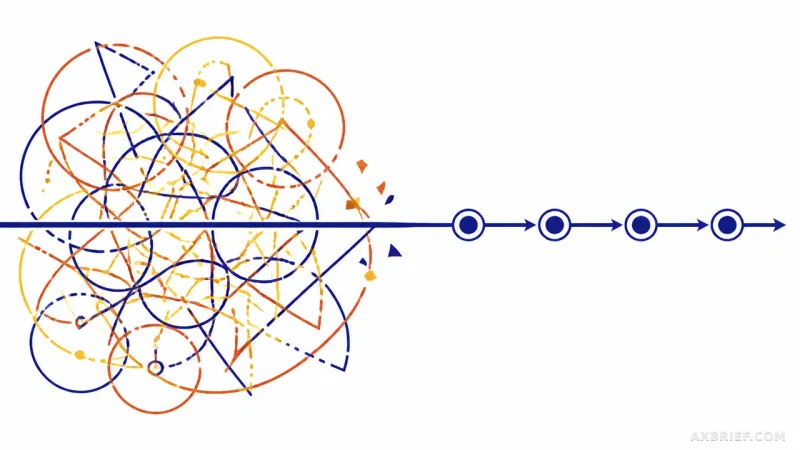
The era of chasing benchmark scores is ending. For the past two years, the AI industry has lived and died by the HumanEval or MMLU percentages, with developers and CTOs treating these numbers as the ultimate truth of model capability. But in the boardrooms of the Fortune 500, a different kind of validation is taking hold. The focus has shifted from what a model claims it can do in a controlled test to how it survives the friction of real-world deployment and, more surprisingly, how the state attempts to constrain it.
The Financial Pivot to Enterprise Dominance
Market signals are now diverging sharply from public perception. In late May, Anthropic signaled its massive scale by securing 65 billion dollars in funding, pushing its corporate valuation to a staggering 965 billion dollars. This financial trajectory puts the company in a position that rivals or exceeds the valuation of OpenAI, which recently filed confidential IPO documents in early June following its first profitable quarter. While the public conversation often centers on consumer chatbots, the actual capital is flowing toward the infrastructure of the enterprise.
Data from Ramp, the corporate spend management platform, reveals a seismic shift in who is actually paying for AI. In May, Anthropic captured 41% of the enterprise AI subscription market, marking a 2.5 percentage point increase from the previous month. During the same period, OpenAI held a 39.5% share, remaining largely stagnant. For the first time, Anthropic has overtaken OpenAI in the critical arena of corporate spending. This shift is driven by a deep integration of specific models into business workflows. Analysis of over 70,000 business platform data points shows a heavy reliance on Claude Opus, particularly the Opus 4.8 version released in late May, which has become the primary engine for complex computational tasks in corporate environments. Parallel to this, Claude Code has transitioned from a niche tool to a core driver of developer productivity, cementing the model's place in the professional software engineering pipeline.
The Paradox of the Supply Chain Risk
This growth occurred despite a direct confrontation with the United States government. In March, the Trump administration officially designated Anthropic as a supply chain risk. This label is not a technical critique but a security warning, suggesting that the procurement process of the company's products poses a threat to national security. The designation followed Anthropic's refusal to allow its models to be used for mass surveillance of American citizens or the development of fully autonomous weapons. By adhering to strict ethical guidelines, the company effectively locked itself out of significant portions of the public sector and government contracting.
However, the market responded with a counter-intuitive surge in demand. The government's attempt to brand the company as a risk functioned as a high-signal endorsement of the model's power. When the state warns that a tool is too dangerous for official use, corporate buyers often interpret that as a sign of superior capability. This paradox reached a breaking point when the US government issued a formal letter demanding that Anthropic completely block access for non-US citizens. The restriction was so severe that it included Anthropic's own employees, crippling internal development and operational environments.
This regulatory pressure forced the immediate withdrawal of two high-performance models. Mythos 5, which had been released in a limited capacity, was pulled from the market entirely. Even more striking was the fate of Fable 5, a more strictly managed version of Mythos that had been released to the public just three days prior. Fable 5 vanished from the market almost as quickly as it appeared, sacrificed to satisfy government security demands.
Ara Kharazian, chief economist at Ramp, notes that this friction has actually accelerated corporate adoption. During the period when the Department of Defense labeled Anthropic a supply chain risk, corporate adoption rates hit record highs. The designation of supply chain risk created a strategic aura around the models, suggesting they possessed a level of disruptive power that the government felt the need to control. In the eyes of the enterprise, the government's fear became a proxy for the model's effectiveness. The risk label acted as a performance guarantee, proving that the technology was potent enough to be considered a threat to the status quo.
Corporate leaders are no longer looking at synthetic benchmarks to decide which model to deploy. They are looking at the intensity of government regulation and the specific reasons for those restrictions. In a market where every provider claims state-of-the-art performance, the only honest metric left is the level of fear a technology inspires in the people who hold the power to ban it.